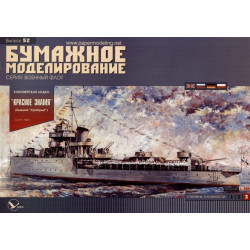
Publisher/ Manufacturer: "Answer" – "Angraf". Poland
Scale: 1 : 200
Number of sheets: 28 x A3
Number of sheets with details: 18
Number of assembly drawings: 51
Difficulty: For intermediate and experienced modelers.
Model dimensions: 935 mm x 105 mm x 227 mm
 Security policy
(edit with the Customer Reassurance module)
 Delivery policy
(edit with the Customer Reassurance module)
 Return policy
(edit with the Customer Reassurance module)
Together with her sister ship HMS “Edinburgh”, she belonged to the “Edinburgh”-class ships, also known as the “Town” 3 series cruisers. Both cruisers, ordered by the Admiralty in 1936, were to become a counterweight to the two Italian “Giuseppe Garibaldi”-class cruisers with a displacement of 9,591 tons. HMS “Belfast” entered service in August 1939. She entered the war as part of the 18th Cruiser Escadre of the Home Fleet, commanded by Captain J. Scott. On 9 October 1939, HMS “Belfast” intercepted the German liner “Cap Norte” (13,615 GRT) north of the Arcade Islands. He was then transferred to Rosyth Base, where on 21 November 1939, while leaving the port, he struck a German magnetic mine, laid by the submarine U-21. The mine, which exploded amidships, caused so much damage, that the ship was taken out of service for 3 years. After repairs, the ship was recommissioned on 8 December 1942, where in January he became the flagship of the 10th Cruiser Escadre of the Home Fleet, commanded by Rear Admiral Burnett. “Belfast's” first Arctic assignment was to escort convoy JW-53 in February 1943. This squadron also escorted convoy JW-54, which sailed in two groups in November 1943. This escadre was followed by a convoy in December 1943. During this escort, a serious clash occurred between the close escort ships of convoy JW-55B, including “Belfast”, and the German battleship “Scharnhorst”. On the British side, HMS “Norfolk” and “Sheffield” also participated in the clash. The British group prevented the German raider from coming within firing range of the convoy ships for several hours, thus holding him off until Admiral Fraser's group (the battleship HMS “Duke of York” and its escort) arrived at the scene of the battle. “Scharnhorst” was sunk in this battle. “Belfast” later carried out convoy escort tasks in the Arctic, participated in the attack on the German battleship “Tirpitz”, and in June 1944 in Operation “Neptune”. In July 1944, the ship began a major overhaul, which was completed in May 19945. The ship was prepared for operations in the Far East, where it arrived in August 1945, but was late for combat operations. The cruiser remained in the Far East until 1947, where an annual inspection and minor modifications were carried out. After all this work, the ship served in the Far East until August 1952, participating in the Korean War. Returning to the Metropolis, it was put into reserve. On January 6, 1956, a large-scale modernization began on the ship: the ship's superstructures were rebuilt, the bridge structure and masts were changed, the latest rescue equipment was installed, the fire control system was updated and expanded, and the number of furnaces in the boiler room was reduced. After the repair, on May 12, 1959, it sailed again to the Far East, where it served until April 1962. Returning to Europe, he served in its waters until February 1963, when he was transferred to the reserve in 1966 (re-qualified as a residential hulk). In May 1971, the decommissioned ship was handed over for cutting, but the British public did not allow this decision to be carried out – cruiser was towed from Portsmouth to London, the ship was anchored in the Thames and in October 1971 opened to the public as a museum ship, which he serves to this day.
A large, well-designed and richly detailed, rather complex model of a British light cruiser, painted in a beautiful broken-spot camouflage. The model is suitable only for medium-experienced and experienced modelers. The model perfectly recreates all the exterior details, armament, lifeboats, deck equipment, catapult and aircraft, excellent color and textures of the wooden decks. The color reserve is quite large, the textual instructions in Polish are just a few general notes, the graphical instructions are large, informative and easy to read.

You might also like
Publisher/ Manufacturer: "Answer" – "Angraf". Poland
Scale: 1 : 200
Number of sheets: 28 x A3
Number of sheets with details: 18
Number of assembly drawings: 51
Difficulty: For intermediate and experienced modelers.
Model dimensions: 935 mm x 105 mm x 227 mm