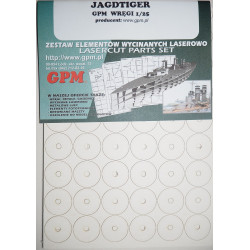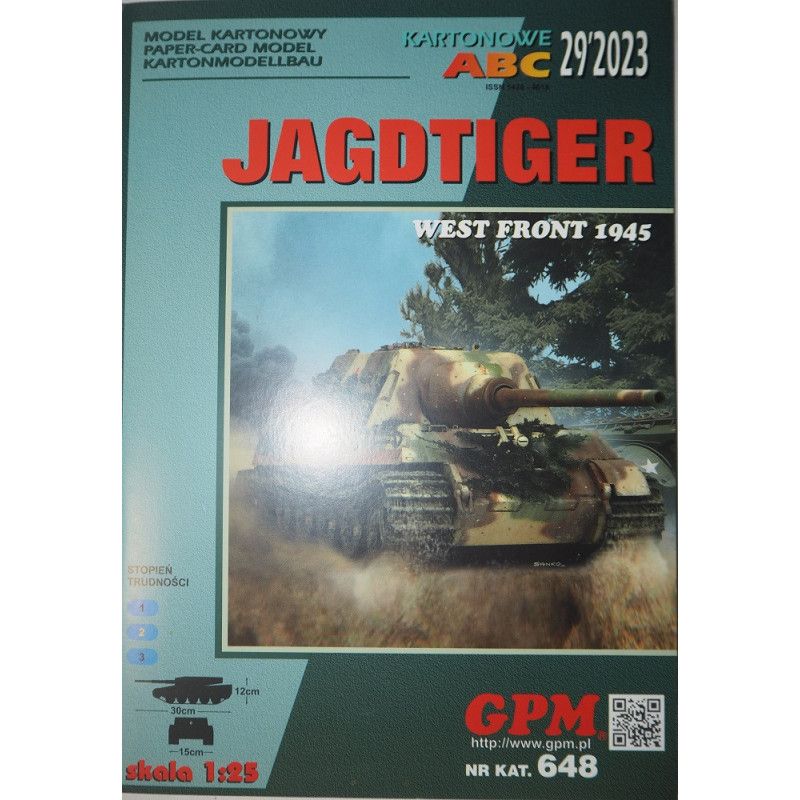


Publisher/ manufacturer: "GPM". Poland
Scale: 1 : 25
Number of sheets: 24 x A4
Number of sheets with parts: 20
Number of assembly drawings: 44
Difficulty level: For intermediate and experienced modelers.
Dimensions of the model: 426 mm x 145 mm x 116,5 mm
 Security policy
(edit with the Customer Reassurance module)
 Delivery policy
(edit with the Customer Reassurance module)
 Return policy
(edit with the Customer Reassurance module)
The German heavy anti-tank gun (according to the German nomenclature - tank destroyer Jagdpanzer) "Jagdtiger" was the heaviest combat vehicle, that was designed and mass-produced during World War II. The emergence of this gun was influenced by a certain type of "gigantomania", that Hitler "suffered". He simply wanted the largest and heaviest combat vehicles possible. They were supposed to destroy Allied tanks, while remaining invulnerable themselves. As a result of this disease, the "Konigstiger" appeared, which was the forerunner of a new generation of tanks. A tank destroyer with a 128 mm gun was built on its base. Although the USSR installed 152 mm guns on its ISU tank destroyers, the German gun surpassed all types of artillery, used on Allied combat vehicles, in its parameters. In Hitler's opinion, well-armed and heavily armored combat vehicles were supposed to hold back the mass-produced tanks of the USSR and the Allies. This was in sharp contrast to the concept of the Inspector General of Armored Units, Hannibal Guderian, who saw the success of operations in a large number of light and well-armored anti-tank and assault self-propelled guns. These could be mass-produced, using existing and proven chassis, and as a result, a wide unification of components. But Hitler decided everything, and therefore such giants, as the "Jagdtiger", were sent to production. Only about 70 units were produced in total, but only 48 entered combat units. The main problem was the irregular supply of 128 mm guns, which is, why it was planned to replace them with the already proven 88 mm L71 cannon. All production took place under constant Allied bombing and a total lack of materials. The "Jagdtiger" was to make its debut in the famous Ardennes Offensive, but the tank destroyers did not have time to arrive there due to weak bridges and unstable ground. The 70-ton mass created problems, that the engineering units could not cope with. Another episode of these tank hunters was the battles in the Remagen region for the bridge, which, by the greatest coincidence, fell to the Allies almost intact. The "Jagdtiger" tanks hunters from the 512th sPzJagAbt received their baptism of fire there. The battles there confirmed the assumption, that they were invincible for Allied tanks and their 128 mm guns could destroy anything, moving up to 3 km away. They could only be defeated by aviation and... malfunctions, that simply haunted the untested in battles design. Most often, the power transmission system failed, which meant, that the machines had to be left to their fate, since there were no suitable means for their evacuation. On the way back, most of the "Jagdtiger"s were left at the main intersections of the cities as obstacles. The "Jagdtiger"s, like the "Konigstiger", although they surpassed all enemy combat vehicles in power, did not have any impact on the outcome of the war for one very simple reason - there were very few of them.
A large, complex, well-designed and richly detailed tank destroyer model with full detailing of the turret and partial detailing of the engine compartment equipment. It recreates the appearance of a tank destroyer, that participated in combat operations on the Western Front in 1945. Excellently detailed chassis, its suspension, exterior detailing, beautiful camouflage. The model is intended only for medium-experienced and experienced modelers. There is no color reserve, the model depicts a "well-used" machine, the text instruction is small, but quite detailed (in Polish), the graphic one is quite large and detailed.

You might also like
Publisher/ manufacturer: "GPM". Poland
Scale: 1 : 25
Number of sheets: 24 x A4
Number of sheets with parts: 20
Number of assembly drawings: 44
Difficulty level: For intermediate and experienced modelers.
Dimensions of the model: 426 mm x 145 mm x 116,5 mm