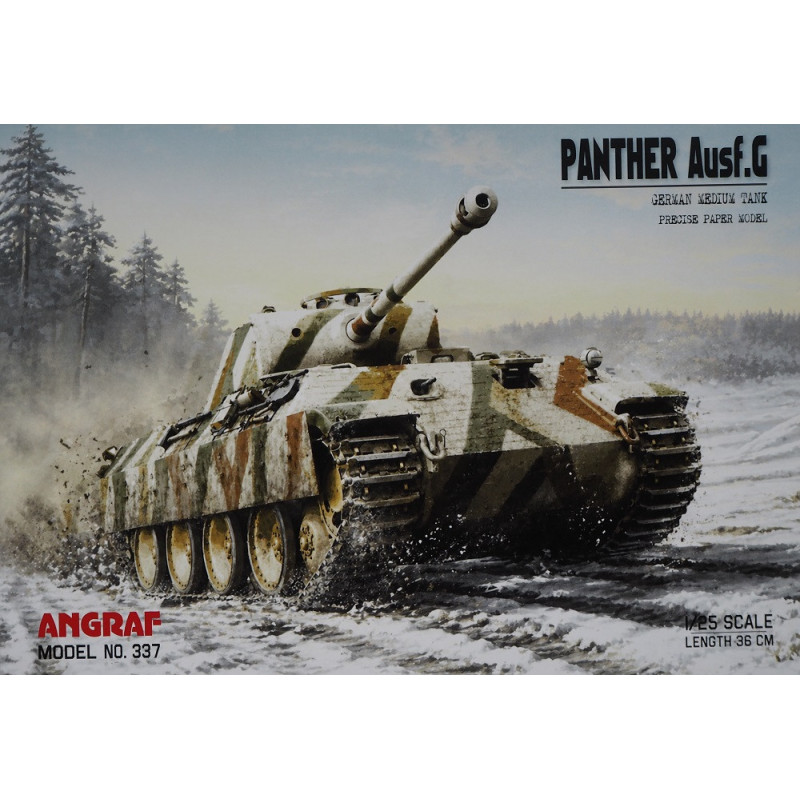


Publisher/ Manufacturer: "Answer" - "Angraf". Poland
Scale: 1 : 25
Number of sheets: 16 x A3
Number of sheets with details: 11 1/3
Number of assembly drawings: 41
Difficulty: For medium and experienced modelers.
Model dimensions: 354.5 mm x 137 mm x 124 mm
 Security policy
(edit with the Customer Reassurance module)
 Delivery policy
(edit with the Customer Reassurance module)
 Return policy
(edit with the Customer Reassurance module)
These tanks appeared in the armament of the German Wehrmacht in 1943 as a response to the Soviet medium tank T-34, but the "Panther" had a better gun and thicker armor. During its baptism of fire in the Battle of Kursk, most of the "Panther" Ausf. D used were lost due to technical problems: 150 tanks out of 204 used. Most of the losses were due to chassis and engine failures. But the battles also proved the tank's good sides - excellent armor (only a few tanks were hit by artillery). Also, not a single hit on the frontal armor plates posed a threat to the “Panthers”. After eliminating the factory flaws, these tanks quickly became a formidable opponent for Soviet armored units. In direct combat, the “Panther” was significantly superior technically to both the T-34 (with a 76 mm cannon very significantly, with an 85 mm - the advantage was much smaller), and the M4 “Sherman”. Thicker armor and better armament gave the “Panther” an advantage over the Allied medium tanks. Their main disadvantage was the high production cost and large production time. By the end of the war, only about 6,000 “Panthers” were produced, while over 100,000 T-34s and “Shermans” were produced together. And when the USSR introduced its latest heavy tanks, the IS-2, and heavy anti-tank guns, the “Panther's” advantage ended. When comparing medium tanks, it should be noted, that the “Panther” weighed about 45 tons, or 13 tons more, than the T-34 or M4. Although the “Panther's” frontal armor was strong, the same could not be said about the side and rear. The main tactics of the Allies in the fight against these tanks were numerical superiority, rapid maneuvering, and speed superiority - all of which led to the capture of positions for attack from the side or rear (where the “Panther” was most vulnerable). After the war, about 50 “Panthers” were included in the armament of the French army, where they served until the end of the 50s.
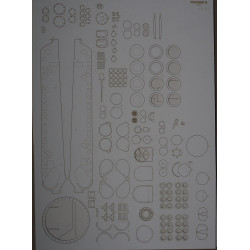
A complex, well-designed and excellently detailed model, that will suit only medium-experienced and experienced modelers. Excellently detailed chassis, its suspension, external detailing, armament, interesting winter camouflage, tracks only from individual tracks. No colors reserves. The model depicts an Ausf.G version tank from the 3/Pz.Rgt. "Grossdeutschland" division, which participated in the winter battles of 1945 in East Prussia near Pilawa. The textual instructions are small and explain only the most complex moments of the model's assembly, the graphical ones are medium-size, detailed, informative and easy to read.

You might also like
Publisher/ Manufacturer: "Answer" - "Angraf". Poland
Scale: 1 : 25
Number of sheets: 16 x A3
Number of sheets with details: 11 1/3
Number of assembly drawings: 41
Difficulty: For medium and experienced modelers.
Model dimensions: 354.5 mm x 137 mm x 124 mm