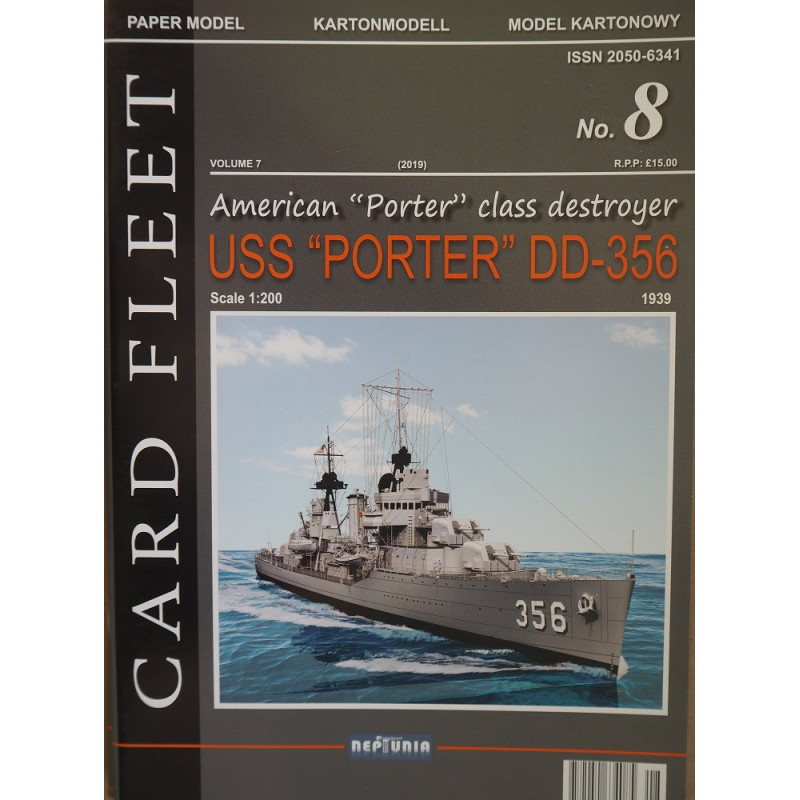


Manufacturer/ Publisher: “Neptunia-Card Fleet“. United Kingdom
Scale: 1 : 200
Number of sheets: 34 x A4
Number of sheets with details: 20
Number of assembly drawings: 149
Difficulty: For intermediate to advanced modelers.
Model dimensions: 581 mm x 56,5 mm x 178,5 mm
 Security policy
(edit with the Customer Reassurance module)
 Delivery policy
(edit with the Customer Reassurance module)
 Return policy
(edit with the Customer Reassurance module)
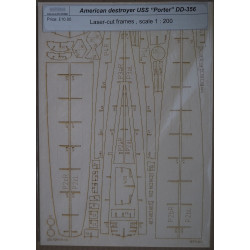
The keel of the US destroyer USS “Porter” was laid down on 18 December 1933 at the “New York Shipbuilding” shipyard in Camden. He was launched on 12 December 1935 and commissioned in Philadelphia on 25 August 1936. Forrest B. Royal became the ship's first commander. After commissioning, he sailed for a mission in northern European waters. In May 1937, he participated in the coronation of King George VI in St. John's, Newfoundland. In August 1937, he was transferred to the Pacific Ocean and, after transiting the Panama Canal, arrived in San Francisco on 5 August 1937. She immediately became the flagship of Destroyer Squadron 2, which was based in San Diego. In 1941, he underwent her first and only major modernization at the “Mary Island Navy Yard”. Then the ship's cruiser appearance was significantly changed - the masts, the aft superstructure was replaced, the spare torpedo store and two aft lifeboats were eliminated. The FC radar and “Oerlikon” anti-aircraft guns were installed. After the reconstruction, the ship was transferred to Pearl Harbor. At that time, the 2nd Destroyer Squadron was renamed the 5th Squadron. On December 5, 1941, USS "Porter" sailed from Pearl Harbor as part of TF 12, escorting the aircraft carrier USS "Lexington", which was to deliver a cargo of aircraft to Midway. After the attack on Pearl Harbor, "Porter" made voyages between Hawaii and the ports of the West Coast of the United States. From mid-August 1942, he mainly participated in training around Hawaii. On October 16, 1942, he was included in TF 16 as the flagship of the 15th Destroyer Division. On October 26, he fought in the Battle of Santa Cruz, where she provided direct cover for the USS “Enterprise”. Shortly after 10:00, the ship's captain, Commander David G. Roberts, received orders to pick up the crew of the torpedo bomber TBF “Avenger”, which had been forced to land on water. USS “Porter” stopped and picked up the pilots. At that time, the pilot of a fighter’s “Wildcat”, flying around the ship, pilot noticed the trace of a torpedo, heading towards the ship and reported it to the ship. However, the torpedo could not be destroyed and it was also not possible to gain speed to deviate from its course. The torpedo hit the starboard side in the boiler area and immediately killed 11 crew members. The stricken ship could not be saved, so her crew abandoned her, and the destroyer was finished off by the artillery of USS “Shaw”. It was long believed, that the ship was sunk by a torpedo, launched by the Japanese submarine “J-21”. However, the latest data, found by historians, show, that the torpedo "launched" itself after the US torpedo bomber TBF "Avenger" made a forced landing in water and it unhooked from the brackets and “started up” - circled until it found its victim.
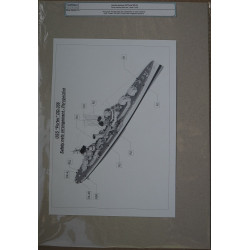
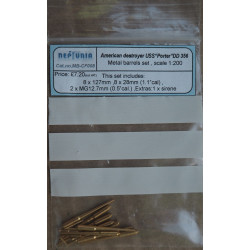
A rather large, complex, well-designed and very richly detailed model of a warship, painted in gray camouflage (1939) for only medium-experienced and experienced modelers. There is no color stock, the text assembly instructions are large and detailed in Polish and English, the graphic ones are simply huge, informative, easy to read and both of them will really help a lot in the process of gluing the model. Excellent print quality.

You might also like
Manufacturer/ Publisher: “Neptunia-Card Fleet“. United Kingdom
Scale: 1 : 200
Number of sheets: 34 x A4
Number of sheets with details: 20
Number of assembly drawings: 149
Difficulty: For intermediate to advanced modelers.
Model dimensions: 581 mm x 56,5 mm x 178,5 mm