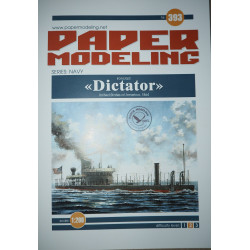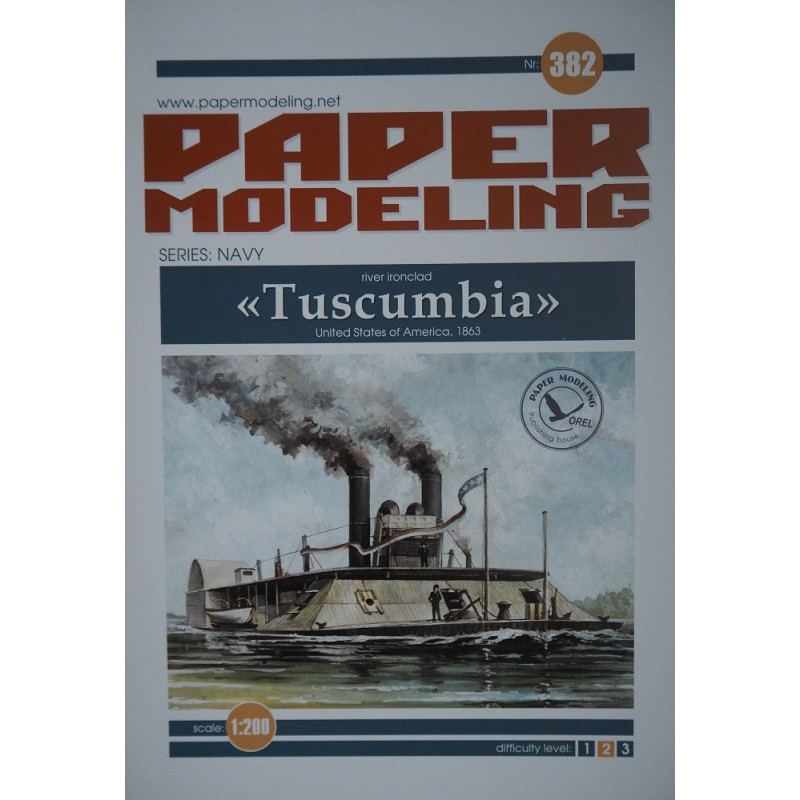


Publisher/ Manufacturer: "Paper Modeling". Ukraine
Scale: 1 : 200
Number of sheets: 10 x A4
Number of sheets with details: 7
Number of assembly drawings: 6
Difficulty: For modelers of any experience.
Model dimensions: 271.5 mm x 114.5 mm x 88 mm
 Security policy
(edit with the Customer Reassurance module)
 Delivery policy
(edit with the Customer Reassurance module)
 Return policy
(edit with the Customer Reassurance module)
The first USS “Tuscumbia” was an artillery ironclad, used by the United States Navy during the American Civil War. It was named after the town of Tuscumbia in Alabama, which was named after a Cherokee chief. “Tuscumbia’ was built in 1862 in Cincinnati, Ohio, by Joseph Brown; launched on December 2; commissioned in Cairo, Illinois, in 1863. On March 12, 1863, under the command of Lieutenant James W. Shirk, he had two engines, driving two side wheels and two smaller engines, driving two small-diameter screws. “Tuscumbia” helped recapture Fort Heyman on the Tennessee River from March 12 to March 14, 1863. The ship destroyed Confederate ships, used to transport troops across the river and laid siege to the southern fortifications beyond the fort. He entered the Mississippi River at the end of the month. In the spring and early summer of 1863, “Tuscumbia” performed valuable service in the landing operations against Vicksburg, Mississippi. On April 1, In 1863, he carried Admiral David D. Porter and Generals Ulysses S. Grant and William Tecumseh Sherman on a reconnaissance expedition up the Yazoo River to determine the feasibility of landing forces above Vicksburg at Hayne's Bluff. “Tuscumbia” withdrew under heavy fire from shore batteries, and it was decided to shift operations below Vicksburg to Grand Gulf. On the night of April 16–17, 1863, “Tuscumbia” participated in a breakout through the Vicksburg batteries to New Carthage, towing the damaged transport ship “Forest Queen” to safety place. On April 20, USS “General Price” and “Tuscumbia” scouted the Mississippi from New Carthage to Grand Gulf, and on April 29 they participated in an attack on Confederate fortifications at Grand Gulf. During the attack, “Tuscumbia” lost five sailors and was hit 81 times. “Tuscumbia” was quickly repaired and again participated in the shelling of Vicksburg batteries on May 19 and 22. On August 22 “Benton”, “Mound City”, “Carondelet” and ‘Tuscumbia” silenced three water batteries and destroyed four guns. “Tuscumbia” returned to the Navy Yard at Memphis, Tennessee, in August for repairs, but was partially dismantled in November for hull replacement. In May 1864, he was repaired at Memphis and assigned to patrol between Cairo and the mouth of the Tennessee River. After further repairs at Mound City, Illinois, in October, he was placed in reserve in February 1865. On November 29, 1941 the “Tuscumbia” was sold at auction in Maund City to W. K. Adams.
A small and not very complicated model of a small ironclad, intended for modelers of any experience. The model is well designed and richly detailed. However, we recommend, that beginners and modelers with little experience work under the supervision of a more experienced colleague, don’t rush, use all the reserves of diligence, patience and attentiveness. There is a large reserve of colors and textures, the textual instruction in Ukrainian, Polish, English and German is small, only a few general notes and an explanation of conventional designations, which is JUST A MUST READ, because in this model the usual designations often mean completely different things, than we are used to. The graphical instructions are small, but very chaotic and do not explain everything, although the drawings are beautiful, but that "arrow hedgehog" will drive any modeler out of patience - each part with its number needs to be "matched" with almost a help from a ruler, a pen and a magnifying glass. And what's more - the lines of the drawing are almost indistinguishable in color or thickness from the arrows or rigging lines. Many parts are printed double-sided, some on thin paper.

Publisher/ Manufacturer: "Paper Modeling". Ukraine
Scale: 1 : 200
Number of sheets: 10 x A4
Number of sheets with details: 7
Number of assembly drawings: 6
Difficulty: For modelers of any experience.
Model dimensions: 271.5 mm x 114.5 mm x 88 mm