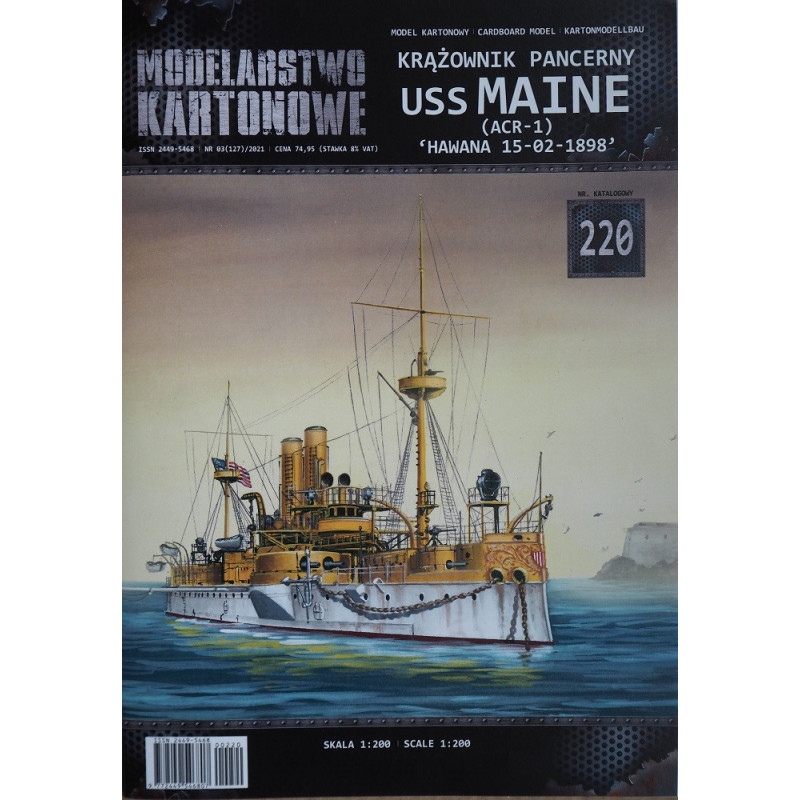


Publisher/ Manufacturer: "PRO-Arte" – "Modelarstwo Kartonowe". Poland
Scale: 1 : 200
Number of sheets: 17 1/2 x A4, + flags,
Number of sheets with details: 13 1/2 x A4, + flags,
Number of assembly drawings: 48
Difficulty: For intermediate and experienced modelers.
Model dimensions: 485 mm x 87 mm x 186.5 mm
 Security policy
(edit with the Customer Reassurance module)
 Delivery policy
(edit with the Customer Reassurance module)
 Return policy
(edit with the Customer Reassurance module)
USS “Maine” (ARC-1) – the US armored cruiser, the first ship of this name in the US Navy, famous for the sinking, that became the cause of the US-Spanish War. “Maine” was the first large warship, built in the United States shipyards, initially classified as an armored cruiser and designated ARC-1 (Armored Cruiser Number 1), later as a Class I battleship. But he was slower, than typical armored cruisers of the time, and for typical battleships of the time he had a weakest armor thickness and armament, closer to that of a Coast Guard battleships. He was the only “Maine”-class ship, not considered a success. USS “Maine” served on the East Coast of the United States and in the Caribbean. In February 1898 the cruiser was sent to Havana, Cuba, where he was to protect American interests during uprisings and riots. On February 15, 1898 at 9:40 p.m., “Maine” exploded in Havana harbor and sank immediately, taking with his 260 crew members. Six more died of their wounds in hospital. As it turned out later, about 5 tons of gunpowder charges for cannons shells exploded in the ammunition store. The explosion destroyed the entire front part of the ship. Captain Charles Sigsbee and most of the officers survived, because their cabins were in the stern. The American authorities investigate the cause of this explosion not for long time. On March 28, 1898 it was reported, that the explosion of the ammunition store was caused by the explosion of a mine, attached to the hull. The US government and public opinion, fueled by an aggressive press, accused Spain, whose colony was Cuba at that time, of blowing up the ship. And the already tense relations between the United States and Spain worsened even more, and war became inevitable. This war was the greatest defeat of the Spanish Navy at Santiago de Cuba. On February 2, 1912 the “Maine” wreck was raised and towed to the open sea, where it was sunk with honors in the deep waters of the Gulf of Mexico on March 16. The cruiser's mast still stands in Arlington Cemetery as a memorial to the victims of the explosion, buried there.
An average, but well-designed and richly detailed model of a medium-size ship, which will suit only medium-experienced and experienced modelers. The model has excellent detailization of the hull, deck equipment, superstructures, artillery, other equipment. There is a solid stock of colors and textures, the flag is printed on thin paper in single-side printing - both sides of the flag are printed on the same side and need to be glued by folding. Very beautiful and realistic texture of wooden decks. There are details of the model's keel-block (stand). The textual instructions in Polish are very small - only a few sentences, but the graphical ones are large, detailed, informative and perfectly readable. The model depicts the cruiser as it looked in the final moments before the explosion.

Publisher/ Manufacturer: "PRO-Arte" – "Modelarstwo Kartonowe". Poland
Scale: 1 : 200
Number of sheets: 17 1/2 x A4, + flags,
Number of sheets with details: 13 1/2 x A4, + flags,
Number of assembly drawings: 48
Difficulty: For intermediate and experienced modelers.
Model dimensions: 485 mm x 87 mm x 186.5 mm