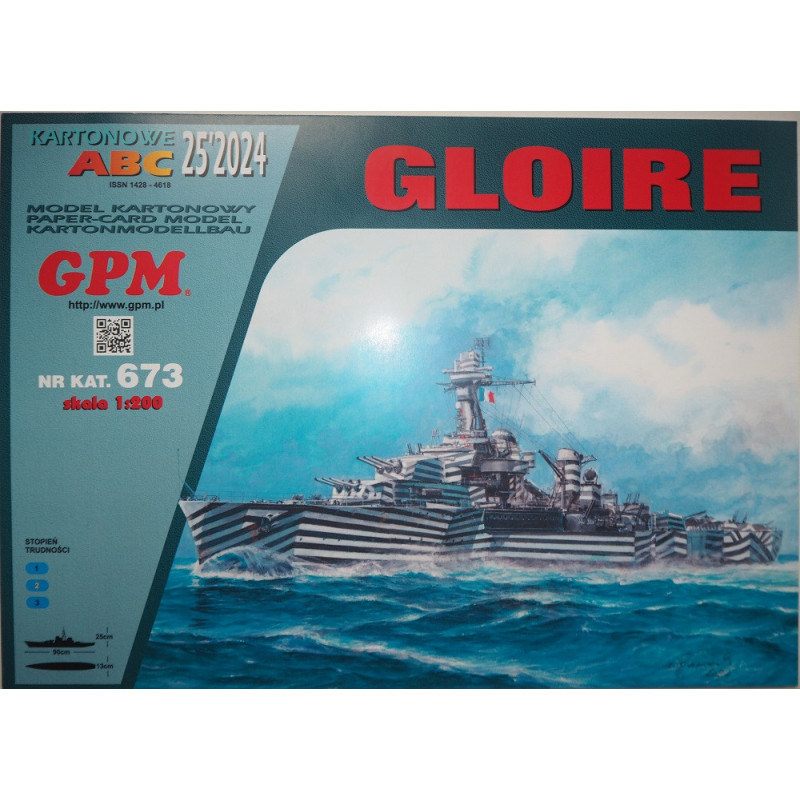


Publisher/ manufacturer: "GPM". Poland
Scale: 1 : 200
Number of sheets: 23 x A3
Number of sheets with parts: 14 1/2
Number of assembly drawings: 121
Difficulty level: For intermediate and experienced modelers.
Dimensions of the model: 895 mm x 87.5 mm x 177,5 mm
 Security policy
(edit with the Customer Reassurance module)
 Delivery policy
(edit with the Customer Reassurance module)
 Return policy
(edit with the Customer Reassurance module)
The keel of the cruiser "Gloire" was laid down on 13 November 1933 at the "Forges et Chantiers de la Gironde" shipyard in Lormont. The ship was launched on 28 September 1935 and commissioned on 15 November 1937. At the outbreak of World War II, the ship patrolled the Atlantic waters, responding to the threat to shipping posed by large German surface ships. After the end of the French campaign, the ship returned to Toulon on 4 July 1940. On 9 September, the cruiser and her co-class cruisers "Montcalm" and "Georges Leygues" were sent from Toulon to Dakar, where they put to sea to restore the Vichy government in Gabon. On 19 September the group encountered Allied heavy cruisers and "Georges Leygues" and "Montcalm" returned to Dakar. Due to engine failure, "Gloire" had to proceed to Casablanca under escort from the Australian cruiser HMAS "Australia". After the Allied invasion of North Africa and the German occupation of Vichy in November 1942, the ship transferred to the Free French Navy. From February to August 1943 "Gloire" underwent repairs and modernization at the Philadelphia shipyard, then returned to Dakar. In February 1944, she supported the Allied landings at Anzio, firing 604 rounds from her guns. In August 1944, she fired 2,000 shells in support of the Allied landings in southern France. After the war, she operated mainly in the Indochina region. On February 1, 1955, "Gloire" was transferred to the reserve, and in 1958 was cut up.
A large, well-designed and richly detailed cruiser model would also be interesting in terms of camouflage, which greatly distorts the appearance of the ship. This is good, if there is an inaccuracy somewhere - it simply will not be visible. But this is also a minus: accurately gluing the parts will be a real challenge. The model recreates the appearance of ship in 1944, which had already served in the Free French Navy, and is intended for medium and experienced modelers. There is a considerable reserve of colors, there are no text instructions, the graphics are simply exemplary.

You might also like
Publisher/ manufacturer: "GPM". Poland
Scale: 1 : 200
Number of sheets: 23 x A3
Number of sheets with parts: 14 1/2
Number of assembly drawings: 121
Difficulty level: For intermediate and experienced modelers.
Dimensions of the model: 895 mm x 87.5 mm x 177,5 mm