

Publisher/ Manufacturer: "PRO-Arte" – "Modelarstwo Kartonowe". Poland
Scale: 1 : 200
Number of sheets: 10 x A4, + flags,
Number of sheets with details: 5 1/5 x A4, + flags,
Number of assembly drawings: 21
Difficulty: For modelers of any experience.
Model dimensions: 382 mm x 66 mm x 78.5 mm
 Security policy
(edit with the Customer Reassurance module)
 Delivery policy
(edit with the Customer Reassurance module)
 Return policy
(edit with the Customer Reassurance module)
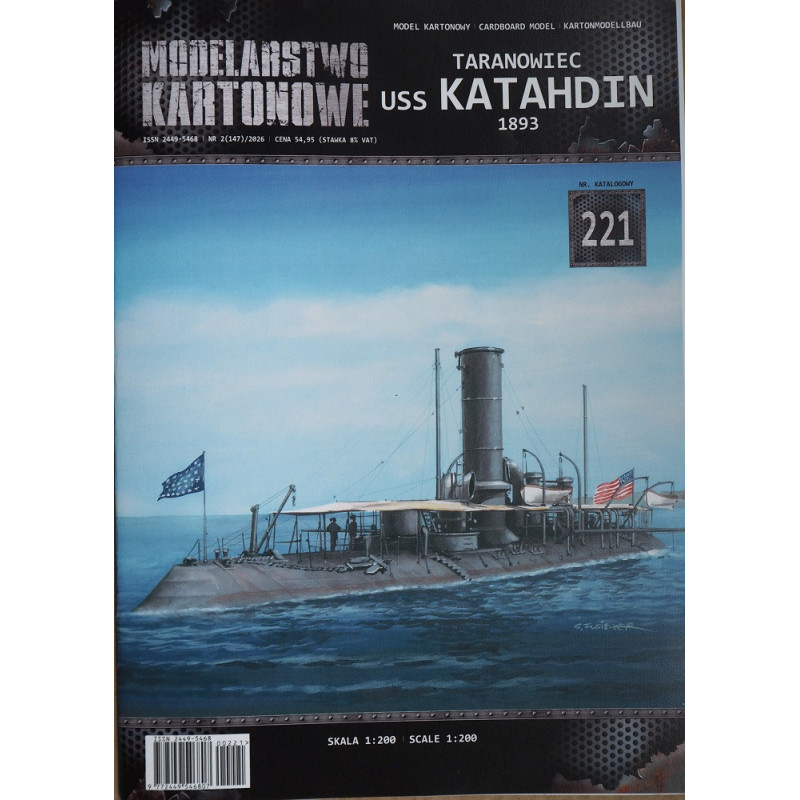
USS “Katahdin” – the US experimental Ironclad harbor-defense ram ship, built for the US Navy at the end of the 19th century. It was a kind of transitional stage in shipbuilding architecture, when the doctrine of naval warfare again considered the use of the ramming method as the main weapon against enemy ships. The ship was built at the “Bath Iron Works” shipyard in Bath, Maine. It was launched on February 2, 1893. It entered service on February 20, 1896. The first captain of the ship was Lieutenant Commander Richard Leary. In 1897 “Katahdin” was transferred to the reserve, but in March 1898 it was returned to service in preparation for the war with Spain. Assigned to the North Atlantic Escadre, it patrolled the eastern coast of the United States. When the threat to these coasts disappeared in the fall of 1898, it was again transferred to the reserve. On July 9, 1909 USS “Katahdin” was struck from the lists of the United States Navy and converted into a target ship. The name was changed to “Ballistic Experimental Target A”. Sunk in September 1909 during naval artillery fire.
A small, but well-designed and richly detailed model of a small ship, which will suit modelers of any experience. Only for beginners and modelers with little experience, we recommend working under the supervision of a more experienced colleague. Just do not rush and do everything carefully and attentively. The model has a well-detailed hull, deck equipment, superstructures, other equipment. There is a considerable reserve of colors, the flag is printed on thin paper, single-sided printing - both sides are printed on the same side and it must be glued by folding, or double-sided printing. Where necessary, the details are printed double-side printing. There are details of the model's keel-block (stand). The textual instruction in Polish is very small - only a few sentences, but the graphical one is large, detailed, informative and perfectly readable.

Publisher/ Manufacturer: "PRO-Arte" – "Modelarstwo Kartonowe". Poland
Scale: 1 : 200
Number of sheets: 10 x A4, + flags,
Number of sheets with details: 5 1/5 x A4, + flags,
Number of assembly drawings: 21
Difficulty: For modelers of any experience.
Model dimensions: 382 mm x 66 mm x 78.5 mm