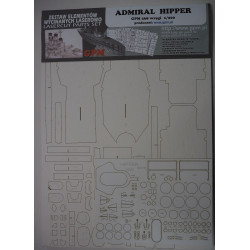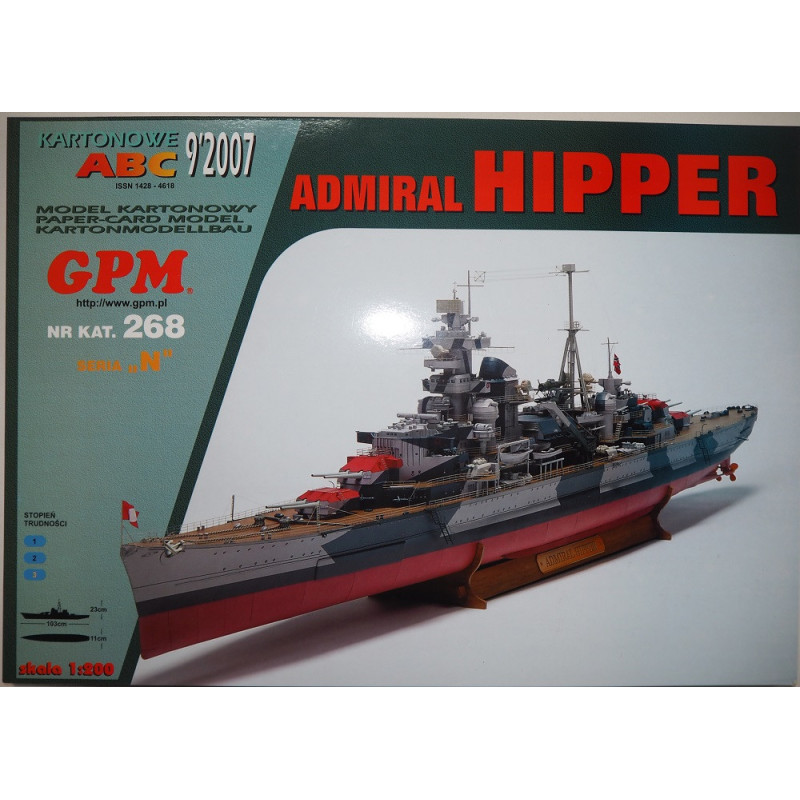


Publisher/ manufacturer: "GPM". Poland
Scale: 1 : 200
Number of sheets: 38 x A3
Number of sheets with parts: 30
Number of assembly drawings: 112
Difficulty level: For experienced modelers
Dimensions of the model: 1030 mm x 106,5 mm x 281 mm
 Security policy
(edit with the Customer Reassurance module)
 Delivery policy
(edit with the Customer Reassurance module)
 Return policy
(edit with the Customer Reassurance module)
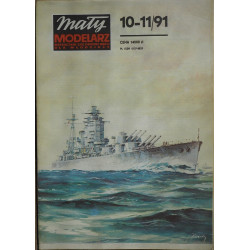
Between 1935 and 1937 two slightly different types of heavy cruisers laid keels. The first type consisted of "Admiral Hipper", "Blucher" and "Prinz Eugen", the second type consisted of "Seydlitz" and "Lutzow'. These cruisers were intended for corsair warfare far from their supply bases, but it soon became clear, that these ships were not suited for such warfare. Their high compression ratio engines were very fuel efficient and their range prevented them from being successfully used in the North Atlantic. In addition, the complicated engine equipment caused a lot of trouble for the crews. Of the five ships, only three were used in combat conditions. "Blucher" was sunk on April 9, 1940 in the Oslo Fjord, "Admiral Hipper" was sunk by its own crew in the last days of the war. And only the only "Prinz Eugen", called the "lucky ship", saw the end of the war. The ship was sunk after the war in 1946 due to atomic bomb tests at Bikini Atoll Lutzow was sold unfinished in 1940 to the USSR, where it was also not completed. Seydlitz was supposed to be converted into an aircraft carrier, but this project was also not completed. The ship was seized by the Soviet Union and cut up in 1958. The only prominent "Admiral Hipper" service episode was a duel with the British squadron destroyer HMS "Glowworm" - and this in favor of the latter. Despite the disproportionality of forces, the British ship's crew fought intelligently - under the cover of smoke screens, they tried to torpedo the German ship. After several unsuccessful attempts, the captain of "Glowworm" made a desperate decision to ram the enemy.The ship struck the "Admiral Hipper's" broadside in the area of the torpedo tubes and sank, killing 114 of the crew. The 31 surviving sailors were taken on board by the crew of the German ship. in 1945 at the beginning, he was sent to a different route - this time to Kiel, where he was transferred to the reserve. There in 1945 May 3 he sank after being hit by several bombs during an Allied air raid.
A complex, highly detailed, large ship model painted in a beautiful spotted camouflage. Model for experienced modelers only.

You might also like
Publisher/ manufacturer: "GPM". Poland
Scale: 1 : 200
Number of sheets: 38 x A3
Number of sheets with parts: 30
Number of assembly drawings: 112
Difficulty level: For experienced modelers
Dimensions of the model: 1030 mm x 106,5 mm x 281 mm