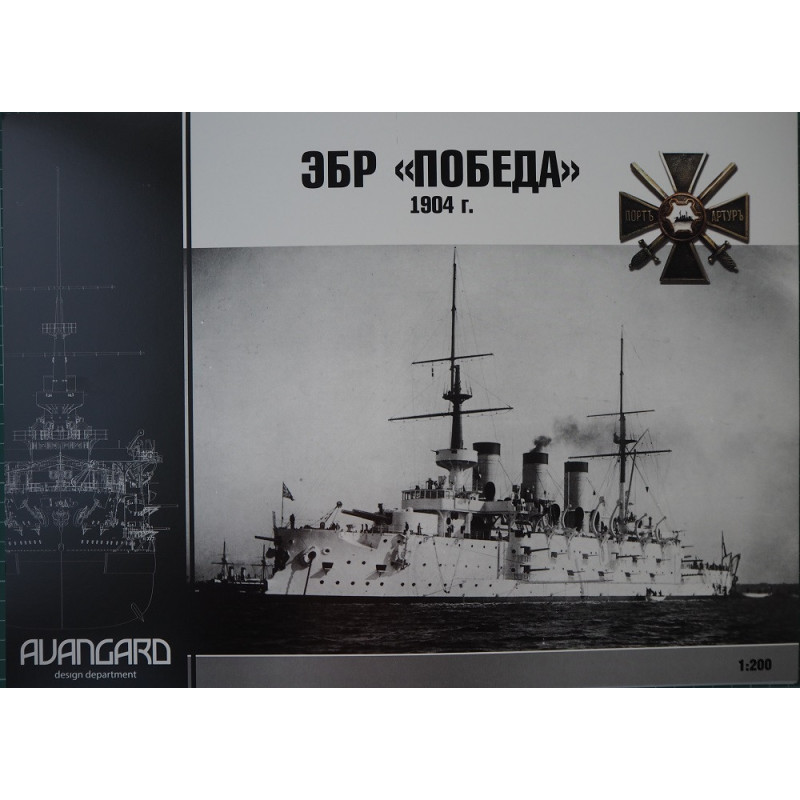


Publisher/ manufacturer: “Avangard". Ukraine
Scale: 1 : 200
Number of sheets: 30 x A3
Number of pages with details: 21
Number of assembly drawings: 126
Difficulty: For intermediate to advanced modelers.
Model dimensions: 662 mm x 109 mm x 246,5 mm
 Security policy
(edit with the Customer Reassurance module)
 Delivery policy
(edit with the Customer Reassurance module)
 Return policy
(edit with the Customer Reassurance module)
“Pobeda” (Russian: «Победа») was a Russian pre-dreadnought battleship of the early 20th century, the last of the “Peresvet”-class ships. It entered service in Russian Navy in 1902. It participated in the Battle of Port Arthur during the Russo-Japanese War. Sunk and captured by the Japanese in Port Arthur in 1905, the ship was raised and entered in service in the Imperial Japanese Navy under the name “Suwo” (周防). “Pobeda” was built as a “Peresvet”-class battleship and entered service with the Imperial Russian Navy in 1902. It was one of the first Russian ships, to be equipped with rapid-fire guns. It had a high forecastle, medium-caliber artillery on two decks, and was armored along the entire length of the hull. It was designed as a heavily armed and fast ship, but it did not meet expectations. "Pobeda" was first damaged by shelling Port Arthur, and then ran a mine. During the Battle of the Yellow Sea, the ship was hit 11 times, and after returning to Port Arthur for repairs, it was hit several times by Japanese coastal batteries. On December 7, 1904, the ship was sunk by Japanese siege guns. After the war, raised in October 1905, the ship was repaired and put into operation under the name "Suwo" after Suwo Province, which now belongs to Yamaguchi Prefecture. After repairs in Yokosuka (installing Japanese boilers and armament), the ship was reclassified as a first-class coastal defense battleship in October 1908. It served in this capacity for many years, and in 1912 it was modernized. During the First World War, during the Siege of Tsingtau, in 1914 On 27 October 1917, the Japanese Navy dispatched an escadre under Vice Admiral Sadakichi Kato, which hoisted its flag on Suwo Island. The escadre was to blockade Jiaozhou Bay, which was controlled by Germany. The two Royal Navy ships assigned to the China Station (the pre-dreadnought battleship HMS “Triumph” and the destroyer HMS “Usk”) were assigned to a Japanese escadre, which was largely composed of obsolete ships, although it also included a few modern ships, such as the seaplane transport “Wakamiya”, the dreadnout’s “Kawachi” and “Settsu”, and the cruiser “Kongō”. After the war, "Suwo" was converted into a training warship, where Imperial Navy cadets were trained in navigation and engine maintenance. In 1917 the ship was converted into a gunnery training ship. In 1922 was commissioned into the Imperial Navy. The old warship was disarmed at Kure. During this process, on 13 July, the predreadnought capsized. The hull was restored to its normal position, and the gun’s turrets, engine room, and main armor were dismantled. However, other work was suspended. The hull was towed to Mitsugojima, where it remained as a warehouse, serving as such throughout World War II. In 1946, the ship was towed to Kure and cut into scrap metal.
A medium-sized, well-designed and richly detailed model of one of the Russian ships of the Russo-Japanese War for medium-experienced and experienced modelers. It perfectly details all the deck equipment, superstructures, hull, armament, rigging and rangout, rescue equipment and other ship details. There is no textual instruction, but it is not necessary, when the graphic one is simply excellent, consistently arranged (only, before starting to use it, it is necessary to compare the order of the instruction sheets, because the sheets are loose) and perfectly readable, explaining the gluing of each detail and its stages. Some sheets and details are printed double-sided, some details are printed on thin paper (not just the frame), there is a considerable reserve of colors, and white ones are even wheelbarrows.

You might also like
Publisher/ manufacturer: “Avangard". Ukraine
Scale: 1 : 200
Number of sheets: 30 x A3
Number of pages with details: 21
Number of assembly drawings: 126
Difficulty: For intermediate to advanced modelers.
Model dimensions: 662 mm x 109 mm x 246,5 mm