

Publisher/ Manufacturer: "Maly Modelarz". Poland
Scale: 1 : 33
Number of sheets: 8 x A4
Number of sheets with details: 4 1/5
Number of assembly drawings: 12
Difficulty: For modelers of any experience.
Model dimensions: 173.5 mm x 258.5 mm x 78.5 mm
 Security policy
(edit with the Customer Reassurance module)
 Delivery policy
(edit with the Customer Reassurance module)
 Return policy
(edit with the Customer Reassurance module)
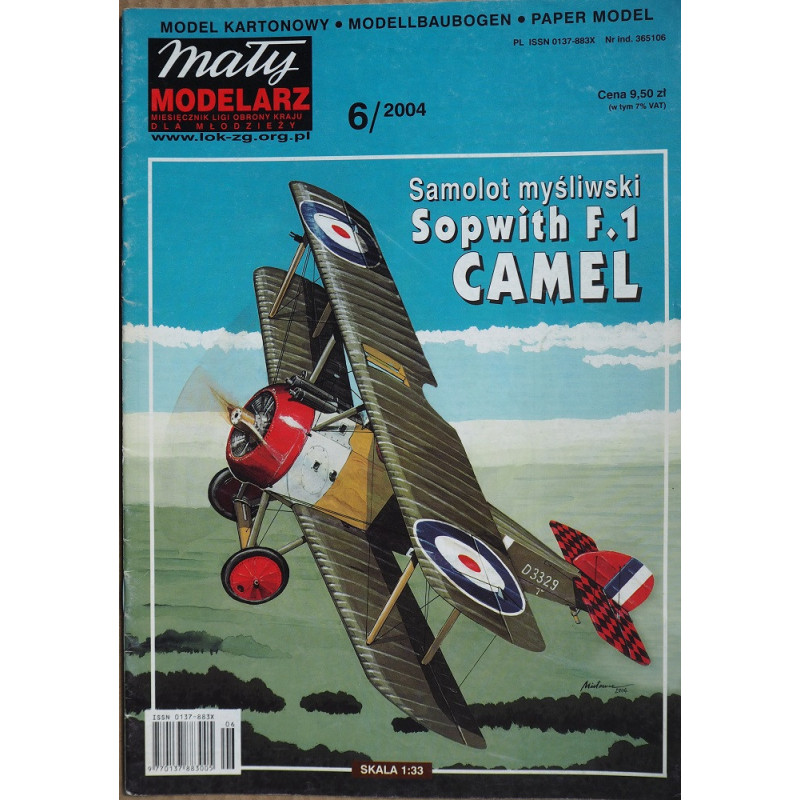
At the end of 1916 the "Sopwith" factory began work on a new fighter, which in its main features closely resembled its predecessor - the Sopwith "Pup". The main difference was the reinforced armament, which consisted of two "Vickers" type machine guns, mounted on the top of the fuselage and partially hidden under the canopy, which gave the aircraft a characteristic slightly hunchbacked appearance. Hence the name of the new fighter - "Camel". Very quickly, the Sopwith "Camel" became the main fighter of the British RAF, although the opinions of the pilots, flying them, were very controversial. By the end of the war, about 5,500 of this type of machine were produced, and the pilots, who flew them, shot down over 2,500 enemy aircraft by the end of the war.
A small model of a small aircraft, but perfectly designed and maximally detailed, but suitable for modelers of any experience. Even a beginner, working under the supervision of a more experienced colleague, will perfectly assemble this beautiful model. It is detailed to the maximum almost everything, that can be detailed on such a scale - cockpit equipment, weapons, a rotative engine, rotating with a propeller, landing gear, exterior detailing. The control plates can be made both together with the main ones or separately. You can make one of two painting options optionally (separate details are provided for them): No. D3329 of 209 RAF Division in 1918, piloted by Lieutenant Mellersh and No. B7270 of the same division in 1918, piloted by Captain A. Roy Brown. There is a small reserve of colors and textures, both textual (in Polish) and graphical instructions are excellent, large, clear and detailed, as is the case with all models, designed by Pawel Mistewicz. Antiquarian publication.

Publisher/ Manufacturer: "Maly Modelarz". Poland
Scale: 1 : 33
Number of sheets: 8 x A4
Number of sheets with details: 4 1/5
Number of assembly drawings: 12
Difficulty: For modelers of any experience.
Model dimensions: 173.5 mm x 258.5 mm x 78.5 mm