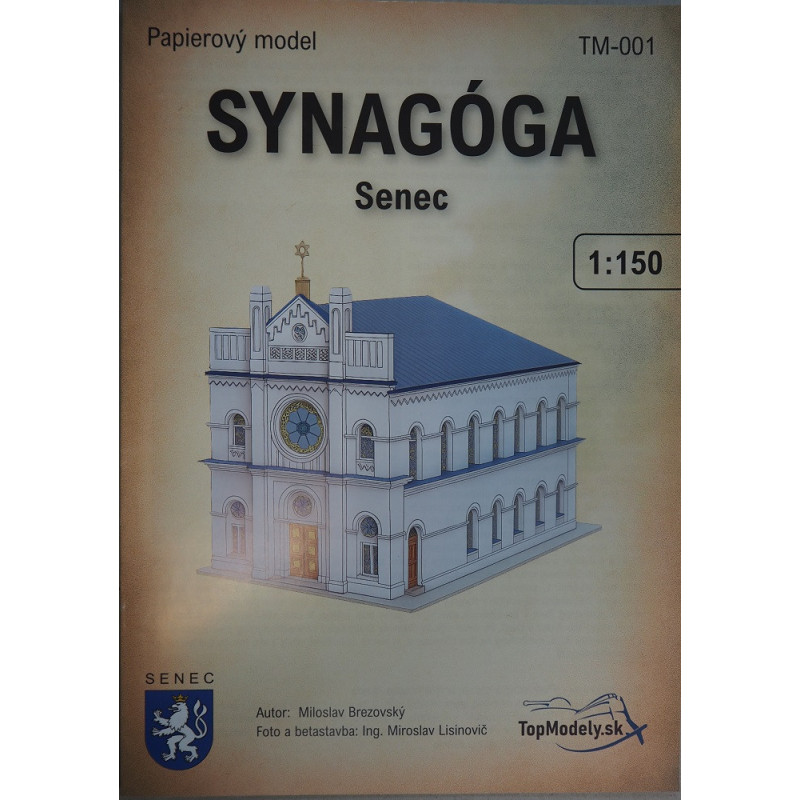


Publisher/ Manufacturer: "TopModely.sk". Slovakia
Scale: 1 : 150
Number of sheets: 6 x A4
Number of sheets with details: 4
Number of assembly drawings: 1
Difficulty: For modelers of any experience.
Model dimensions: 148 mm x 90 mm x 133 mm
 Security policy
(edit with the Customer Reassurance module)
 Delivery policy
(edit with the Customer Reassurance module)
 Return policy
(edit with the Customer Reassurance module)
In the Middle Ages, important trade routes intersected at the junction of the upper and lower Danube. At their intersection, a settlement was formed, and later a village, mentioned as early as 1252 under the German name Zemch. At that time, Germans lived in the upper part of Žitný ostrov. In 1412, the present-day Senec is already mentioned as a toll station, and in the 15th century it became a trading town. There was even a defensive castle here, from which the then historical name "Wartberg" came from. A famous chapter in the city's history is the operation of the first university-type educational and economic institution in 1763–1776. The “Collegium Oeconomicum” was founded by Maria Theresa with the help of the court chancellor František Esterházy. Over time, Senec became an important center of the Bratislava County, and in the 19th century - the center of the district. At the turn of the 19th and 20th centuries, Senec was a prosperous and open city, an integral part of which was a large Jewish community. The older synagogue, built in 1827, became too small over time. Therefore, in 1906, the Jewish community built a new synagogue on the current Peace Square, according to the project of the local builder Josef Halzl. Its architecture is a combination of neo-Romanesque and so-called Moorish styles. The plastically structured street facade is dominated by a large rose window on the ground floor and an entrance portal with a typical horseshoe-shaped arch. The superstructure of the facade pediment has a frieze with a hexagram of the Star of David and the tablets of the Ten Commandments. The rectangular plan of the building is divided into a vestibule and a main space of one nave. A side staircase leads from the vestibule to the women's galleries on the first floor. Modern structural elements were also used in the construction, such as cast-iron gallery supports and iron ceiling beams. Of the valuable artistic and artistic-craft elements, the coffered ceiling, doors, part of the windows and the remains of the original decorative painting were preserved. During the renovation, a rare washbasin with a donor plate from the synagogue vestibule was stolen. On the territory of the synagogue there are the remains of a residential and ritual complex with a ritual bath (mikvah), a domed brick oven and a well. The majority of the Jewish population of Senec tragically perished during the Holocaust. Efforts to restore community life were thwarted by the communist regime. In 1956 the synagogue was taken over by the state and used as a storage room and granary. In recent decades, the monument has been abandoned and gradually decayed. In 2015 the synagogue was purchased by the Bratislava Municipality from the Central Union of Jewish Religious Communities of the Slovak Republic for a symbolic 1 euro. The goal of the region was to restore the synagogue and adapt it to a multifunctional cultural and social center with an exhibition of the history of Jewish culture in the region. The restoration of the monument took place in 2018–2023 and included the building of operating and visitor facilities, the so-called information pavilion on the territory of the synagogue. The restoration of the remains of the ritual-residential complex has not yet been completed.
A small, not very complex, fairly well-designed and excellently detailed model, who will suit modelers of any experience. Only beginners and modelers with little experience recommend working under the supervision of a more experienced colleague, do not rush and use all the reserves of diligence, attentiveness and patience. There is no color range (or one could say, that there is a lot of it - after all, the model is mostly white), the textual instruction in Slovak is not great, but You will have to rely on them, because the graphical ones consist of only 1, albeit well-drawn, assembly drawing.

Publisher/ Manufacturer: "TopModely.sk". Slovakia
Scale: 1 : 150
Number of sheets: 6 x A4
Number of sheets with details: 4
Number of assembly drawings: 1
Difficulty: For modelers of any experience.
Model dimensions: 148 mm x 90 mm x 133 mm