- New
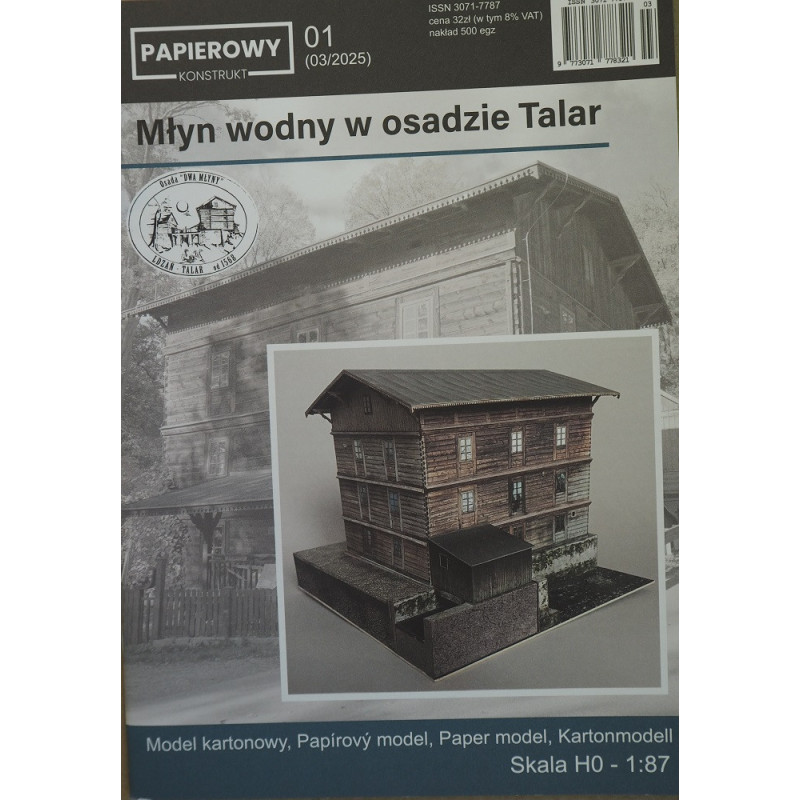


Publisher/ Manufacturer: "Papierowy Konstrukt" (Poland)
Scale: 1 : 87
Number of sheets: 10 x A4
Number of sheets with parts: 7 1/2
Number of assembly diagrams: 6
Difficulty level: Suitable for modelers of all experience levels.
Model dimensions: 218 mm x 202 mm x 168 mm
 Security policy
(edit with the Customer Reassurance module)
 Delivery policy
(edit with the Customer Reassurance module)
 Return policy
(edit with the Customer Reassurance module)
Millers' settlements along the Grabia River began to emerge as early as the 16th century; the first mill in the area was built in Ldzany in 20es of XVI century. By the 17th century a mill was already operating at the site of the current structure, which also housed a water-powered sawmill. Only two buildings from a later period have survived to the present day: an older, smaller building, equipped with its own vertical turbine, and a larger one, built in the late XIXth century. The model in this edition reproduces the appearance of this building. Originally, the millstones were turned by a wheel, driven by the water, flow below. In the 1910s this wheel was replaced by a vertical Francis-type turbine. After World War II electricity was installed in the mill, allowing operations to be powered by both - water and electric current. Local legend has it, that a generator, powered by the water wheel, was installed in the mill to provide backup electricity for local residents—all without the permission of the authorities at the time. The Fischer family, who managed the buildings for many years, is also worth mentioning. The mill’s operational history mirrors the twists and turns of the region's own history: it began as a private enterprise, was operated by the Germans during World War II, and was subsequently used by the Gmina Farmers' Mutual Aid Society. In the mid-1990s the Dobroń Gmina took over the mill and designated it a protected site. The entire mill complex was eventually sold to a private person. Ownership changed hands several times, before the current owners—the Radgowski family—acquired it. They restored the building to its original appearance during a five-year renovation project and established the Jan Radgowski Museum on the premises.
This medium size model is well-designed, with intricate exterior detailing—faithfully reproduces the mill's current appearance. Its straightforward construction reflects the simplicity of the original building, making it suitable for modelers of all skills. However, we advise beginners and little experienced to work under the guidance of a more experienced modeler, work without rushing, attentively and accurately. Colors and textures reserves is available. The textual instruction in Polish is extensive, informative, and detailed; the graphical ones is concise yet quite comprehensive, but easy to read and they are certainly sufficient for successfully assembling the model.

Publisher/ Manufacturer: "Papierowy Konstrukt" (Poland)
Scale: 1 : 87
Number of sheets: 10 x A4
Number of sheets with parts: 7 1/2
Number of assembly diagrams: 6
Difficulty level: Suitable for modelers of all experience levels.
Model dimensions: 218 mm x 202 mm x 168 mm