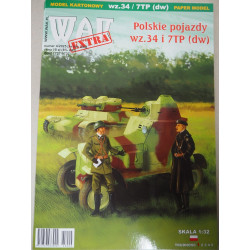
Publisher/ Manufacturer: "WAK". Poland
Scale: 1 : 25
Number of sheets: 10 x A4
Number of sheets with details: 5
Number of assembly drawings: 18
Difficulty: For modelers of any experience.
Model dimensions: 127 mm x 68.5 mm x 60 mm
 Security policy
(edit with the Customer Reassurance module)
 Delivery policy
(edit with the Customer Reassurance module)
 Return policy
(edit with the Customer Reassurance module)
In 1938 the British Ministry of War decided, that there was a need to design and equip the armed forces with light, fast and maneuverable reconnaissance armored cars. Three companies participated in the competition: "Morris Gars Ltd.", Alvis Ltd." and "BSA Cycles Ltd." The version, proposed by BSA, was selected for production due to its better cross-country ability. The first 172 cars were ordered with a delivery date of mid-1939, since this company was taken over by the “Daimler” concern, they received the designation "Daimler Scout Car" Mk. I and the widespread name "Dingo". This car was a two-seater, all-wheel drive, equipped with a 55 h. p. “Daimler” gasoline engine. In the Mk. I version both axles were steered, which was abandoned in later modifications. The armored car was armed with a “Bren” light machine gun, and radio stations were installed on them. From 1942 the "Dingo" was also produced by the Canadian division of the “Ford” factory, where they received the name "Lynx" and a more powerful engine. In total, over 6,600 "Dingo" and 3,255 "Lynx" were produced by 1945. These cars were used for reconnaissance, communications and as headquarters vehicles.
A medium-complexity, well-designed and richly detailed model for modelers of any experience. Only advanced beginners and modelers with little experience recommend working under the supervision of a more experienced colleague, not rush, using all the reserves of care and attention. The model recreates a Mk. Ia version car, which can be made in one of two camouflage versions: a car, that served in the 1st Armored Division of the British Expeditionary Force or a car, that served in Italy in 1944 as part of the II Polish Corps. The model perfectly recreates the visible part of the chassis, interior, armament and exterior detailing, there is no detailing of the engine compartment. There is a small reserve of color. The textual instruction in Polish and English is not a big, but quite well illuminate the entire process of gluing the model and complement the good, well-drawn, informative and easy-to-read graphical instruction.

You might also like
Publisher/ Manufacturer: "WAK". Poland
Scale: 1 : 25
Number of sheets: 10 x A4
Number of sheets with details: 5
Number of assembly drawings: 18
Difficulty: For modelers of any experience.
Model dimensions: 127 mm x 68.5 mm x 60 mm