

Publisher/ Manufacturer: "Orlik". Poland
Scale: 1 : 25
Number of sheets: 18 x A4
Number of sheets with details: 9 2/3
Number of assembly drawings: 62
Difficulty: For intermediate and experienced modelers.
Model dimensions: 209 mm x 62 mm x 75 mm
 Security policy
(edit with the Customer Reassurance module)
 Delivery policy
(edit with the Customer Reassurance module)
 Return policy
(edit with the Customer Reassurance module)
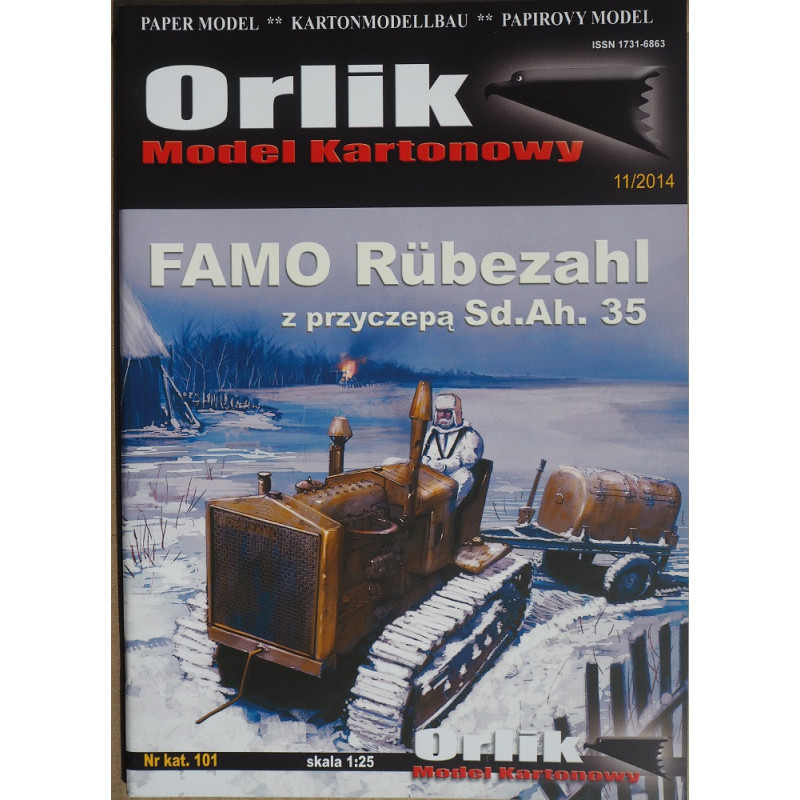
FAMO "Rubezahl – the German tracked tractor of the interwar period and World War II. It was powered by a single 50 h. p. engine, which was synchronized with a 4-speed (3 forward gears - one reverse) manual gearbox. The first exemplar was manufactured in 1932. In the same year serial production began, which continued until 1944. The total mass of the tractor was 4700 kilograms. FAMO "Rubezahl was ordered by the German Reichswehr, which was looking for a new universal tracked tractor in the late 1920s. Projecting and experimental work took place in 1928-1932. Ultimately, a tractor with a relatively low maximum speed was created, capable of towing several tons of cargo in difficult terrain conditions. In addition, it was quite easy to control and was characterized by cheap operation. Due to its high characteristics, it quickly found its way not only to the civilian market, but also to the airline “Lufthansa”, which used it to tow planes. The FAMO "Rubezahl" tractor was used by the Wehrmacht as a light artillery tractor during World War II, but was mainly used in supply units.
A small model of a small tractor with a tank trailer, well designed and richly detailed, quite complex. We recommend gluing it only to modelers with medium experience and experienced. The model perfectly reproduces all visible external details, chassis, suspension, driver's workplace, engine and its environment, tank trailer. Tracks - only from separate tracks. The model depicts a tractor, used by the Wehrmacht at the end of World War II. The colors reserve is considerable. The textual instruction in Polish is large, informative, perfectly explaining the entire process of assembling the model, the graphical instruction is very extensive, consistently arranged, informative and easy to read.

Publisher/ Manufacturer: "Orlik". Poland
Scale: 1 : 25
Number of sheets: 18 x A4
Number of sheets with details: 9 2/3
Number of assembly drawings: 62
Difficulty: For intermediate and experienced modelers.
Model dimensions: 209 mm x 62 mm x 75 mm