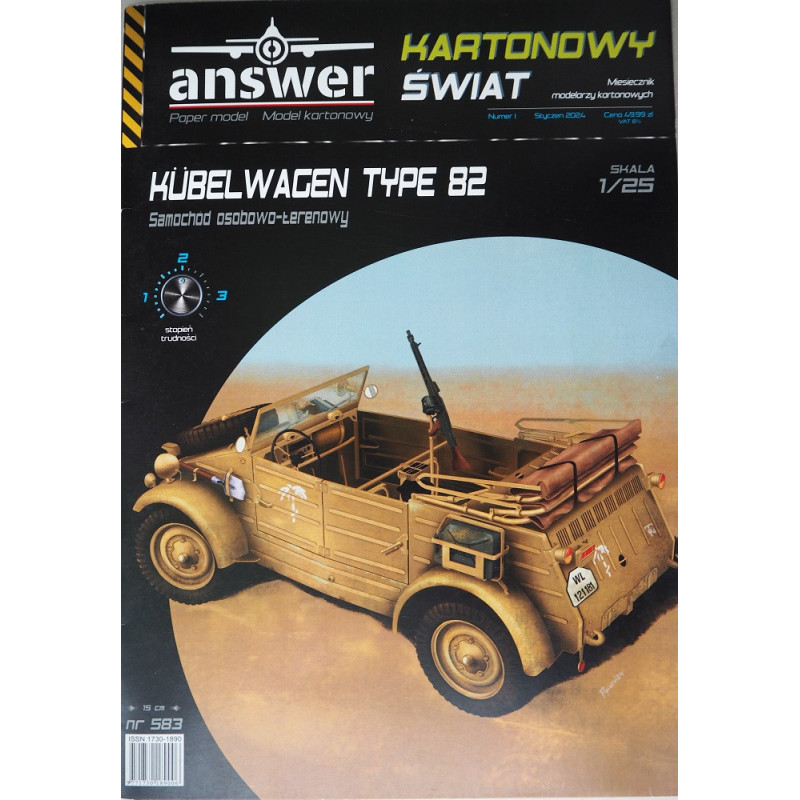


Publisher/ manufacturer: "Answer. Kartonowy Swiat". Poland
Scale: 1 : 25
Number of sheets: 8 x B4
Number of pages with details: 4
Number of assembly drawings: 19
Difficulty: For modelers of all experience.
Model dimensions: 149,5 mm x 64 mm x 66 mm
 Security policy
(edit with the Customer Reassurance module)
 Delivery policy
(edit with the Customer Reassurance module)
 Return policy
(edit with the Customer Reassurance module)
Since the mid-1920s, the German army was looking for a passenger car with increased cross-country ability. According to the requirements, submitted to the companies, it had to have a standard 4x2 wheel formula and an open body. A folding canvas roof and roll-up canvas covers instead of doors were to be provided for protection from bad weather conditions. The clearance of these cars was to be increased by installing larger wheels and reinforced springs, and the exhaust system and brakes were to be improved. The safety of the car crew, when driving off-road, was to be increased by specially designed so-called "bucket" ("Kubel") seats. Additional side supports were attached to them to protect against falling out of the car. Initially, such cars were called "Kubelsitze" in the army, later - "Kubelsitzwagen", and the shortened version of this name - "Kubelwagen" became the most popular. Over time, this name became a common name in the German army for two-axle light off-road cars with an open top. They were called that, even when the characteristic seats were no longer used. The German army (first the Reichswehr, later the Wermacht) used cars of this type of various brands. Often these were "off-road" civilian versions of cars. The first talks about a military version of Volkswagen cars began in 194. It was supposed to be a passenger car, designed to transport three passengers and a light machine gun with ammunition. But this idea was not developed. It was returned to on January 14, 1938. While participating in the tests of the "Beetle", SS Hauptsturmfuhrer A. Linse presented the concept of the military use of this car to the Land Divisional Armaments Board. The proposal was approved and on November 3, 1938, the first prototype of the car, called the Volkswagen Typ 62, was presented. It had an open, streamlined steel body, no doors, and the windshield was fixed, and the whole car was very similar to the "Beetle". In the same month, tests began at the Munsingen proving ground. They showed, that the chassis scheme should be changed to 4X4, but the designers left this without due attention. It was decided not to change anything cardinally in the design of the prototype, which was later recognized as the designers' biggest mistake. At the beginning of 1939, the VW Typ 62 received a new body, which differed slightly from the previous serial samples. It was made of thin steel sheets with longitudinal stamping's, had 4 doors, a folding windshield and a folding canvas roof. This version was first publicly demonstrated at the Vienna Motor Show in 1939. After subsequent tests, the Land Forces Armaments Board requested improvements to some of the vehicle's cross-country ability. The new version was ready in December 1939. It had increased ground clearance and changed the gearbox ratio, and installed an auxiliary power transmission to the rear axle. The car was powered by a 4-cylinder engine, left over from the days of a civilian car. This type was designated Typ 82 and was mass-produced. It was adopted as the standard all-terrain passenger car of the German army. Mass production began in the spring of 1940. The first 25 cars were manufactured at the Stuttgart factory, in May their production was transferred to the Wolfsburg "'KdF Stadt" factory, where 100 cars were manufactured that same month, 200 in June, and 275 in July. By December, the first 1,000 cars were manufactured. 4 main versions were produced: 4-seater all-terrain vehicle Kfz.1, 4-seater reconnaissance Kfz.3, three-seater communications Kfz.2 and two-seater repair shop versions Kfz. 2/4. Type 62 prototype cars were tested in combat conditions during the September 1939 Polish offensive, serial Type 82s were used in battles in France. The first large deliveries to line units began in mid-1940. Since then, the "Kubelwagen" has become one of the main all-terrain vehicles of the German army and has been used in all types of armed forces and on all fronts.
The model is quite easy to assemble, so it is suitable for modelers of any experience. A well-designed and moderately detailed (no engine compartment, but with excellent interior and exterior detailing) model, recreating the appearance of the all-terrain vehicle, used by the Africa Corps. There is a small supply of colors, the car is easily "exploited", the graphic instructions are excellent, the textual instructions are minimalistic.

You might also like
Publisher/ manufacturer: "Answer. Kartonowy Swiat". Poland
Scale: 1 : 25
Number of sheets: 8 x B4
Number of pages with details: 4
Number of assembly drawings: 19
Difficulty: For modelers of all experience.
Model dimensions: 149,5 mm x 64 mm x 66 mm