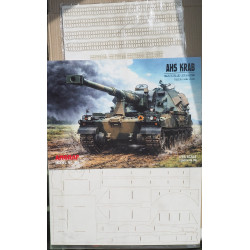
Publisher/ manufacturer: "Параллель плюс". Ukraine
Scale: 1 : 72
Number of sheets: 6 x A4
Number of sheets with parts: 4 1/6
Number of assembly drawings: 4
Difficulty level: For modelers of any experience
Dimensions of the model: 166 mm x 99 mm x 61 mm
 Security policy
(edit with the Customer Reassurance module)
 Delivery policy
(edit with the Customer Reassurance module)
 Return policy
(edit with the Customer Reassurance module)
It was a gigantic machine: 20 meters long, 14 meters wide and 10 meters high. The weight of the “Iron Kaput” was about 270 tons. It was more of a “cruiser on tracks”, than a tank in the modern sense. The hull of the combat vehicle was riveted from 100 mm thick armor plates. The steel, used to create the “monster”, was taken from the reserves of the Kaiserliche Marine Corps. Towing hooks were installed in the lower frontal part. True, it is not entirely clear, how it was possible to tow a 270-ton tracked combat vehicle at the beginning of the 20th century. Unless, of course, there was another one of the same type nearby, which would indicate plans for mass production. In the upper frontal part there is a canopy, covering the transmission cooling system, and next to it there is a hatch for accessing the same transmission. On top are two 150 mm guns. Below is a sub-tower box with a turret, recessed into it. This turret was armed with a 420 mm "Big Bertha" gun and a 280 mm quick-loading gun "Bruno". The radio station of the monstrous tank, if we believe the surviving information, had a range of almost 150 km. The sides of the "Iron Kaput" were strictly vertical. Each of them had two built-in sponsons with 170 mm cannons. The tank's ammunition stock consisted of 600 shells of various calibers. The width of the massive tank tracks was 230 cm. The combat vehicle was driven by four 650 h. p. engines. According to some data, partly based on information from tests in Africa, the tank could develop up to 12 km/h speed. Initially, the crew of the "Iron Kaput" consisted of 12 people. In 1912 the 270-ton machine was tested in Germany. Then the "Iron Kaput" was sent to East Africa, where it took a limited part in operations against individual tribes. The tank could not participate in the First World War, because Germany did not have time to bring it back. At the end of the war, one of the secret points of the Treaty of Versailles, was the destruction of the "miracle machine", which was done in November 1919.
A small, simple, moderately designed and moderately detailed tank model for modelers of any experience. Only beginners and those with little experience are recommended to work under the supervision of a more experienced colleague. Several parts are printed double-sided, there are also silhouette models of the crew, which allow you to estimate the size of this monster.

Publisher/ manufacturer: "Параллель плюс". Ukraine
Scale: 1 : 72
Number of sheets: 6 x A4
Number of sheets with parts: 4 1/6
Number of assembly drawings: 4
Difficulty level: For modelers of any experience
Dimensions of the model: 166 mm x 99 mm x 61 mm