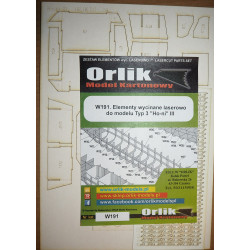
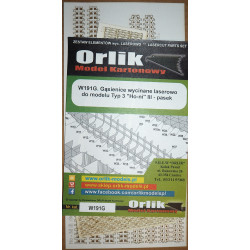
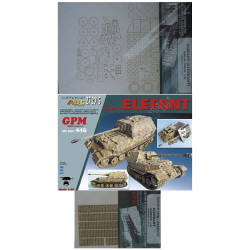
Publisher/ manufacturer: "Orlik". Polland
Scale: 1 : 25
Number of sheets: 16 x A4
Number of pages with details: 10 2/5
Number of assembly drawings: 71
Difficulty: For intermediate to advanced modelers
Model dimensions: 221 mm x 91,5 mm x 95,5 mm
 Security policy
(edit with the Customer Reassurance module)
 Delivery policy
(edit with the Customer Reassurance module)
 Return policy
(edit with the Customer Reassurance module)
In the late 1930s, the Japanese arms industry carried out design work on three types of self-propelled artillery units (SPAU). These machines were built on the chassis of light and medium tanks. In 1940, serial production of the Type 1 "Ho-ni" I self-propelled artillery units began. They were mounted on the chassis of the Type 97 "Chi-ha" tanks. These self-propelled artillery unit were armed with a 75 mm "Type 90" cannon. They were to be included in the composition of armored divisions and their task was to support their own tanks and destroy enemy armored vehicles. In 1943, a new full closed hull was constructed, which accommodated a crew of 7 people. This entire hull was a welded structure, rigidly attached to the chassis. The machine was armed with a new 75 mm "Type 3" cannon, the same as in the "Chi-nu" tanks. A two-part door was installed at the rear of the superstructure, viewing embrasures and small hatches were cut into the side panels. Instead of a hull machine gun, an additional ammunition storage compartment was installed. These SPAU had a radio station, which was mounted at the rear of the machine and had two rod antennas, attached to the mudguards. These SPAU were designated Typ 3 "Ho-ni" III. These machines with fairly good combat characteristics were produced in very small numbers and in it were armed the 4th Armored Division. They did not participate in any battle, as they were being stored to repel the expected US invasion of the main islands of Japan.
If we do not count the chassis, then the model is simple and would certainly be suitable for any experience modeler. But that chassis - just looking at the drawings - Br-r-r-r... The model, although without internal equipment, is intended only for medium-experience and experienced modelers, but even they will have to think a lot. The model is well designed and richly detailed, painted in colorful camouflage, where necessary, double-sided printing was used. The textual instructions are large and quite detailed, the graphic ones are large, detailed, and easy to read. There are colors reserves.

You might also like
Publisher/ manufacturer: "Orlik". Polland
Scale: 1 : 25
Number of sheets: 16 x A4
Number of pages with details: 10 2/5
Number of assembly drawings: 71
Difficulty: For intermediate to advanced modelers
Model dimensions: 221 mm x 91,5 mm x 95,5 mm