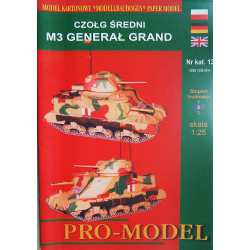


Publisher/ Manufacturer: "Model-Hobby". Poland
Scale: 1 : 25
Number of sheets: 12 x A4
Number of sheets with details: 8 1/4
Number of assembly drawings: 36
Difficulty: For medium and experienced modelers.
Model dimensions: 157.5 mm x 89 mm x 69.5 mm
 Security policy
(edit with the Customer Reassurance module)
 Delivery policy
(edit with the Customer Reassurance module)
 Return policy
(edit with the Customer Reassurance module)
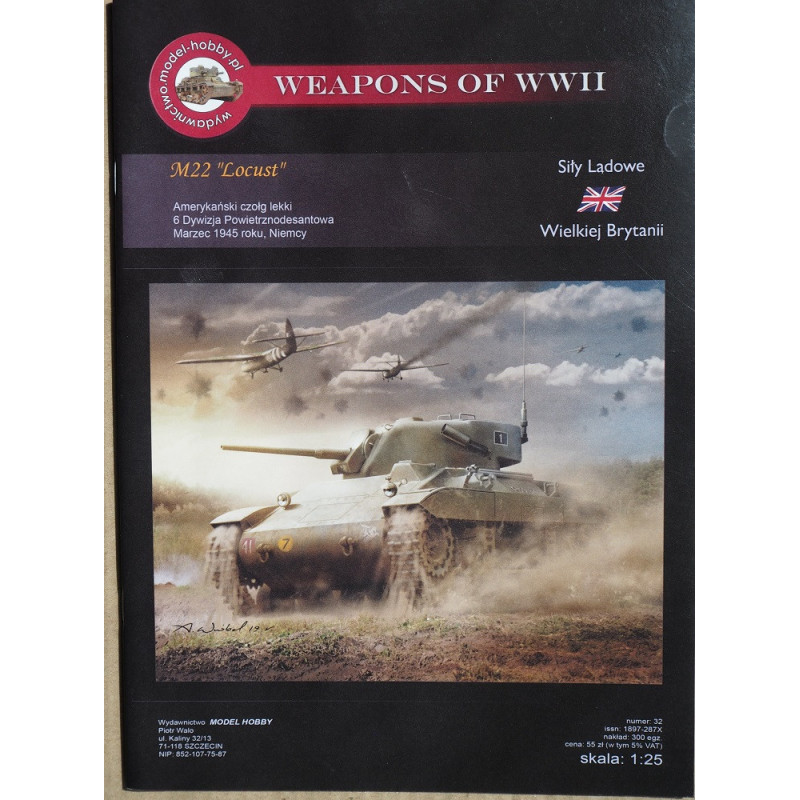
M22 “Locust” – American light tank of the Second World War. The first prototypes were produced in 1941, serial production in 1942–1944, 830 of these tanks were produced. M22 “Locust” was powered by a single carburetor engine “Lycoming” 0-435T, developing 162 h. p. power, armed with one 37 mm M6 cannon in the turret and 1 “Browning’ 1919 7.62 mm machine gun. In May 1941 the US airborne forces ordered a new tank for their troops. As a result of this order, the light tank M22 "Locust" was built. The new tank was supposed to be light, therefore poorly armored, have a crew of three people and be armed only with a light 37 mm cannon. Despite many months of testing and introduction into serial production, the M22 "Locust" did not fully meet the requirements for it. First of all, the American airborne forces did not have either an airplane or a glider, capable of transporting the new tank, and its loading, unloading and preparation for combat after transportation by C47 aircraft took more, than three hours! As a result, the M22 was never used in combat by the US army. However, it was included in the "Lend-Lease" program to Great Britain, which had more powerful gliders and in March 1945 used the M22 "Locust" in Operation "Varsity". After 1945 some of the tanks were transferred to Egypt, which in turn used them in the war with Israel in 1948-1949.
A small and well-designed model of a small tank, richly detailed, but without internal equipment. Although it looks simple, it is not - the complexity lies in the chassis (as, by the way, in all tracked "creatures"). Perhaps the chassis of this tank is not comparable to the chassis of German tanks, but for inexperienced modelers it is difficult to bite. The model recreates the vehicle of the British 6th Airborne Division from the fighting in Germany in March 1945. There are no reserves of colors, where necessary, the details are printed double-sided. The textual instructions in Polish are not very large, but quite a good complement to the excellent graphical instructions, which are informative, detailed and easy to read.

Publisher/ Manufacturer: "Model-Hobby". Poland
Scale: 1 : 25
Number of sheets: 12 x A4
Number of sheets with details: 8 1/4
Number of assembly drawings: 36
Difficulty: For medium and experienced modelers.
Model dimensions: 157.5 mm x 89 mm x 69.5 mm