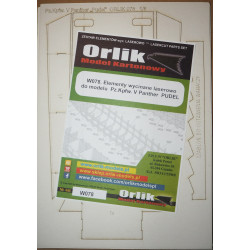
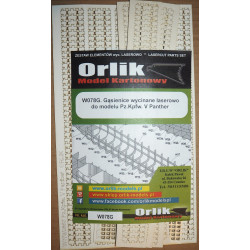
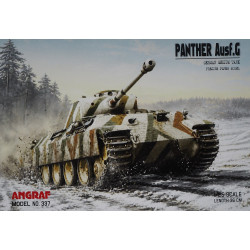
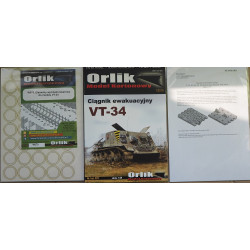
Publisher/ Manufacturer: "Orlik". Poland
Scale: 1 : 25
Number of sheets: 26 x A4
Number of sheets with parts: 21 1/3
Number of assembly drawings: 83
Difficulty level: For medium experienced and experienced modelers.
Dimensions of the model: 363,5 mm x 136 mm x 120 mm
 Security policy
(edit with the Customer Reassurance module)
 Delivery policy
(edit with the Customer Reassurance module)
 Return policy
(edit with the Customer Reassurance module)
Pz. Kpfw. V (Sd. Kfz 171) "Panther" - German heavy tank, considered one of the best tanks of World War II. This combat vehicle was a response to the Soviet T-34. The first serial versions appeared in 1942, but the "Panther" first appeared on the front lines in the summer of 1943 at the Battle of Kursk. Due to a very high number of failures and numerous structural problems of the "infantile" machine, 150 out of 204 combat units were lost. However, it is interesting, that only a few of these 150 tanks were lost due to the effects of anti-tank guns and artillery of the Soviet troops. After eliminating these shortcomings, the "Panther" became famous as an extremely effective tank. This was due to the good shape of the frontal armor and the excellent KwK 42 / L70 cal 75mm gun. The basic version of the T34/76 had no chance against the "Panther". Only the appearance of the T34/85 and IS-2 tanks changed this situation. In turn, the Allied „Sherman“ tanks could compete with the „Panther“ only when armed with a 17-pounder gun (Sherman „Firefly“). Nevertheless, it should not be forgotten, that the Achilles heel of this successful construction was the weak side armor and the high technical complexity of the entire design, and hence the long production time. During the entire war, about 6,000 „Panther“ units of all versions (Ausf. D, A, G) were produced. The first mass-produced version was the "D" version with 80 mm thick frontal armor and a „Maybach „230 P30 engine developing 700 h. p. From the second half of 1943 armored screens were installed on tanks of this version. The „Panther“ Ausf G. was launched in September 1943. Its hull was equipped with a spherical mount for the MG-34 machine gun. This version was produced until March 1944 and was the most mass-produced version of the „Panther“. Over 3,700 tanks of this model were produced. In this version, the angle of installation of the frontal armor and its thickness were increased. The shape of the gun mounting “mask” was also changed. The tank destroyer “Jagdpanther” (Sd. Kfz. 179) was produced on the „Panther“ chassis. When evaluating the Pz. Kpfw. V, one should remember not only the excellent frontal armor or the excellent gun, but also pay attention to the shortcomings of the weapon - large dimensions, complex suspension and chassis, increasingly deteriorating armor quality, which arose due to the lack of armor steel (Germany was seriously lacking molybdenum in the final stages of the war) or too thin side armor. During the Warsaw Uprising, the insurgents captured two „Panther“ tanks, one of which was named „Pudel“ (the model presented in the publication reproduces it). It was captured on August 3, 1944, and destroyed on August 11.
A rather complex, well-designed and excellently externally detailed model without internal equipment for medium-experienced and experienced modelers. There is a large supply of colors, the graphic instructions are excellent, the textual instructions are quite large, but only basic notes about the most difficult places.

You might also like
Publisher/ Manufacturer: "Orlik". Poland
Scale: 1 : 25
Number of sheets: 26 x A4
Number of sheets with parts: 21 1/3
Number of assembly drawings: 83
Difficulty level: For medium experienced and experienced modelers.
Dimensions of the model: 363,5 mm x 136 mm x 120 mm