- New
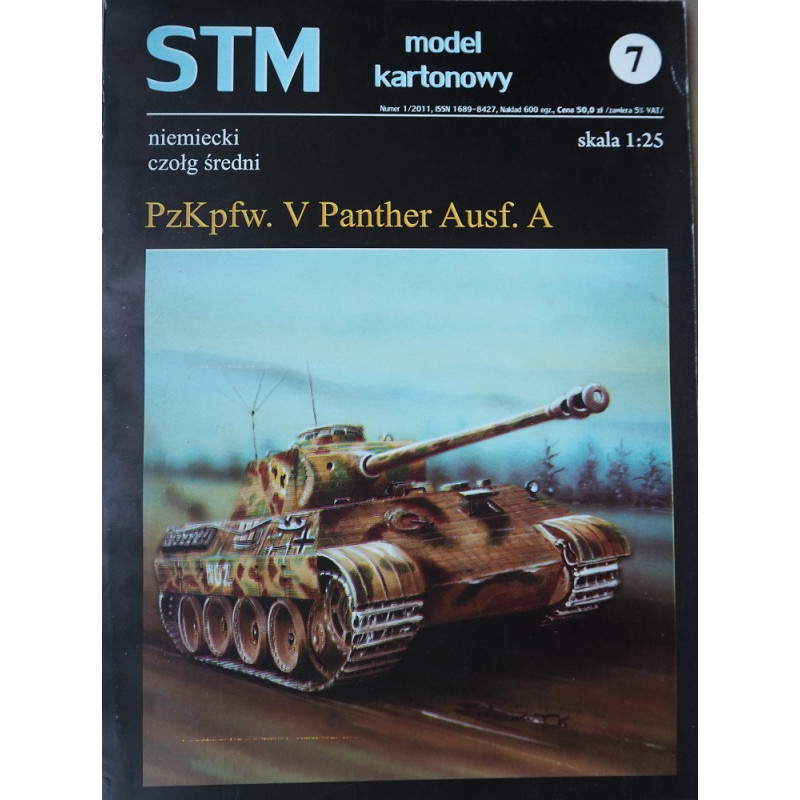


Publisher/ Manufacturer: "Answer” – “STM”. Poland
Scale: 1 : 25
Number of sheets: 27 x B4
Number of sheets with details: 20 1/2
Number of assembly drawings: 67
Difficulty: For medium and experienced modelers.
Model dimensions: 346.5 mm x 131 mm x 119.5 mm
 Security policy
(edit with the Customer Reassurance module)
 Delivery policy
(edit with the Customer Reassurance module)
 Return policy
(edit with the Customer Reassurance module)
The Pz. Kpfw. V “Panther” tanks were put into service in 1943 as a response to the Soviet T-34 tanks. The German tank had a more powerful gun and thicker armor. During its baptism of fire in the Battle of Kursk, the “Panther” Ausf. A suffered greatly, because it had a number of technical shortcomings. In this battle 150 of the 204 tanks of this type were lost. Most of these losses were due to engine or chassis failures. The “Panther's” good feature was its thick, high-quality armor - only a few tanks were destroyed by artillery fire, and not a single hit to the frontal plates was of such a nature, that it had serious consequences. After eliminating the factory flaws, the “Panther” became a formidable opponent for Allied tanks. Only when the USSR began to use heavy IS-2 tanks in its armored forces, and artillery - more powerful anti-tank guns, did the situation level out. The “Panthers” were significantly more advanced, than the T-34/76 and the “Sherman”, but they also had disadvantages in this comparison. The “Panther” weighed 45 tons, i.e. one and a half times more, than the T-34 and the “Sherman”, which weighed about 32 tons. It can be argued, that the Pz. Kpfw. V was to be considered a heavy tank. Very thick armor and a more powerful gun gave the “Panther” an advantage in duels with enemy medium tanks. A very important drawback of this monster was the high cost of production and the time it took to produce it. As a result, only about 6 thousand “Panthers” were produced by the end of the war, while the T-34 and “Sherman”, taken together, produced about 100 thousand. Three versions of this tank were produced: A, D and G. Version F did not go beyond test exemplars, the most numerous version produced was G.
A large, complex, well-designed and almost maximally detailed model, which will suit only medium-experienced and experienced modelers. The model does not have an engine, fighting compartment detailing, it perfectly recreates the hull, chassis, its suspension, all external details and other equipment. The model is painted in the "fresh" camouflage, used by the German Wehrmacht armored units in the Battle of Kursk. There is a small supply of colors. The tracks can be assembled both: as strips and as from individual tracks. The textual instruction in Polish is not very extensive, explaining only the most complex stages of assembling the model, and it perfectly complement the large, informative and easy-to-read graphical instruction.

You might also like
Publisher/ Manufacturer: "Answer” – “STM”. Poland
Scale: 1 : 25
Number of sheets: 27 x B4
Number of sheets with details: 20 1/2
Number of assembly drawings: 67
Difficulty: For medium and experienced modelers.
Model dimensions: 346.5 mm x 131 mm x 119.5 mm