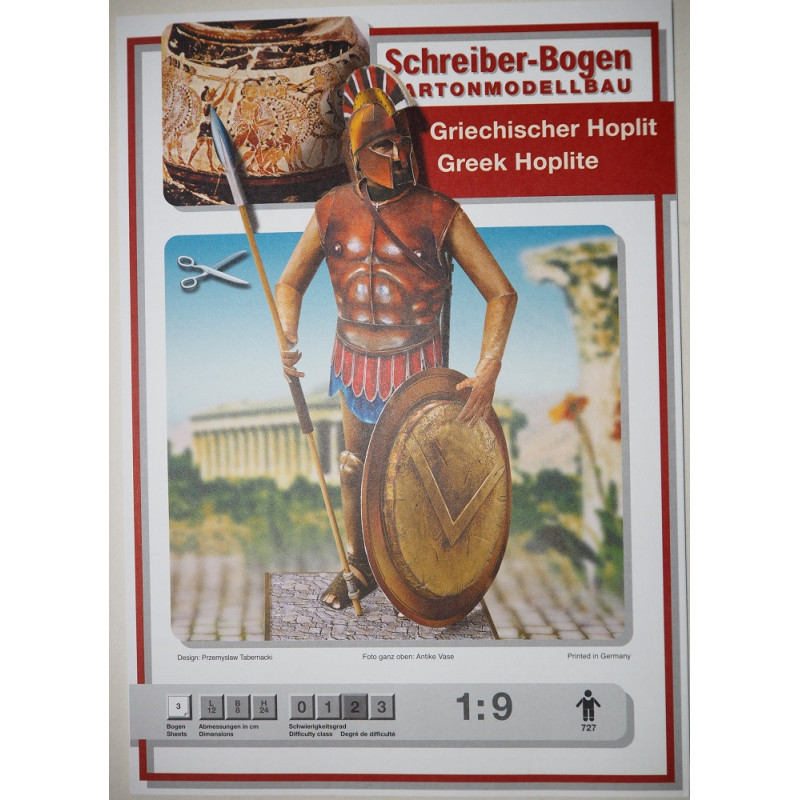


Publisher/ manufacturer: "Schreiber-Boggen". Germany
Scale: 1 : 9
Number of sheets: 7 x B4 (1 sheet of 1 mm cardboard)
Number of pages with details: 4
Number of assembly drawings: 16
Difficulty: For modelers of all experience.
Model dimensions: 120 mm x 80 mm x 240 mm
 Security policy
(edit with the Customer Reassurance module)
 Delivery policy
(edit with the Customer Reassurance module)
 Return policy
(edit with the Customer Reassurance module)
The Greek hoplite has a full set of armor and a wooden shield, studded with metal parts. He was armed with a spear and a short sword, which was used, when the spear broke. The warrior defended himself with a round wooden shield with a bronze frame. Some shields were completely covered with bronze. Most often, the shield was decorated with a family coat of arms or other personal sign of the owner. In Sparta, and later in other cities, uniform shield signs began to be used. As a chest protection, the hoplite wore armor, made of brass. The cuffs were made of bronze. Due to the use of several metals, the hoplite's equipment was quite expensive. Therefore, hoplites from the poorer classes abandoned some parts of the armor or made them from lighter materials. In ancient Greece, military conflicts between individual city-states (poles) occurred almost every year. The reasons for this were very diverse. Often, the newly elected government was concerned about honor and political recognition. The leading politicians were also military leaders. Every male citizen of the city was also a soldier and, when war broke out, had to be called up for service. Military duties corresponded to social status, as each citizen had to pay for his own equipment. In addition to armor and weapons, nobles could also afford horses and thus gain higher military positions. The nobility also usually financed wars. The very outcome of the battle was usually decided by ordinary infantry in hand-to-hand combat. As the non-noble population grew economically, warfare also changed. In the 5th century BC, land combat was no longer man-to-man, but in phalanxes. A phalanx consisted of several rows of soldiers, standing in formation and forming a wall of shields. The soldiers of the phalanx were called hoplites.
This model recreates the appearance of an ancient Greek hoplite (spearman). The model is well designed and well detailed, but not complicated. With the advice of a more experienced colleague, it will be perfectly glued even by a beginner, and the modelers with little experience. You can choose one of two versions of the warrior's face and one of two shield options. There is 1 sheet of cardboard (1 mm thick) for gluing the details.

Publisher/ manufacturer: "Schreiber-Boggen". Germany
Scale: 1 : 9
Number of sheets: 7 x B4 (1 sheet of 1 mm cardboard)
Number of pages with details: 4
Number of assembly drawings: 16
Difficulty: For modelers of all experience.
Model dimensions: 120 mm x 80 mm x 240 mm