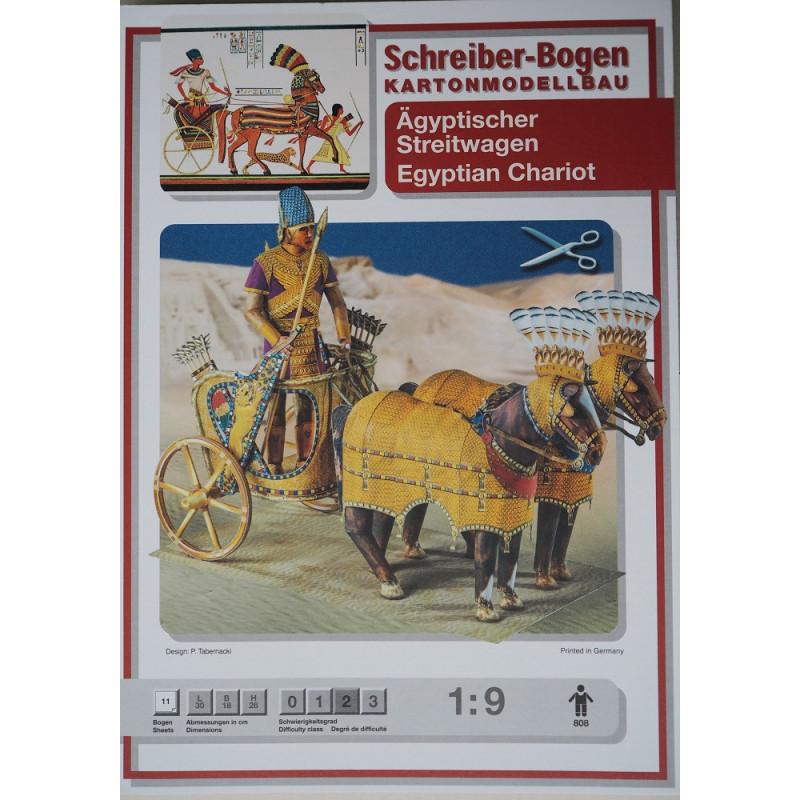


Publisher/ manufacturer: "Schreiber-Boggen". Germany
Scale: 1 : 9
Number of sheets: 30 x B4 (8 sheets of 1 mm cardboard)
Number of pages with details: 16 1/4
Number of assembly drawings: 38
Difficulty: For intermediate and experienced modelers.
Model dimensions: 300 mm x 180 mm x 260 mm
 Security policy
(edit with the Customer Reassurance module)
 Delivery policy
(edit with the Customer Reassurance module)
 Return policy
(edit with the Customer Reassurance module)
In ancient times, chariots were single-axle military vehicles, pulled by horses. They were usually two-wheeled with a simple yoke to which horses were harnessed. The platform was D-shaped, with railings on the sides and front. Chariots were usually richly decorated. Entry was through an open back. The chariot was built so light, that it could be carried by one person. From the Hittites and Hyksos, a group of foreign kings, the Egyptians adopted many weapons technologies, probably including chariots. As a great power, Egypt could afford to acquire and maintain such means of transport and combat. Maintenance required specialized knowledge and a lot of effort. In addition, horses had to be kept in large herds, which had not existed in Egypt before. This meant, that proper housing, care and training of the animals were necessary. Training of charioteers and horse riders was also very expensive. Fighters in chariots were usually archers. The chariots were covered with shields and armed with peculiar weapons - clubs, axes or throwing spears. The chariot corps of the Egyptian army was an elite force. They were divided into squadrons of 25 chariots. Several squadrons formed a regiment. Many chariot regiments rode in battle on the flanks of the infantry, while others were ready behind the front as a reserve. During an attack, several hundred chariots rode close to each other. This gave them greater impact and affected the enemy psychologically. The reserve was responsible for pursuing the enemy. Pharaohs always rode into battle in chariots. It is not known, whether they rode in the forefront, along with the army, or remained in the background. Reliefs from Egyptian tombs and temples, dating back about 3,600 years, show pharaohs and warriors, proudly riding into battle in horse-drawn chariots. However, these fighting vehicles were not only popular in the Egyptian army. Anyone, who was even slightly important, bought one or more chariots as objects of prestige. People at that time admired the latest technologies, practicality and comfort. Chariots could reach speeds of 40 kilometers per hour. In ancient times, such speeds were unimaginable. Of course, the enthusiasm for these vehicles was also great among kings and pharaohs. Queen Nefertiti is depicted in a relief with her chariot. During archeological excavations, huge stables, dating back to the time of Ramses II, were discovered. Several chariots were found in the burial chambers of Tutankhamun as funerary objects.
A large, rather complex, well-designed and richly detailed figurine for intermediate and experienced modelers. There are enough details, that even they will have a place to demonstrate all their skills, but the final result will repay all the effort and time, spent gluing it. There is no color stock, and it wouldn't really help here - the figure is quite colorful. The text instructions are quite extensive and detailed in German and English, the graphic ones are also large and quite clearly illustrate the entire process of assembling the figure.

Publisher/ manufacturer: "Schreiber-Boggen". Germany
Scale: 1 : 9
Number of sheets: 30 x B4 (8 sheets of 1 mm cardboard)
Number of pages with details: 16 1/4
Number of assembly drawings: 38
Difficulty: For intermediate and experienced modelers.
Model dimensions: 300 mm x 180 mm x 260 mm