
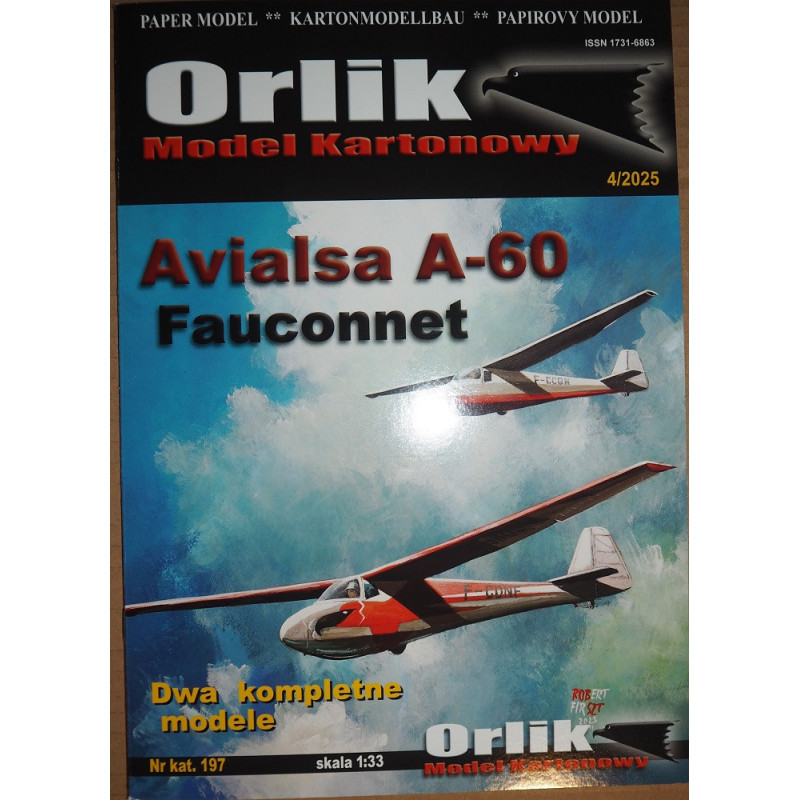


Publisher/ Manufacturer: "Orlik". Poland
Scale: 1 : 33
Number of sheets: 6 x A4
Number of sheets with parts: 3
Number of assembly drawings: 22
Difficulty level: For modelers of any experience.
Dimensions of the model: 192,5 mm x 454,5 mm x 55 mm
 Security policy
(edit with the Customer Reassurance module)
 Delivery policy
(edit with the Customer Reassurance module)
 Return policy
(edit with the Customer Reassurance module)
The Scheibe “Spatz” (German for "Sparrow") was a German glider of mixed metal and wood construction, that was produced from 1952 to 1962. Later versions were known as the "L-Spatz", the letter L standing for "Leistung", which is German for "performance". “Scheibe Flugzeugbau” produced the “Spatz A” in 1952. Two years later, in 1954, the first “L-Spatz” 55 flew. Three hundred “L-Spatz” 55s were built in Germany, 155 in France - there designated Avialsa A.60 "Fauconnet", and 16 in Italy - designated Meteor MS-30 L "Passero"; production ended in 1962. It is a single-seat glider with a high-slung cantilever wing, with a cruising speed (maximum L/D) of 45 mph. The empty aircraft weighed 157 kg; the maximum take-off weight was 269 kg. The wing and tail were made of fabric-covered wood, and the fuselage was made of fabric-covered steel tubes. The “L-Spatz” 55 has good climbing characteristics due to its lightweight construction. The glide ratio is 29:1. The longest known cross-country flight was over 600 km from Burg Feuerstein, Germany, to France. Many gliding clubs used the “L-Spatz” 55, which was well known for its easy handling, including easy recovery from a spin.
The details of two simple, small models are included in this publication. The models are well designed and richly detailed for a glider, but remain easy to assemble and will be perfect even for novice modelers, who have assembled several simpler models before. The models reproduce the appearance of the French production gliders with the markings F-CDNF and F-CCQN. The graphic instructions are quite large and clear, easy to read, the textual is small and only general notes. The details on the sheets are printed with a dark gray background for the entire sheet, since most of the details are white. The color reserve is small, but sufficient for such small models.

Publisher/ Manufacturer: "Orlik". Poland
Scale: 1 : 33
Number of sheets: 6 x A4
Number of sheets with parts: 3
Number of assembly drawings: 22
Difficulty level: For modelers of any experience.
Dimensions of the model: 192,5 mm x 454,5 mm x 55 mm


