- New
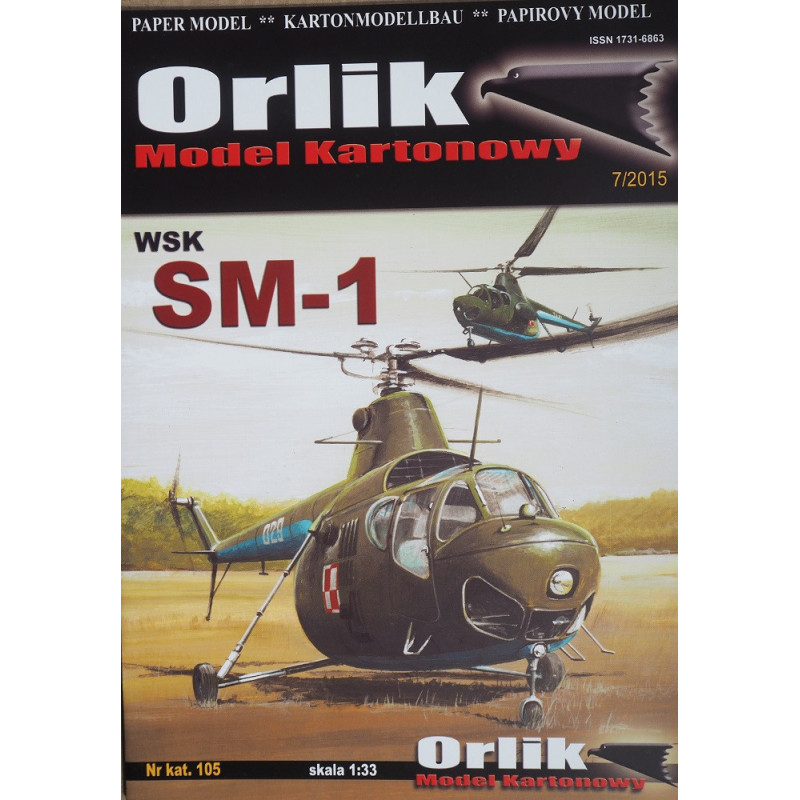


Publisher/ Manufacturer: "Orlik". Poland
Scale: 1 : 33
Number of sheets: 10 x A4
Number of sheets with details: 6
Number of assembly drawings: 26
Difficulty: For modelers of any experience.
Model dimensions: 515 mm x 43.5 mm x 100 mm
 Security policy
(edit with the Customer Reassurance module)
 Delivery policy
(edit with the Customer Reassurance module)
 Return policy
(edit with the Customer Reassurance module)
WSK SM-1- Polish light multi-purpose helicopter from the Cold War period. The prototype's first flight took place in 1956, and soon after that WSK Świdnik began serial production. The helicopter was equipped with a 575 h. p Lit-3 engine. The WSK SM-1 helicopter was a licensed version of the Soviet Mil Mi-1 machine, the documentation for which was submitted to the Polish PR side in 1954 or 1955. Initially, the WSK SM-1 machines were manufactured from parts and assemblies, manufactured in the USSR, but quite quickly, from 1957, they were assembled from parts, manufactured in the Polish People Republic. During production, several versions of the helicopter were created, including: SM-1/600 (basic, connecting version), SM-1D (version with a winch, the carrying capacity of which reached up to 120 kg), SM-1S (sanitary version) and SM-1Ż (agricultural helicopter). Also in 1960, the SM-1W version was created with an enlarged cabin and new navigation devices. Production of SM-1 helicopters ceased in 1965, after 1594 units were produced. m.
A small and well-designed and richly detailed model of a small helicopter is quite simple. We can recommend it even to beginners and modelers with little experience, but they should work under the supervision of a more experienced colleague and simplify or even omit something. Of course, the model will not forgive haste and carelessness. The model perfectly recreates the fuselage, all visible exterior detailing, cabin and passenger compartment equipment, rotors, chassis. The color reserve is quite large - and not only the stripes in the middle of the sheets. The textual instruction in Polish is small and only covers the gluing of some nodes in general terms, the graphical instruction is quite extensive, consistent, informative and easy to read.

You might also like
Publisher/ Manufacturer: "Orlik". Poland
Scale: 1 : 33
Number of sheets: 10 x A4
Number of sheets with details: 6
Number of assembly drawings: 26
Difficulty: For modelers of any experience.
Model dimensions: 515 mm x 43.5 mm x 100 mm