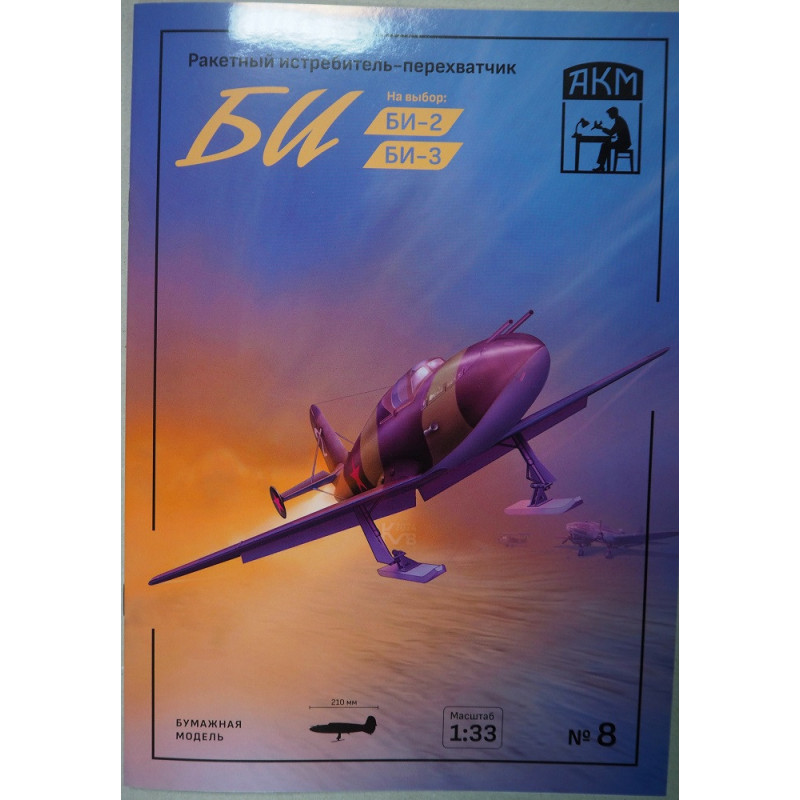


Publisher/ manufacturer: "AKM". Russia
Scale: 1 : 33
Number of sheets: 8 x A4
Number of sheets with parts: 3
Number of assembly drawings: 44
Difficulty level: For modelers of any experience
Dimensions of the model: 210,5 mm x 200,5 mm x 76 mm
 Security policy
(edit with the Customer Reassurance module)
 Delivery policy
(edit with the Customer Reassurance module)
 Return policy
(edit with the Customer Reassurance module)
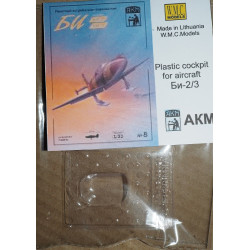
BI (from Berezniak-Isaev) - Soviet experimental interceptor-rocket plane, created by designers Alexander Yakovlevich Berezniak and Alexei Mikhailovich Isaev in the design bureau of the 293rd plant in Khimki. The idea of creating a rocket fighter-interceptor arose for Berezniak after getting acquainted with the rocket engine, designed by Leonid Dushkin. At the beginning of the 1940s, radar stations were still being developed, and bombers were mainly detected visually, so it was necessary to react in the shortest possible time. Therefore, the concept of a fighter, that could instantly take off and attack approaching bombers in the shortest possible time, seemed very attractive not only to Soviet designers - a similar concept existed in Germany. The outbreak of World War II forced the USSR leadership to accelerate this project and by September 1941 BI-1 was used for glider tests, and on May 15, 1942, the aircraft took off for the first time with a rocket engine. The flight lasted 3 minutes 9 seconds, the liquid-fuel rocket engine worked for 60 seconds, and an altitude of 840 meters was reached, the maximum speed was 400 km/h, and the maximum climb rate was 23 m/s. The task of the flight on March 27, 1943 (the seventh in a row, the sixth in 1943) was different from the previous ones. If earlier the aircraft was tested for maximum altitude and climb rate, now it was necessary to test the maximum flight speed. From the point of view of observers from the ground, the flight went according to plan until the moment the engine was turned off, but then the aircraft began to dive and, without making any attempts to recover from the dive, hit the ground. The test pilot Grigoriy Bachchivanji was killed. After the death of G. Y. Bachchivanji, the unfinished 30-40 BI-VS aircraft were destroyed, but work on this topic continued for some time.
A very interesting model of a rocket fighter. The cockpit is well detailed, separate control surfaces and faint traces of exploitation. There is a color reserve. You can glue one of the two models from the magazine: 1. The second prototype (BI-2), on which four flights were made: three by the pilot G. Ya. Bachchivanji and one by the test pilot K. A. Gruzdev. Airfield of the Military Air Force Research Institute near the city of Koltsovo (80 km from Bilimbay and Pervouralsk). January 1943. 2. The third prototype (BI-3), on which the sixth and seventh flights were made by the pilot G. Ya. Bachchivanji. The plane crashed on March 27, 1943 during the seventh test flight. There are details printed double-sided. There are no text instructions, the graphic ones are large and informative.

You might also like
Publisher/ manufacturer: "AKM". Russia
Scale: 1 : 33
Number of sheets: 8 x A4
Number of sheets with parts: 3
Number of assembly drawings: 44
Difficulty level: For modelers of any experience
Dimensions of the model: 210,5 mm x 200,5 mm x 76 mm