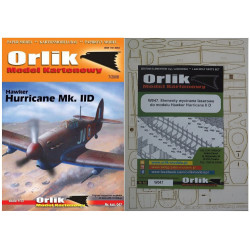
Publisher/ Manufacturer: “Orlik”. Poland
Scale: 1 : 33
Number of sheets: 14 x A3
Number of detail sheets: 11
Number of assembly drawings: 66
Difficulty: For average experience and experienced modelers
Model dimensions: 464 mm x 609,5 mm x 84,5 mm
 Security policy
(edit with the Customer Reassurance module)
 Delivery policy
(edit with the Customer Reassurance module)
 Return policy
(edit with the Customer Reassurance module)
The Northrop P-61 was a three-seat, twin-engined night fighter with a twin-fuselage construction, a mid-mounted wing, and retractable landing gear, adapted to operate from land bases. The prototype first flew in May 1942. The aircraft was of all-metal construction, initially made of magnesium alloys, later of duralumin. The semi-monocoque fuselages were reinforced with a metal frame. The crew cabin, located in a gondola, located in the middle of the wing, housed three crew members. The pilot sat in the forward part, behind him - the on-board gunner and finally the radar operator. In versions without a turret, the radar operator was moved to the gunner's cabin, and an additional seat was located in the rear. The entire cabin was armored. The P-61 was equipped with SCR-720 radar, with a range of 10 km, it was located in the forward part of the fuselage and was connected to an IFF device for identification of friendly and hostile aircraft. Radar readings were received by a radar operator, who sat in a cockpit at the rear of the gondola. Armament consisted of four 12.7 mm machine guns, mounted in a remotely controlled turret, which not all versions of the fighter had, and four 20 mm cannons, mounted in the fuselage. Each crew member had a sight, which the pilot used in typical fighter attacks, when the enemy's direction of flight coincided with his own plane's flight. In other cases, fire was controlled by the onboard gunner, who was also the gunner's turret operator. If it was necessary to defend against an attack from the rear, the gunner's duties and control of the gunner's turret were taken over by the radar operator. In addition, some machines, mainly operating in Europe, carried out strike missions with bombs, unguided rockets or napalm charges.
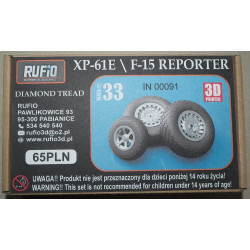
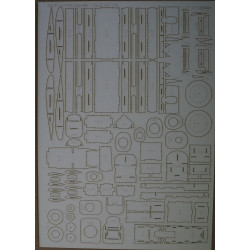
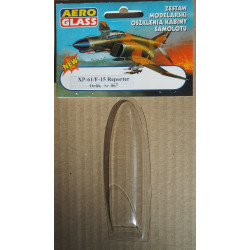
A complex, perfectly designed and maximally detailed (visible engine parts, complete detailization of the chassis, their niches, cockpit interior, armament, exterior detailing) model of a night fighter for only medium-experienced and experienced modelers. Excellent print quality, "metal" cladding details printed with "metal" paints. There is no color stock, the textual instruction is large and detailed, the graphic one is exemplary. You can glue the prototype XP-61E or the F-15 "Reporter" night fighter model optionally. Only offset-printed metal cladding details are not as realistic, as those printed on calk paper.

You might also like
Publisher/ Manufacturer: “Orlik”. Poland
Scale: 1 : 33
Number of sheets: 14 x A3
Number of detail sheets: 11
Number of assembly drawings: 66
Difficulty: For average experience and experienced modelers
Model dimensions: 464 mm x 609,5 mm x 84,5 mm