- New
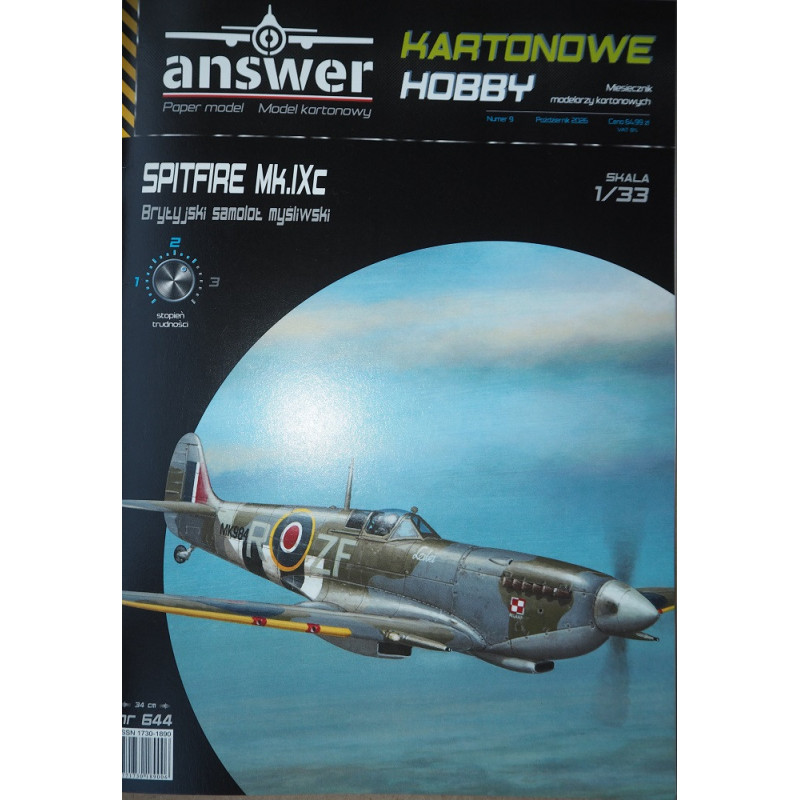


Publisher/ Manufacturer: "Answer" – "Kartonowe Hobby". Poland
Scale: 1 : 33
Number of sheets: 8 x B4
Number of sheets with details: 5
Number of assembly drawings: 20
Difficulty: For intermediate and advanced modelers.
Model dimensions: 276 mm x 340 mm x 105 mm
 Security policy
(edit with the Customer Reassurance module)
 Delivery policy
(edit with the Customer Reassurance module)
 Return policy
(edit with the Customer Reassurance module)
Vickers Supermarine “Spitfire” – the British single-seat fighter aircraft, designed and manufactured at the “Vickers Supermarine” factory in Southampton, England. It was very adaptable to development and, changing versions, served throughout the Second World War. These fighters became one of the most famous combat aircraft, used in World War II, often fought by Polish pilots. The “Spitfire” was designed by the famous engineer Reginald Joseph Mitchell, who was the designer of the famous record-breaking seaplanes of the 1930s. In 1931 the Ministry of Aviation issued a requirement No. F7/30 for the construction of a new fighter. In response, “Vickers Supermarine” created a machine, designated Type 224. It was an all-metal low-wing monoplane with a non-retractable landing gear. It was equipped with the most powerful Rolls Royce “Goshawk” engine at the time with a condensation cooling system on the wings, which caused a number of problems. The aircraft's characteristics were not better, than those of its competitors. In 1935 it was given the name “Spitfire”. Then the competition was won and serial production began the Gloster “Gladiator”. Work began in the summer of 1934 to improve the aircraft's performance, and the prototype was designated Typ 300. A new PV12 engine, later known as the “Merlin”, was installed, along with retractable landing gear, a thinner elliptical wing, a covered cockpit, and a load-bearing cladding. Based on this design, the Ministry of Aviation issued new requirements Nos. F37/34 and F10/35. The cooling system of the 1935 design was still the same as that of its predecessor, but was later changed to a system with a radiator. The Focke-Wulff FW-190, which appeared in August 1941, surpassed the “Spitfire” Mk.V in combat performance, and RAF losses increased so much, that most operations over continental Europe were suspended in November 1941. A similar situation prevailed in March 1942, when flights resumed, but already had equipment, that could withstand German fighters. Although the introduction of the Mk. VII and Mk. VIII versions into serial production required not only the changes in machine construction, but also the restructuring of the production lines, it was decided to look for a quick solution. It was decided to install the same engine, that was intended for the Mk. VII and Mk. VIII versions, in the Mk. V glider with as few changes as possible. The two Mk. Vc gliders were equipped with the “Merlin” 61 engine with a 4-blade propeller and a reinforced engine mounting frame. The changes had such a great effect on the aircraft's characteristics, that it was decided to immediately begin serial production. The new “Spitfire” surpassed the Mk. V by 64 km/h, climbed to 1219 meters in 1 minute, and the ceiling increased from 11,034 to 13,106 m. Production began at full speed in June 1942 and the machines had already reached combat units the following month. Together with the very similar version Mk. XVI, 7180 fighters of this type were produced. Comparisons with the captured FW-190s showed, that they were equal opponents. In the spring of 1943 the new “Merlin” 63, 66 and 70 engines were installed on the Mr. IX, with which the fighter began to surpass the combat characteristics of its main opponent, and the further it went, the more powerful the armament was installed on these fighters.
A complex, well-designed and excellently detailed model, which will suit only medium-experienced and experienced modelers. The rather complex fuselage and wing shapes make it almost inaccessible to advanced beginners and modelers with little experience. The fuselage, cockpit, landing gear, its niches, all the remaining external detailing are perfectly detailed. Nice standard RAF camouflage with light signs of use. There are no color reserves. The textual instruction in Polish is small, but quite detailed and clearly explain the entire assembly process of the model. It perfectly complement the informative and easy-to-read graphical instruction, which is of medium size, but sufficient for good assembly of the model.

You might also like
Publisher/ Manufacturer: "Answer" – "Kartonowe Hobby". Poland
Scale: 1 : 33
Number of sheets: 8 x B4
Number of sheets with details: 5
Number of assembly drawings: 20
Difficulty: For intermediate and advanced modelers.
Model dimensions: 276 mm x 340 mm x 105 mm