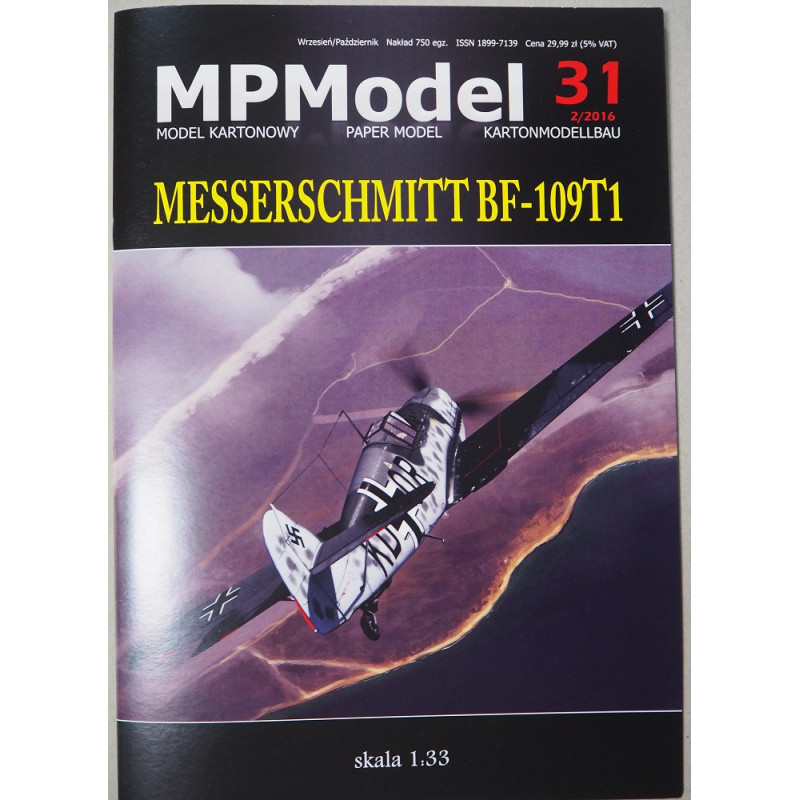


Publisher/ manufacturer: “MP Model". Poland
Scale: 1 : 33
Number of sheets: 8 x A4
Number of sheets with parts: 3 1/3
Number of assembly drawings: 14
Difficulty level: For any experience modellers.
Dimensions of the model: 265 mm x 335,5 mm x 75,5 mm
 Security policy
(edit with the Customer Reassurance module)
 Delivery policy
(edit with the Customer Reassurance module)
 Return policy
(edit with the Customer Reassurance module)
Before the war, the Kriegsmarine had been interested in the idea of an aircraft carrier. Borrowing ideas from the British and Japanese (mainly "Akagi"), they began construction of "Graf Zeppelin" as part of the reconstruction of the navy. The carrier's air group was to consist of Messerschmitt Bf 109T fighters and Ju 87C dive bombers. The suffix "T" is German for "Träger" (aircraft carrier). Despite references to a Bf 109 T-0 version, this version never existed. The aircraft of the seven previous versions (Bf 109 B, Bf 109 C, Bf 109 E) were converted into experimental carrier-based fighters. They were equipped with a tail hook, catapult mountings, an increased wingspan of 11.08 m, increased aileron length, flap length, flap stroke. The wing was not modified to be fold-able, since the "Graf Zeppelin" was designed for the intended aircraft types, so the lifting devices were adapted to the Bf 109T with a wingspan of 11 m. However, as with every version of the Bf 109, the wing could be dismantled for transportation purposes. After flight tests, especially catapult launches at the "Fieseler" factory in Kassel, 70 T-1s with DB601N were to be produced, but after seven T-1s were built, the aircraft carrier project was canceled. The remaining 63 of the 70 T-1s were built as T-2s without the carrier-specific equipment, and some T-1s could be converted to T-2 standard. The T-2 was found to have very similar characteristics to the E-4/N, and due to its ability to take off and land in shorter distances, these fighters were assigned to I/JG.77, stationed in Norway on short and often cross-winded landing strips. In late 1941, the unit was ordered back to Germany and replaced by E-3s. The Bf 109T's armament consisted of two 7.92 mm MG 17s above the engine and one 20 mm MG FF/M cannon in each wing. Interest in the "Graf Zeppelin" revived as the value of aircraft carriers became apparent, and in 1942 the ship was again in building at the shipyard in the hope of being completed. By then, the Bf 109T was hopelessly outdated and a new fighter was needed. Messerschmitt responded by updating the Me 155A series, but work on the ship was again halted, and the Me 155 was later adapted as a high-altitude interceptor fighter. Design work was transferred to "Blohm & Voss", and the aircraft was designated the BV 155. In 1943, the Bf 109T was transferred to several training units. In April 1943, the "Jagdstaffel Helgoland" was formed, which was based at Dune until the end of 1943, when the unit was transferred to Lista in southern Norway. From 30 November 1943, the unit was renamed 11./JG 11, and the Bf 109T was in service until the summer of 1944, after which some were used in training units in Germany.
A small, not very complicated, well-designed and moderately detailed aircraft model in standard German camouflage. The model is suitable for modelers of any experience, only beginners and modelers with little experience are recommended to work under the supervision of a more experienced colleague and make the cockpit equipment, the released landing gear, the transparent cockpit canopy as a test: if it works - HURACH!!! - we make the full version, if it doesn't work - ... The graphic instructions are small, but quite informative and well-readable, the textual in Polish is also not very large, but informative, perfectly complementing the graphic ones. There are no color reserves, but, let's hope, they will not be needed.

You might also like
Publisher/ manufacturer: “MP Model". Poland
Scale: 1 : 33
Number of sheets: 8 x A4
Number of sheets with parts: 3 1/3
Number of assembly drawings: 14
Difficulty level: For any experience modellers.
Dimensions of the model: 265 mm x 335,5 mm x 75,5 mm