

Manufacturer/ Publisher: "GPM". Poland
Scale: 1 : 100
Number of sheets: 10 x A4
Number of laser-cut parts sheets: 4 x A4, 1 x 294 mm x 102 mm, 1 x 237 mm x 60 mm,
Number of laser-cut parts: 124
Cardboard thickness: 0.25; 0,5 and 1 mm
Number of sheets with parts: 4
Number of assembly drawings: 60
Difficulty: For any experience modelers.
Model dimensions: 439,5 mm x 49 mm x 126 mm
 Security policy
(edit with the Customer Reassurance module)
 Delivery policy
(edit with the Customer Reassurance module)
 Return policy
(edit with the Customer Reassurance module)
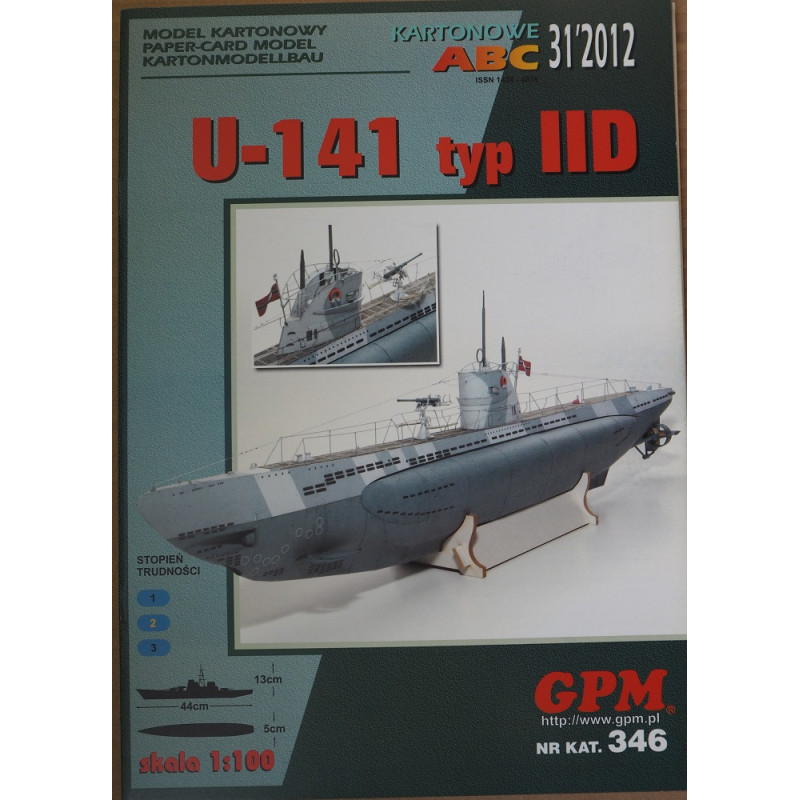
The Type II submarines (Einbaum - hollowed-out) were the first combat submarines, built by Germany after World War I. The first 12 ships of this class were built by 1935 in the very isolated parts of the “Germania” and “Deutsche Werke” AG shipyards in Kiel. They were modeled after the “Vesika”, a submarine, designed for Finland by the “Ingenieurkantoor voor Scheepsbouv den Hag” (I. V. S) and built at the “Chrichton-Vulkan” shipyard in Turku (1933). The first German Type II U-Boats were commissioned on 29 June 1935. Their construction was to provide experience for the construction of the later submarine fleet of the Third Reich. For the same reason, they were to become training and coast guard ships. These ships had three forward torpedo tubes and initially did not have a deck gun. As combat experience accumulated, it was decided to install a 20 mm caliber anti-aircraft gun on the ships. Due to the low power of the electric motors, they developed a low underwater speed. The relatively large difference between the surface and underwater displacements led to a low submergence speed. A serious drawback of the ships was the short operating range and cramped interior. These reasons limited the use of the ships only in the North Sea and the eastern and southern coasts of England. During the war, they were used in the invasion of Norway in 1940 and in the Black Sea against the USSR. To this sea, the submarines were transported by rail to Linz, and then sailed downstream along the Danube. Type IID submarines were built in 1939–1940 and 16 units were built (numbers U-137–U-152). U-141 entered service on August 21, 1940, made 4 combat voyages, sank 4 ships with a total tonnage of 6801 BRT. On May 2, 1945, it was removed from the fleet lists, when the crew scuttled it in Wilhelmshaven.
The model is not difficult to assemble, but it requires care and attention, and does not like to rush. Each detail must be carefully matched to the previously assembled one. Therefore, the model is more suitable for modelers with average experience and experienced, but, working under the supervision of a more experienced colleague and simplifying some details, this model can also be assembled by modelers with less experience. The publication is completed with laser-cut frame and thickening parts and laser-cut parts of decks and railings, which are cut from thick paper, colored gray in mass of the required thickness. There is a reserve of colors, the text instruction in Polish is quite large and will help You a lot during the assembly process, the graphic one is such, that every publication should have it.

Manufacturer/ Publisher: "GPM". Poland
Scale: 1 : 100
Number of sheets: 10 x A4
Number of laser-cut parts sheets: 4 x A4, 1 x 294 mm x 102 mm, 1 x 237 mm x 60 mm,
Number of laser-cut parts: 124
Cardboard thickness: 0.25; 0,5 and 1 mm
Number of sheets with parts: 4
Number of assembly drawings: 60
Difficulty: For any experience modelers.
Model dimensions: 439,5 mm x 49 mm x 126 mm