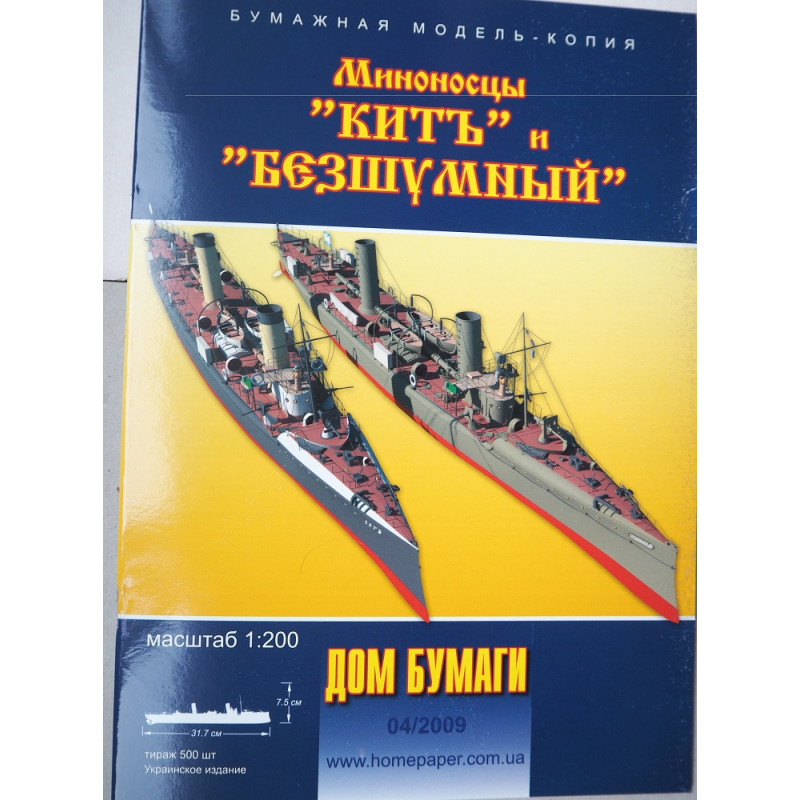


Publisher/ manufacturer: “Budynok Paperu". Ukraine
Scale: 1 : 200
Number of sheets: 12 x A4
Number of pages with details: 6 1/3
Number of assembly drawings: 34
Difficulty: For intermediate and advanced modelers
Model dimensions: 317,5 mm x 35 mm x 65 mm.
 Security policy
(edit with the Customer Reassurance module)
 Delivery policy
(edit with the Customer Reassurance module)
 Return policy
(edit with the Customer Reassurance module)
The "Kit"-class destroyers ("Kasatka" or "Bditelny" type) were ordered under the 1898 program "For the needs of the Far East". In total, 4 destroyers of this type were built in 1898–1900: "Delfin", "Kit", "Skat" and "Kasatka" (in 1902 they were renamed "Biezstrashny" ("Fearless"), "Bditielny" ("Attentive"), "Besposhchadny" ("Merciless") and "Besshumny" ("Noisy"), respectively). All ships were built abroad, at the "Friedrich Schichau" shipyard in Elbing. "Kit": The destroyer "Bditelny" (formerly "Kit") ran a mine during the Russo-Japanese War and exploded. The hull was severely damaged and the ship was towed to Port Arthur. Repair work was delayed due to lack of materials and mechanisms. On the night of January 2, 1905, it was blown up by the crew to prevent it from falling into the hands of the Japanese. "Biesshumny": after moving from Kronstadt to Port Arthur, it became part of the Baltic Fleet's Pacific Escadre. During the Russo-Japanese War, it participated in the defense of Port Arthur, performed patrol and guard duties, and provided support and cover for the fleet's minelaying and trawling operations. Since 1905 the ship was part of the Siberian Flotilla, and in May 1906 it arrived in Vladivostok from China. On October 10, 1907 the destroyer was reclassified as a squadron destroyer. In 1917, "Biesshumny" moved from Vladivostok to the Barents Sea. On October 22, 1917 it was included in the Arctic Ocean Flotilla. During the First World War it protected and escorted convoys, performed guard and patrol tasks. On November 8, 1917 the ship joined the Red Flotilla in the Arctic Ocean. In March 1918 it was captured by the White Guards and British interventionists in Murmansk. On February 21, 1920 the destroyer was recaptured by units of the Red Army, and in March 1920 it was included in the White Sea Flotilla. On April 24, 1920 the ship became part of the Northern Sea Fleet. On June 24, 1924 it was written off from the Red Army Navy and transferred to the "Komgosfond" for sale.
The publication contains parts for two complete models. They consist of many small parts and are perfectly designed. The assembly diagrams are drawn in 3D technology and are quite readable and informative. The text instructions in Russian are large and explain the entire gluing process in great detail. Although the model is intended for medium-experienced and experienced modelers, but, working under the supervision of a more experienced colleague, these models will be perfectly glued together by both an advanced beginner and a modeler with little experience. But these models do not forgive carelessness and haste.
You might also like
Publisher/ manufacturer: “Budynok Paperu". Ukraine
Scale: 1 : 200
Number of sheets: 12 x A4
Number of pages with details: 6 1/3
Number of assembly drawings: 34
Difficulty: For intermediate and advanced modelers
Model dimensions: 317,5 mm x 35 mm x 65 mm.