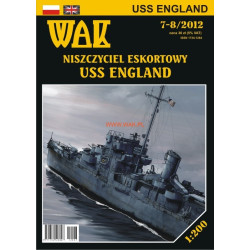
Publisher/ manufacturer: “Budynok Paperu". Ukraine
Scale: 1 : 100
Number of sheets: 8 x A4
Number of pages with details: 4
Number of assembly drawings: 31
Difficulty: For modelers of any experience.
Models dimensions: 187 mm x 34,5 mm x 45 mm ir 193 mm x 34,5 mm x 94 mm
 Security policy
(edit with the Customer Reassurance module)
 Delivery policy
(edit with the Customer Reassurance module)
 Return policy
(edit with the Customer Reassurance module)
Project M-123bis - post-war rework of project 123bis, was carried out by CKB-19 (chief designer V. M. Burlakov). Design work was completed in 1946. Their main focus was on replacing the frequently misfiring "Packard" gasoline engines with Soviet-made diesel engines M-50 . Serial production of ships of this project began in 1947 at Tyumen plant No. 639. Further construction was carried out by plant 831 in Feodosia, where in 1948 16 unfinished ships were delivered from Tyumen. In the spring of 1948, during tests of the first boat (400th factory build) in the Sevastopol area, insufficient hull strength was revealed, which was due to the higher speed of the ship in rough seas, compared to the ships of Project 123bis, which had gasoline engines. In total, the country's shipbuilding industry delivered 50 ships of this project to the Navy. Project 123K: this variant was the final stage of modernization of Project 123. The project was developed by CKB-19 (chief designer V. M. Burlakov), and design was completed in 1950. The serial builder, Feodosia Shipyard No. 831, built two main ships, according to the armament options: "A" - without radar and "Z" - with an openwork mast for mounting the combined "Zarnitsa" radar and "Fakel-M" identification station antenna equipment. Shipbuilding according to Project 123K was carried out at Plant 831 from 1950 to 1955. In total, the Navy received 205 such ships.
The magazine presents 2 full-fledged models of the M123bis and 123K projects of the "Komsomolets" torpedo boats. The well-designed and richly detailed ship models are not very complicated and, working under the supervision of a more experienced colleague, they can be perfectly constructed even by an advanced beginner or a modeler with little experience. Where necessary, double-sided printing was used. The assembly diagrams were made, using 3D technology, and are perfectly readable and informative, there is no text instruction, but it is not superfluous. There is a small reserve of colors.
Publisher/ manufacturer: “Budynok Paperu". Ukraine
Scale: 1 : 100
Number of sheets: 8 x A4
Number of pages with details: 4
Number of assembly drawings: 31
Difficulty: For modelers of any experience.
Models dimensions: 187 mm x 34,5 mm x 45 mm ir 193 mm x 34,5 mm x 94 mm