

Publisher/ manufacturer: “Avangard". Ukraine
Scale: 1 : 200
Number of sheets: 14 x A3
Number of pages with details: 7
Number of assembly drawings: 101
Difficulty: For intermediate to advanced modelers.
Model dimensions: 502,5 mm x 54 mm x 148 mm
 Security policy
(edit with the Customer Reassurance module)
 Delivery policy
(edit with the Customer Reassurance module)
 Return policy
(edit with the Customer Reassurance module)
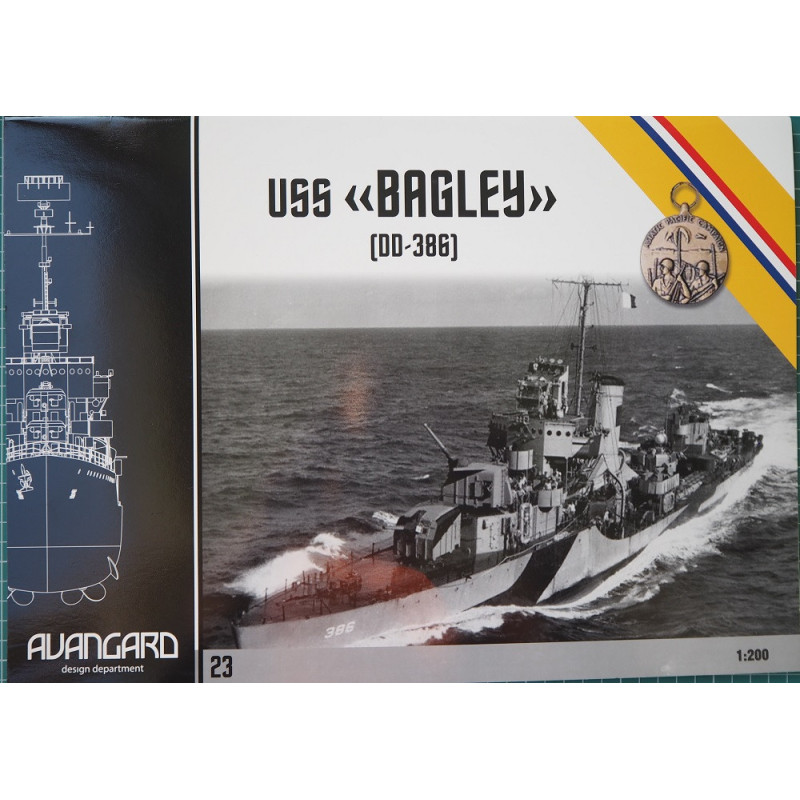
USS “Bagley” was the first of eight destroyer leaders of the class, that bears her name. She was built at the Norfolk Naval Shipyard and commissioned in June 1937. She served primarily in the Atlantic during her first year, but was soon sent to the Pacific to help deal with the unrest there. “Bagley” was at Pearl Harbor Naval Shipyard, when the Japanese attack began on 7 December 1941. After the attack, ship primarily performed escort duties, accompanying aircraft carrier operations on long-range cruises and invasions. “Bagley” participated in the battles of Guadalcanal and Savo Island, and returned to escort and patrol duties in late 1942 and early 1943. USS “Bagley” was actively involved in the capture of Woodlark Island and New Britain, before returning to the United States for an overhaul. Then sent back to the Pacific, where he took part in many attacks and operations, including the battles of Leyte, Iwo Jima and Okinawa. In August 1945 he accepted the Japanese surrender and then for 5 months participated in the actions of the Japanese occupation escadre. In November the destroyer leader returned to the United States, and in June 1946 he was stricken from the fleet lists and sold for scrap in October 1947.
A medium-size, well-designed and richly detailed model of one of the American destroyer leader USS "Bagley" for medium-experienced and experienced modelers. It perfectly details all the deck equipment, superstructures, hull, armament, rigging and rangout, rescue equipment and other ship details. There is no textual instruction, but it is not necessary, when the graphic one is simply excellent, consistently arranged and perfectly readable, explaining the gluing of each detail and its stages. Some sheets and details are printed double-sided, some details are printed on thin paper (not just the frame), there is a solid reserve of colors - and not shades of gray.

You might also like
Publisher/ manufacturer: “Avangard". Ukraine
Scale: 1 : 200
Number of sheets: 14 x A3
Number of pages with details: 7
Number of assembly drawings: 101
Difficulty: For intermediate to advanced modelers.
Model dimensions: 502,5 mm x 54 mm x 148 mm