

Publisher/ manufacturer: “Budynok Paperu". Ukraine
Scale: 1 : 200
Number of sheets: 27 x A3
Number of pages with details: 18 1/3
Number of assembly drawings: 106
Difficulty: For medium experienced and advanced modelers.
Model dimensions: 965 mm x 100 mm x 175 mm.
 Security policy
(edit with the Customer Reassurance module)
 Delivery policy
(edit with the Customer Reassurance module)
 Return policy
(edit with the Customer Reassurance module)
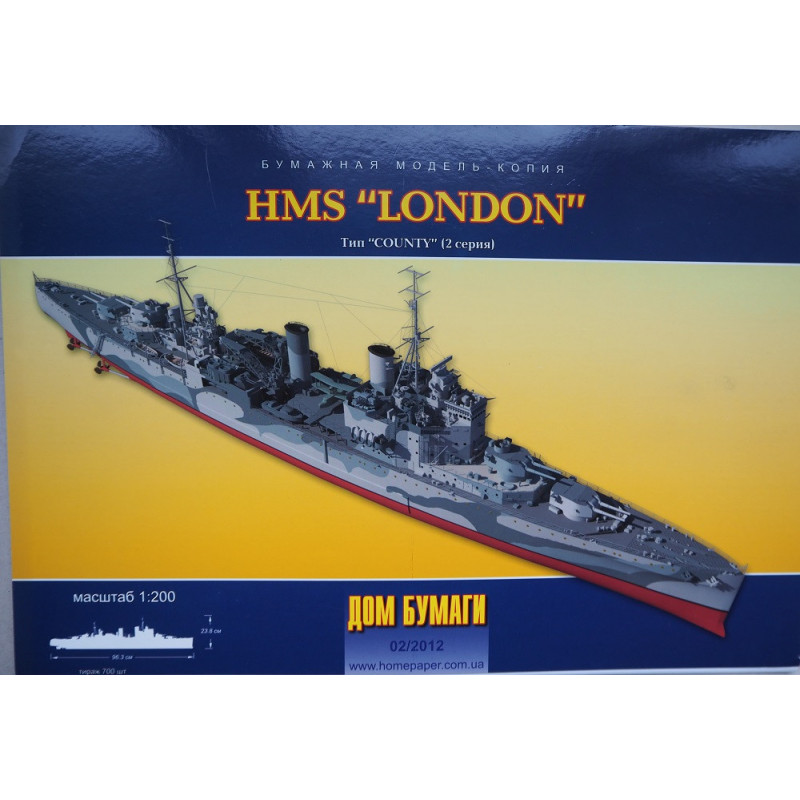
HMS "London' was a British "County'-class heavy cruiser of World War II. The ship was the first in a second series of "County"-class cruisers, known as the "London" sub-class. The ship was assigned the hull number 69. After the first seven "County'-class cruisers, known as the "Kent" sub-class, were built, minor changes were made to the design, armory and armament, resulting in a ship, known as the "London" sub-class. The keel of the cruiser HMS "London" was laid down on 23 February 1926 at "HMNB" Dockyard, Portsmouth. She was launched on 14 September 1927 and commissioned on 31 January 1929. After commissioning, she became part of the 1st Cruiser Escadre, stationed in the Mediterranean. With the outbreak of the Spanish Civil War, she was sent to local waters, where, among other things, she participated in the evacuation of civilians from Barcelona. In March 1939, the ship was repaired and modernized, the modernization was completed in March 1941. This completely changed the silhouette of the ship - she was the only "County"-class cruiser, to receive two funnels and a large forward superstructure. After returning to service, the ship was assigned to convoy protection. On May 26, she was included in the forces searching for the battleship 'Bismarck". In June 1941, "London" contributed to the sinking of three German transport ships in the South Atlantic. In September, she was sent to the North Atlantic, where she guarded Arctic convoys. In October, hull damage was discovered, resulting from structural weakening after previous reconstructions. The ship required repairs, which were completed in January 1942. Until November 1942, together with other heavy cruisers, she participated in escorting Arctic convoys. Due to service in difficult conditions, the ship's hull again required repairs. In March 1944, the cruiser was assigned to the 4th Cruiser Escadre of the British Eastern Fleet, stationed in Ceylon. The ship was mainly used there to cover aircraft carriers and fire on land targets. During the Chinese Civil War, the ship was deployed in Chinese waters to protect British interests. On 21 April 1949, while sailing up the Yangtze River to assist the damaged frigate HMS "Amethyst", the ship was fired upon by the field artillery of the Chinese Communist Army. During the shelling, the ship fired, among other things, 132 203 mm and 449 102 mm shells and anti-aircraft guns. HMS "London" was also damaged and forced to retreat. 17 people died on board (1 officer, 3 junior officers, 9 sailors, 2 marines and two inland navigation pilots) (according to other data, 13 sailors). Both bow and one stern towers were damaged. In October 1949, the ship was transferred to the reserve. In January 1950, it was sold for scrap.
A fairly large, well-designed and richly detailed ship model in a beautiful spotted camouflage for medium-experienced and experienced modelers. Where necessary, the details are printed double-sided, there are two options for underwater cladding: separate sheets for each sector (classic) and the so-called "stock" type cladding. Graphic instructions - 3D render type, quite well readable and very informative, there is no textual instruction, but it is not really needed. It's just a shame, that the colors are out of stock.
You might also like
Publisher/ manufacturer: “Budynok Paperu". Ukraine
Scale: 1 : 200
Number of sheets: 27 x A3
Number of pages with details: 18 1/3
Number of assembly drawings: 106
Difficulty: For medium experienced and advanced modelers.
Model dimensions: 965 mm x 100 mm x 175 mm.