

Publisher/ manufacturer: “Avangard". Ukraine
Scale: 1 : 200
Number of sheets: 14 x A4
Number of pages with details: 7
Number of assembly drawings: 76
Difficulty: For intermediate to advanced modelers.
Model dimensions: 500 mm x 47 mm x 110,5 mm
 Security policy
(edit with the Customer Reassurance module)
 Delivery policy
(edit with the Customer Reassurance module)
 Return policy
(edit with the Customer Reassurance module)
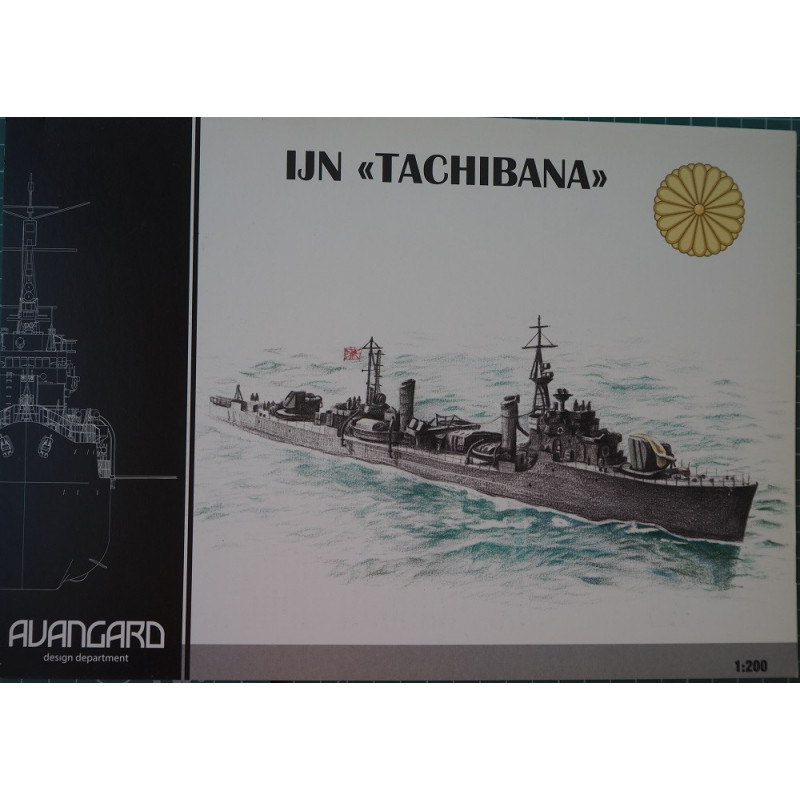
“Tachibana” (橘) was the lead ship of her subclass (also known as the "modified D-class") of “Matsu” -class escort destroyers, built for the Imperial Japanese Navy during the final stages of World War II. Completed in early 1945, the ship was assigned to escort convoys in Japanese waters. The “Tachibana” subclass was a simplified version of the earlier “Matsu” -class, further adapting them to mass production in a sectional manner. The ship had an overall length of 100 meters, a beam of 9.35 meters, a draft of 3.37 meters. The standard displacement was 1,309 metric tons (1,288 long tons), a maximum displacement of 1,554 metric tons (1,529 long tons). The ship was equipped with Kampon steam turbines with reduction gears, each driving a single drive shaft, using steam, supplied by two Kampon water-tube boilers. The turbines had a combined output of 19,000 h. p. (14,000 kW), and a speed of 27.8 knots (51.5 km/h). The “Tachibana”-class destroyers had a range of 4,680 nautical miles (8,670 km) at a speed of 16 knots (30 km/h). The “Tachibana”-class's main armament consisted of three Type 89 127-millimeter (5 in) multi-purpose guns, mounted in one twin-gun turret aft and one single turret forward, in front of the superstructure. The single turret was partially covered by a spray shield. The Type 89 guns were not very accurate against air targets, as they did not have a high-angle gun control device. The ship was armed with 25 25-millimeter (1 in) Type 96 anti-aircraft guns -4 triple-barreled and 13 single-barreled guns. The “Tachibana” destroyers were equipped with Type 13 early warning and Type 22 low-altitude detection radars. The ships were also armed with one four-barreled torpedo apparat for 610-millimeter torpedoes. They were also armed with 60 depth charges, fired from the rear bomb bays and two side-mounted launchers. On 14 July 1945, a Japanese destroyer, probably “Tachibana” or “Yanagi”, was attacked off Fukushima, Hokkaido, and was badly damaged in the same area. “Tachibana” (mandarin orange) was ordered in fiscal year 1943 under the modified 5th Naval Armaments Program as part of the “Matsu” class, but the design was simplified to facilitate production, and the ship was one of those, built to the modified design, the name of which was adopted by the entire subclass. Her keel was laid down on 8 July 1944 at the Yokosuka Naval Arsenal, launched on 14 October, and completed on 20 January 1945. The ship was assigned to the Combined Fleet and was briefly attached to the Second Fleet from 1 April to 20 April. On 22 May, “Tachibana” arrived at Ominato, on the northern tip of Honshu, to perform escort and patrol duties. On 14 July the escort destroyer was sunk by aircraft of the US 38th Battle Group during raids in Hakodate Bay, killing 135 crew members. The ship was stricken from the Navy List on 10 August.
A small, but quite complex, well-designed and maximally detailed escort destroyer model for medium-experienced and experienced modelers. There are no textual instructions, but they are not really needed, when the graphic ones are simply amazing - everything is laid out in excellent drawings, which are arranged in the publication quite systematically and easily readable. Some sheets and details are printed double-sided, there is a considerable reserve of gray color.

You might also like
Publisher/ manufacturer: “Avangard". Ukraine
Scale: 1 : 200
Number of sheets: 14 x A4
Number of pages with details: 7
Number of assembly drawings: 76
Difficulty: For intermediate to advanced modelers.
Model dimensions: 500 mm x 47 mm x 110,5 mm