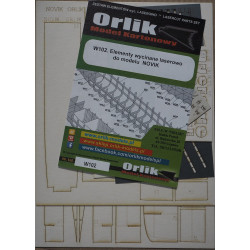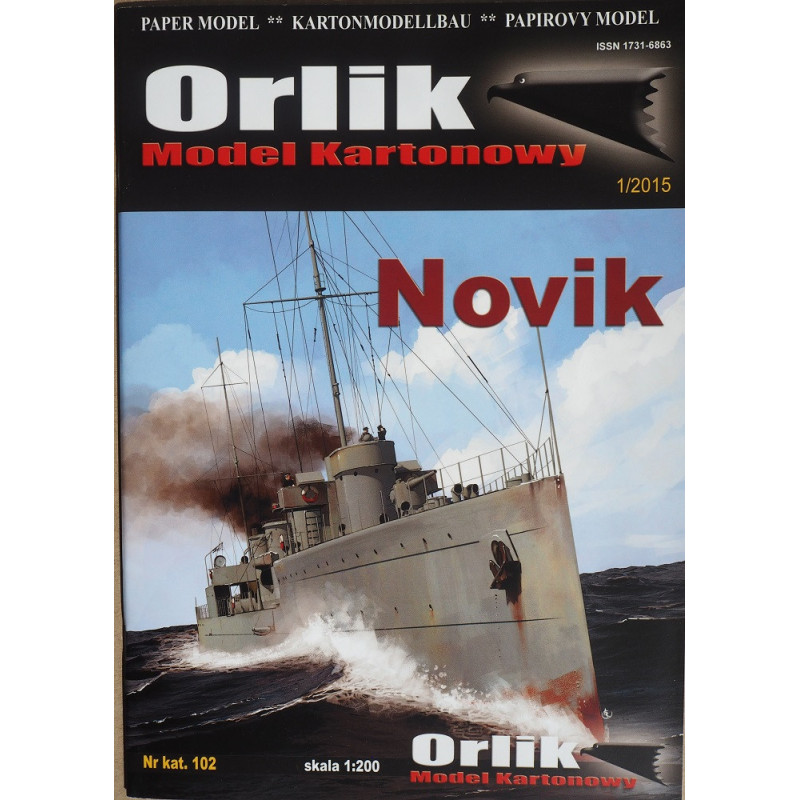


Publisher/ Manufacturer: "Orlik". Poland
Scale: 1 : 200
Number of sheets: 18 x A4
Number of sheets with details: 10
Number of assembly drawings: 75
Difficulty: For medium and experienced modelers.
Model dimensions: 512 mm x 47.5 mm x 151.5 mm
 Security policy
(edit with the Customer Reassurance module)
 Delivery policy
(edit with the Customer Reassurance module)
 Return policy
(edit with the Customer Reassurance module)
"Novik" - the destroyer of Tsarist Russia and the USSR of the First World War, the interwar period and the Second World War. The keel of the ship was laid in 1910, launched in 1911, entered service in 1913. The length of the ship - 102.4 meters, width - 9.5 meters. The total displacement reached 1590 tons, maximum speed - about 37-38 knots. At the initial stage of service, the armament consisted of 4 x 102 mm guns, four "Maxim" machine guns, 4 twin-barreled 457 mm torpedo apparats and up to 60 sea mines. The destroyer was built in St. Petersburg. "Novik" belonged to a series of four ships of the same type, which is widely recognized as the most successful series of Russian destroyers of the First World War and is often considered one of the best in Europe. The ship was distinguished not only by its extremely ascetic silhouette or superstructure architecture, but also by its extremely high maximum speed and many modern solutions. Suffice it to say, that "Novik" was the first destroyer in Europe, to use oil instead of coal in the boiler room, at the beginning of service it was the fastest ship of its type in the world! The destroyer took a very active part in the hostilities in the Baltic Sea in 1915-1917, during the October Revolution it joined the Bolsheviks. In 1923 its name was changed from "Novik" to "Yakov Sverdlov". Under this name he fought in the initial stage of World War II, but on August 28, 1941 he sank after hitting a mine.
A small and well-designed, richly detailed model of a small warship, quite complex. We recommend gluing it only to modelers with medium experience and experienced. But an advanced beginner and a modeler with little experience, working under the supervision of a more experienced colleague, can also try gluing it. Of course, the model will not forgive haste or carelessness. The model perfectly recreates the hull, underwater part, deck equipment, superstructures and their equipment, armament (there are pieces as many, as 50 of two types of sea mines). You can make a model of the ship, as it looked in 1914 and after the changes in 1916, but only one of these options. The color reserves are considerable, but they can be enlarged even more perfectly from the remains of sheets, printed entirely in double-sided printing. But, I hope, that they will not be needed. The textual instructions in Polish and Russian are large, informative, and perfectly cover the entire process of assembling the model, the graphical instructions are very extensive, consistently arranged, informative, and easy to read. Only perhaps the general drawings of the ship's images would be larger.

You might also like
Publisher/ Manufacturer: "Orlik". Poland
Scale: 1 : 200
Number of sheets: 18 x A4
Number of sheets with details: 10
Number of assembly drawings: 75
Difficulty: For medium and experienced modelers.
Model dimensions: 512 mm x 47.5 mm x 151.5 mm