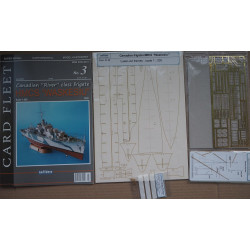
Manufacturer /Publisher: “Neptunia-Card Fleet”. United Kingdom
Scale: 1 : 200
Number of sheets: 26 x A4
Number of sheets with details: 14 2/3
Number of assembly drawings: 86
Difficulty: For intermediate and advanced modelers.
Model dimensions: 574.5 mm x 55.5 mm x 180.5 mm
 Security policy
(edit with the Customer Reassurance module)
 Delivery policy
(edit with the Customer Reassurance module)
 Return policy
(edit with the Customer Reassurance module)
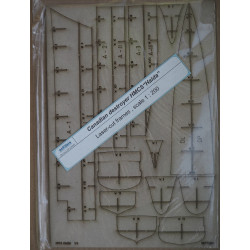
The destroyer HMCS “Haida” belonged to the well-known British “Tribal”-class destroyer. Their creation was influenced by the desire to have large destroyers, that could essentially perform cruiser tasks, which meant - they had to be large and well-armed. Naturally, the Canadians chose the British “Tribal”-class destroyers for their fleet. Although the wishes were great, Canada did not receive a single destroyer before the war. The whole process was accelerated by the outbreak of war. Only 8 days had passed since Canada entered the war (18.09.1939), and the naval command submitted to the government cabinet a plan for the building of large-scale minesweepers and corvettes, which envisaged their building in its own shipyards, and not in the already overburdened British shipbuilding enterprises. It was also planned to build 2 "Tribal" class destroyers each year for 3 years. Since the workers of Canadian shipyards had no experience in building such large ships, after lengthy negotiations an agreement was reached with British shipbuilders on the building of two ships of this type for Canada, and the British purchased corvettes, built in Canada. Ultimately, the first 4 destroyers were built in Britain, the remaining 4 in Canada. The project itself was slightly modified, compared to British counterparts. The experience of the war and the use of the British "Tribal" influenced the widening of the hulls and a fairly significant strengthening of the construction. Improved ventilation and installed a heating of some mechanisms, which helped to avoid their freezing, which was a common phenomenon, when these ships were operated in the Arctic, strengthened anti-aircraft artillery, abandoning one twin-barreled 120 mm caliber gun turret on the aft superstructure and replacing them with universal 102 mm guns, new rangefinders and new observation posts were installed on the fighting bridge, and radar equipment, which was already quite advanced at that time, was installed. The keel of the "Haida" was laid down on 29 September 1941 at the “Vickers-Armstrong” shipyard in Newcastle, launched on 25 August 1942, and entered service on 18 September 1943. The ship spent the rest of the war on combat voyages, escorts, fought against German "wolfpack" submarines, aviation, and escorted Arctic convoys. Destroyer participated in the operations in Spitsbergen, Norway, and the Battle of Usmant. The ship's crew sank three German destroyers and 1 U-boat. After the capitulation of Germany, a few months later, the ship sailed to Canada, where it was directed to operations against Japan, but the Japan capitulated before reaching the intended areas of combat operations. In March 1946, the ship was transferred to the Reserve Fleet, retrained as an escort destroyer, and participated in the Korean War in 1952–54. On October 11, 1963, it was removed from the fleet lists, and on August 25, 1964, it became a museum ship, which it is to this day. It is the only one of the 27 "Tribal" class ships, that has survived for this days.
A large, complex, well-designed and very detailed model of a warship, painted in colorful camouflage (1944) for only medium-experienced and experienced modelers. There is a reserve of colors, the text assembly instructions are large and detailed in Polish and English, the graphic ones are simply huge, informative, easy to read and both of them will really help a lot in the process of assembling of the model.

You might also like
Manufacturer /Publisher: “Neptunia-Card Fleet”. United Kingdom
Scale: 1 : 200
Number of sheets: 26 x A4
Number of sheets with details: 14 2/3
Number of assembly drawings: 86
Difficulty: For intermediate and advanced modelers.
Model dimensions: 574.5 mm x 55.5 mm x 180.5 mm