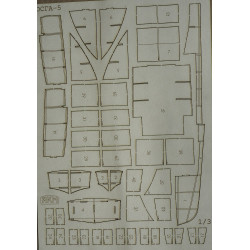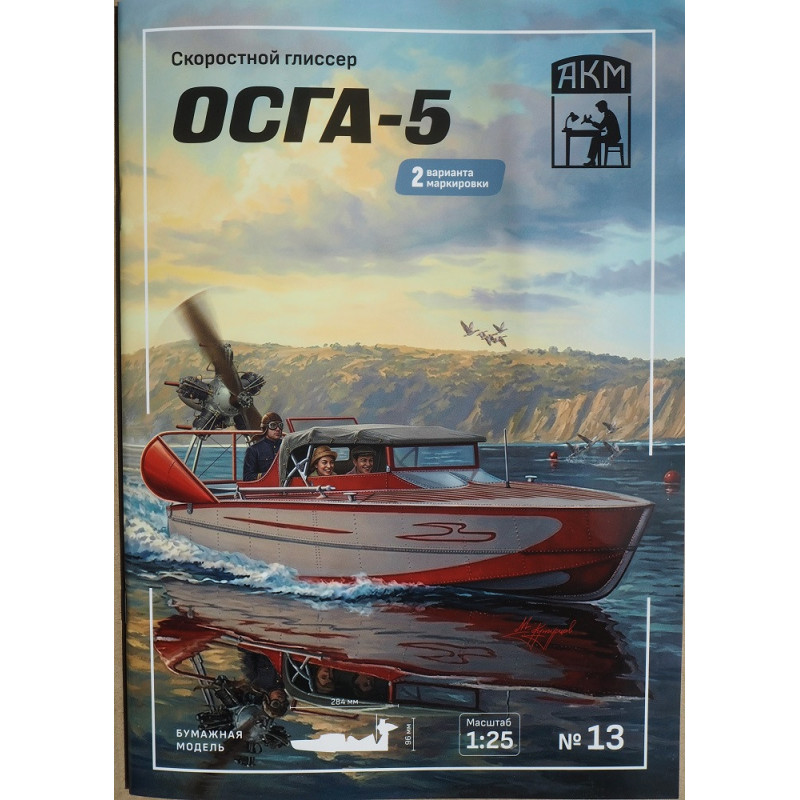


Publisher/ Manufacturer: "Артель Картонных моделистов". Russia
Scale: 1 : 25
Number of sheets: 16 x A4
Number of sheets with details: 10 2/3
Number of assembly drawings: 49
Difficulty: For modelers of any experience.
Model dimensions: 284 mm x 66 mm x 96 mm
 Security policy
(edit with the Customer Reassurance module)
 Delivery policy
(edit with the Customer Reassurance module)
 Return policy
(edit with the Customer Reassurance module)
OSGA-5 was created immediately after OSGA-1 and on the basis of this hovercraft. Its direct predecessors were the high-speed boats "Avtodor-3" and "Avtodor-11", and later - their improved model - OSGA-3. Initially, OSGA-3 was planned as a military high-speed boat and already at the projecting stage had a machine gun mount, which distinguished it from OSGA-1 in its construction and contours. The improved bottom construction with a flat keel profile, with front and rear redans, a noticeable difference in width between them, an improved rudder and a reduced overall weight significantly improved the performance of the speedboat. The light and elegant OSGA-5, equipped with a standard Soviet M-11 aircraft engine, developing 100 h. p. power, became one of the most popular speedboats in the USSR. The OSGA-5 was used in river navigation, in the NKVD system, for mail delivery and other purposes. The prototypes of the OSGA-5 hovercraft and the first OSGA-6 airslades, manufactured in 1934, were presented at the International Aviation Exhibition in Copenhagen in 1934, where they attracted attention due to their elegant shape and high-quality finishing. This speedboat also attracted considerable attention at the International Exhibition in Paris in 1936. The production of the OSGA-5 (later renamed NKL-5) reached 200 units per year and continued until the evacuation of factory No. 41 in the autumn of 1941. The experience, gained in developing small airships, led to the creation of multi-seat machines with more powerful engines. The steel OSGA-7 hovercraft with a propeller was developed, but this type was not widely used, although a few years later similar metal airships with propellers and engines, integrated into the hull, began to be developed in Germany.
A small, simple model with full cockpit equipment, hull, engine and propeller, exterior detailing. The model will suit modelers of any experience. Only for beginners and modelers with little experience this should not be one of the first, more complex models they make, and they should work under the supervision of a more experienced colleague, slowly, carefully and accurately, and some things can be simplified (e.g. engine, deck reinforcements). The model is perfectly designed, richly detailed. You can choose one of two painting options: a serial speedboat or a boat, exhibited at the 1934 Copenhagen and 1936 Paris exhibitions. There is a considerable reserve of colors, where necessary, double-side printing was used. The textual instruction are not even a hint, but the graphical one is simply wonderful.

You might also like
Publisher/ Manufacturer: "Артель Картонных моделистов". Russia
Scale: 1 : 25
Number of sheets: 16 x A4
Number of sheets with details: 10 2/3
Number of assembly drawings: 49
Difficulty: For modelers of any experience.
Model dimensions: 284 mm x 66 mm x 96 mm