

Publisher/ Manufacturer: "Swiat z Kartonu". Poland
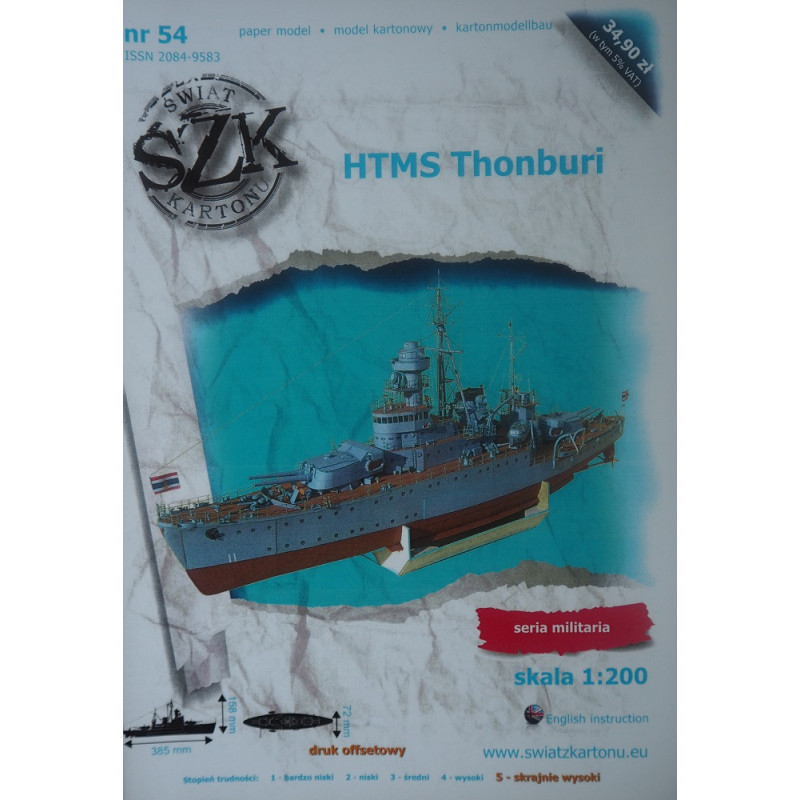
Scale: 1 : 200
Number of sheets: 16 x A4
Number of sheets with details: 10
Number of assembly drawings: 104
Difficulty: For intermediate and experienced modelers.
Model dimensions: 385 mm x 72 mm x 158 mm
 Security policy
(edit with the Customer Reassurance module)
 Delivery policy
(edit with the Customer Reassurance module)
 Return policy
(edit with the Customer Reassurance module)
HTMS "Thonburi" – the Siamese coast guard armored ship of the interwar period and World War II. The keel of this ship was laid in 1936, launched in July 1937, entered service in January 1938. The length of the ship is 77 m, width is 14.4 m, draft is about 4.2 meters. Displacement - about 2270 tons, maximum speed - about 15.5 knots. Armament consisted of four 203 mm guns, four 76 mm universal guns and 4 20 mm anti-aircraft guns. HTMS "Thonburi", along with the ship of the same class HTMS "Sri Ayudhya", were ordered by the Siamese Navy and built at the shipyard of the Japanese "Kawasaki" factory. The design and construction of both of these battleships clearly drew on the experience, gained from operating the ships of the "Ratanakosindra" class. First of all, the new ships, compared to their predecessors, have a much more powerful main armament (203 mm guns instead of 152 mm), and the ships themselves have been significantly enlarged and better armored. By the way, it can be added, that the main artillery of HTMS "Thonburi" and HTMS "Sri Ayudhya" had the same, as the Japanese heavy cruisers (e.g. "Mogami" class). Both ships were considered very useful in the Siamese fleet. However, the combat path of HTMS "Thonburi" was relatively short, since during the Second World War it had to fight in only one serious naval battle - the Battle of Koh Chang in January 1941, which, moreover, ended in a shameful defeat for Siam.
A small model of a small ship, but complex, well-designed and well-detailed, suitable only for medium-experienced and experienced modelers. But even for them it will not be an “easy walk” here. There are colors reserves but simply a "meager" amount. The textual instruction in Polish and English is relatively small, but quite detailed, informative and perfectly complement the graphical instruction, which is quite large and not easy to read due to the very small assembly drawings (some people will even need a magnifying glass to read them), but the instruction themselves is quite detailed and informative.

You might also like
Publisher/ Manufacturer: "Swiat z Kartonu". Poland
Scale: 1 : 200
Number of sheets: 16 x A4
Number of sheets with details: 10
Number of assembly drawings: 104
Difficulty: For intermediate and experienced modelers.
Model dimensions: 385 mm x 72 mm x 158 mm