

Publisher/ manufacturer: "Modelik". Poland
Scale: 1 : 150
Number of sheets: 20 x A4
Number of pages with details: 16
Number of assembly drawings: 7
Difficulty: For all experience modelers.
Model dimensions: 344 mm x 223 mm x 320 mm
 Security policy
(edit with the Customer Reassurance module)
 Delivery policy
(edit with the Customer Reassurance module)
 Return policy
(edit with the Customer Reassurance module)
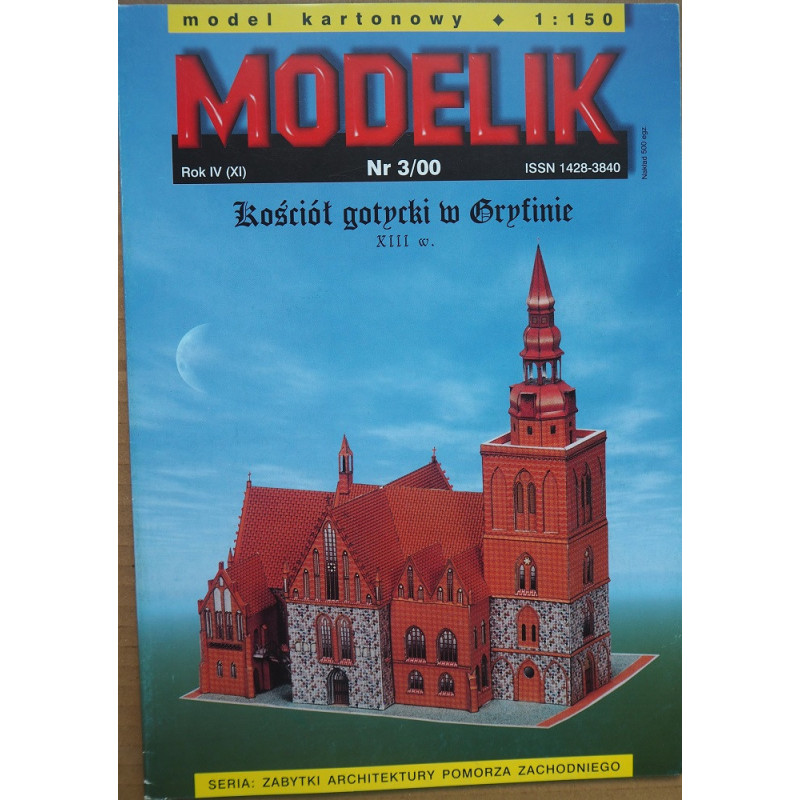
According to Szczecin art historian Wojciech Łopuch, the building of the church began in 1278, when Duke Barnim I entrusted it to the patronage for the Church of St. Mary of Szczecin. Zygmunt Świechowski, writing in the 1950s, marked this date as the date of completion of the entire church. Wojciech Łopuch associates the building of the altar in 1300 with the completion of the eastern part of the church, namely the presbytery and transept. These parts were built of hewn stone, with brick added in architectural details. The second stage of building was probably completed in 1325, when Duke Otton I donated the second altar. It is believed, that the three-nave, single-bay basilica body with a lower western tower was built of brick. The existence of a basilican layout at that time (the side naves are lower than the main nave) is evidenced by the windows in the upper part of the nave facade, now visible in the upper part of the church. The third stage of building dates back to the late Gothic period, in the 15th century. The side naves were raised to the height of the central nave (creating a hall-type layout), and star vaults were installed (until then the church had been covered with a wooden ceiling). In the 16th century, the church was taken over by Protestants. The architecture of the church has remained largely unchanged to this day. In 1861–1863, under the direction of architect Buchterkirch, known for his unsuccessful re-Gothicization of Pomerania churches, a major reconstruction took place. In 1938, the medieval cone on the tower was replaced by a Neo-Baroque dome, which spoiled the Gothic-style architecture. Since 1945, it has been a Catholic church again.
A medium-complexity, well-designed and richly detailed model of a large and beautiful church for modelers of any experience. It is not suitable for beginners, and for modelers with little experience, we recommend working under the supervision of a more experienced colleague. The model perfectly reveals the textures of building materials, the sequence is well thought out, there are a few more complex moments, but everything can be overcome without rushing. The textual instruction is medium-sized, but quite detailed, the graphic one is small, but perfectly complements the textual one. There are no stocks of colors and textures.

Publisher/ manufacturer: "Modelik". Poland
Scale: 1 : 150
Number of sheets: 20 x A4
Number of pages with details: 16
Number of assembly drawings: 7
Difficulty: For all experience modelers.
Model dimensions: 344 mm x 223 mm x 320 mm