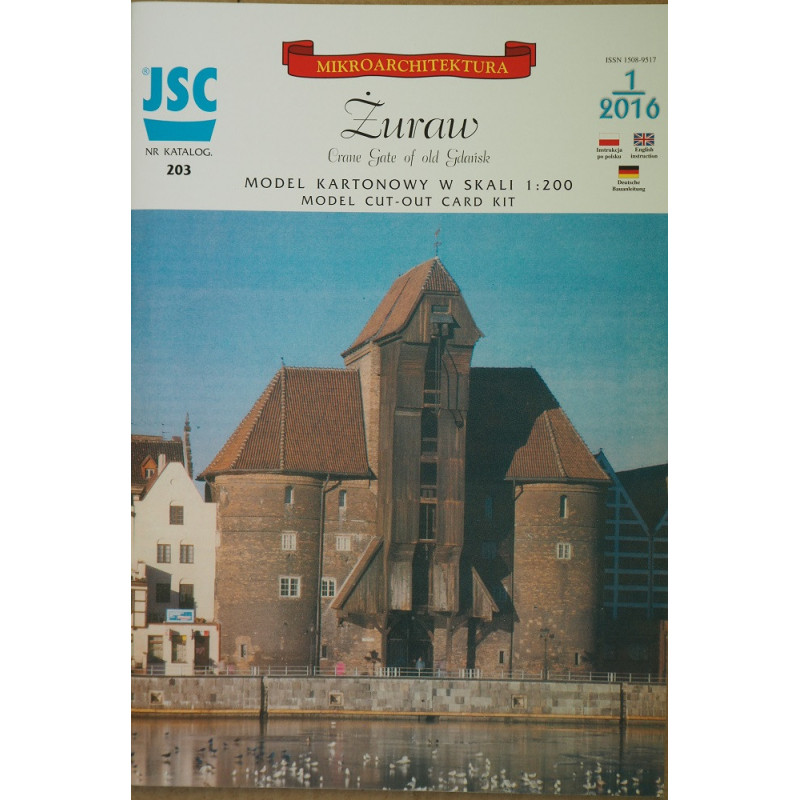


Manufacturer/ Publisher: "JSC". Poland
Scale: 1 : 200
Number of sheets: 8 x A4
Number of sheets with details: 4
Number of assembly drawings: 5
Difficulty: For modelers of any experience.
Model dimensions: 150 mm x 85 mm x 125 mm
 Security policy
(edit with the Customer Reassurance module)
 Delivery policy
(edit with the Customer Reassurance module)
 Return policy
(edit with the Customer Reassurance module)
A gate of unknown appearance existed here as early as 1363, and a Latin reference to a crane called "caranum" (crane) from 1367 has survived. The current form of the Crane was built in 1442-1444. Two massive brick towers and a wooden lifting mechanism were built, which were later raised. Although the facades of the gate on the Motława River and city sides look different, the entire structure retains the Flemish Gothic style. At the beginning of the 17th century the Crane lost its military significance. Over time, the brick towers were inhabited, workshops were established, and window openings were added during the reconstruction of the premises. From the very beginning, it served mainly as a port facility for loading goods and ballast onto ships and for raising ship masts. The mechanism consists of two pairs of running wheels, each with a diameter of about six meters. People, walking inside these drums, were the driving force. The device could lift a weight of two tons to a height of 27 meters or, with both wheels turned on, a weight of four tons to a height of 11 meters. The crane was set on fire in 1945, when the city was occupied by the Red Army. The wooden part burned down, but part of the walls survived. The gate was reconstructed in the late 1950s, and on December 18, 1959, the crane was included in the register of historical monuments. From 2022 to 2024 the building was completely restored. During the restoration work, thousands of historical objects, dating from the Middle Ages to the 20th century, were discovered.
A small, simple, but attractive model, that even a beginner or inexperienced modeler can assemble perfectly without any help from more experienced colleagues. And those experienced ones can really squeeze a lot out of this model, especially if they use a second copy as a "donor". The description of the Crane itself is given in Polish, English and German, but the textual instruction is only in Polish and only a few sentences, and the graphical instruction are also such, that even the devil himself would break his leg. But let's hope, that the modelers' legs are stronger, than the devil.

Manufacturer/ Publisher: "JSC". Poland
Scale: 1 : 200
Number of sheets: 8 x A4
Number of sheets with details: 4
Number of assembly drawings: 5
Difficulty: For modelers of any experience.
Model dimensions: 150 mm x 85 mm x 125 mm