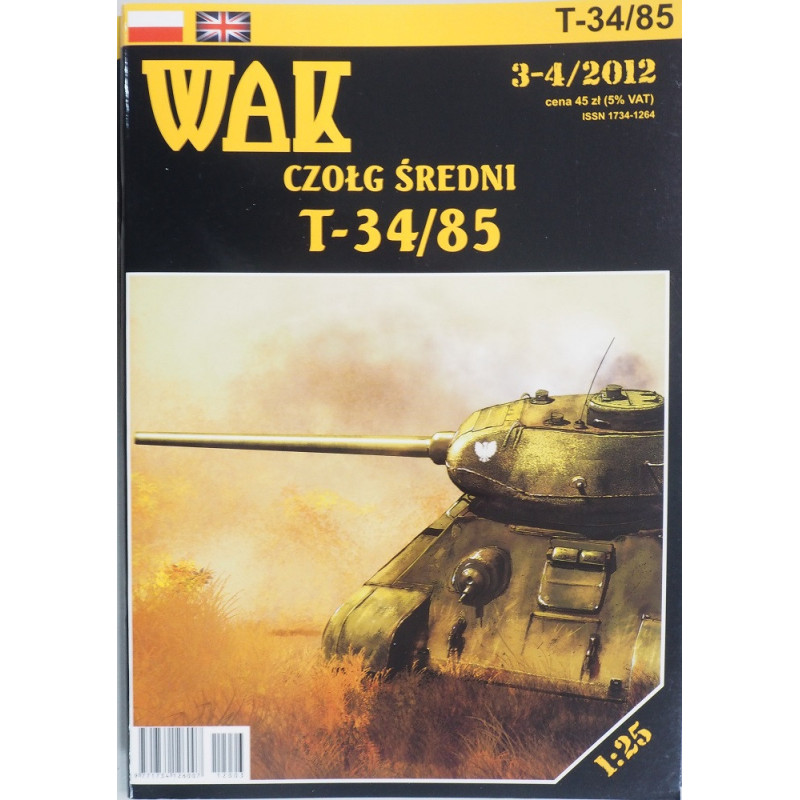


Publisher/ manufacturer: "WAK". Poland
Scale: 1 : 25
Number of sheets: 20 x A4
Number of sheets with details: 17
Number of assembly drawings: 60
Difficulty: For medium experienced and advanced modelers.
Model dimensions: 326 mm x 120 mm x 109 mm
 Security policy
(edit with the Customer Reassurance module)
 Delivery policy
(edit with the Customer Reassurance module)
 Return policy
(edit with the Customer Reassurance module)
T-34 - Soviet medium tank of the II World War and the first decade of the post-war period. The first prototypes were produced in 1937-1940, serially produced in the USSR in 1940-1957. About 84,000 units were produced, making the T-34 one of the most mass-produced tanks in history! The tank was equipped with one V-2-34 diesel engine with a power of 500 h. p. The initial version was armed with a 76.2 mm F-34 cannon and two 7.62 mm DT machine guns. The later and main version of the T-34/85 is armed with the ZIS-S-53 85 mm cannon. The T-34 is undoubtedly one of the most famous tanks both in the history of the II World War and in the history of the armed forces in general, a symbol of the Soviet Army's victory in the war against the Third Reich. The combat vehicle was created at the request of the Red Army as a successor to the so-called BT series pursuit tanks (BT-5 and BT-7) and the fast tank T-26. Work on this machine began in 1937 in a special design office at the Kharkov Engine Plant. At first, the works were led by Eng. Adolf Dik (he also made the first sketch drawings of the new tank), and after his arrest by the Security Authorities of the USSR, the works were headed by Mikhail Koshkin. The tank was originally designated A-20. However, a second prototype (A-32) was quickly built, with a main armament of 76.2 mm cannon and much thicker frontal armor. It was the latter prototype that was finally accepted for serial production. It can be assumed that the T-34 was a very successful tank in many respects when it entered service. It featured – for the 1940s – very powerful armament, well-placed armor consisting of sloping armor plates, and very good mobility and maneuverability. Disadvantages - very poor ergonomics of the combat vehicle and poor optics used in the first production batches. Despite these shortcomings, when the T-34 appeared on the Eastern Front, the German soldiers were very surprised by it. The high overall rating and combat characteristics of the T-34 led to its mass production and the fact, that it became the main tank of the Red Army during the battles of 1942-1945. The structure was also further improved, for example, in 1942, a new hexagonal tower with a commander's turret appeared, improving the working conditions and quality of the crew members. The engine and gearbox were also improved. In 1944, the T-34/85 model entered service with a completely new three-man crew turret and 85 mm main gun. The T-34 tank fought in almost all the major battles between the Red Army and the Wermacht on the Eastern Front between 1941 and 1945: starting with the Battle of Moscow, through the Battles of Stalingrad and Kursk, Operation "Bagration" and the capture of Berlin. After 1945, the T-34 tank was still in use and was also widely exported outside the USSR to countries such as Czechoslovakia, Poland, East Germany, Hungary and Syria.
A well-designed and richly detailed model of a medium tank for intermediate and advanced modellers. In addition, the relatively simple shapes of the hull, tower and chassis allow this model to be built by advanced beginners and modelers with little experience, working under the supervision of a more experienced colleague. There is no detailing of the combat compartment and the engine compartment, there is not a very large stock of colors, it is possible to make a model in one of two painting options: Polish 3rd Training Tank Regiment, May 1944, Ukraine or the vehicles of an unidentified unit of the USSR Red Army, Spring 1944, Ukraine. The graphic instruction is just an example, of what it should be, the textual one is small, but perfectly complements the drawings.

You might also like
Publisher/ manufacturer: "WAK". Poland
Scale: 1 : 25
Number of sheets: 20 x A4
Number of sheets with details: 17
Number of assembly drawings: 60
Difficulty: For medium experienced and advanced modelers.
Model dimensions: 326 mm x 120 mm x 109 mm