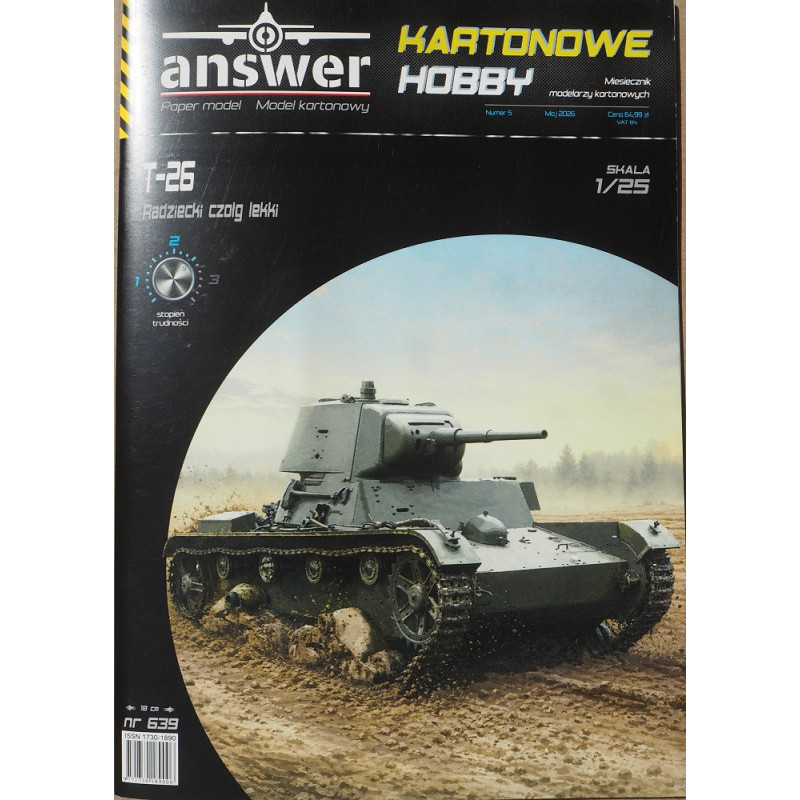


Publisher/ Manufacturer: "Answer" – "Kartonowe Hobby". Poland
Scale: 1 : 25
Number of sheets: 14 x B4
Number of sheets with details: 9
Number of assembly drawings: 32
Difficulty: For modelers of any experience.
Model dimensions: 185 mm x 97.5 mm x 93 mm
 Security policy
(edit with the Customer Reassurance module)
 Delivery policy
(edit with the Customer Reassurance module)
 Return policy
(edit with the Customer Reassurance module)
T-26 – the light tank, one of the most successful modifications of the British "Vickers" E tank. About 12,000 copies were produced in 1931-1940, which the USSR used in many conflicts, including World War II. The T-26 was the most widely produced tank of the interwar period and was used quite successfully in the Spanish Civil War, the USSR-Japanese conflict, the USSR's offensive in Poland, the Winter War with Finland and the occupation of the Baltic states. They were the main tank of the Red Army, successfully produced in Soviet industrial plants. Their production was relatively cheap and the quality of the tank itself was significantly improved, compared to the British prototype. The T-26 was first used against Japan during the border incidents in Manchuria in 1934 and 1935, and on a larger scale in the battles at Lake Khasan and the Khalkhin-Gol River in 1938 and 1939, where, together with the BT-5 and BT-7 tanks, it contributed to the USSR's victory over the Japanese army. During the Spanish Civil War the Republicans received 347 of the 362 tanks, sent to them, among which the majority were T-26s of the 1933 model. They were superior in their characteristics to the German Pz. Kpfw. I and the Italian CV. 33. 281 T-26 tanks, which the USSR delivered to Spain in 1936–1939, fought on the Republican side. But they were easily vulnerable to anti-tank artillery fire. After the war, these tanks, taken over by the Nationalists, served until the mid-1950s. About 80 tanks of this type were received by Chiang Kai-Shek's Chinese units, they were delivered in 1938–1939. They were included in the 200th Infantry Division - the only motorized unit of the Chinese army at that time. On September 17, 1939 the USSR attacked Poland with 1,675 tanks of this type. During this campaign the Red Army lost 8 or 9 tanks and 5 T-20 artillery tractors in the Battle of Szack. During the entire Polish campaign the USSR lost only 15 T-26 tanks, but as many as 302 were decommissioned due to breakdowns and damage. In 1939–1940 these tanks were used in the Winter War. After its end, Finland had 34 operational captured tanks of this type. The surviving specimens, together with the existing “Vickers” tanks, were re-armed with Soviet 45 mm cannons and designated T-26M. They were included in the “Lagus” Division and used in the Continuing War with the USSR. They served on the front line until 1944, and the surviving specimens were used for training purposes until the 1960s. After Germany attacked the USSR in 1941, T-26 and BT tanks made up about 75% of the technical fleet of the Red Army armored units. A large number of them were abandoned or destroyed in battles in 1941. Since 1942, it has been used in small quantities and only in secondary directions of action and gradually replaced by newer machines. The last time it was used in combat was in August 1945 in the battles with the Kwantung Army in Manchuria.
A medium-complexity, well-designed and excellently detailed model, that will suit modelers of any experience. However, advanced beginners and modelers with little experience should work under the supervision of a more experienced colleague, don’t rush, work patiently and carefully. The hull, chassis, its suspension, armament and all other external detailing are perfectly detailed. There is a considerable reserve of colors. Tracks are only a tape. The textual instruction in Polish is small and provides only general notes and a description of the assembly of the most complex nodes. But it perfectly complements the small, but sufficient for good model assembly, informative and easy-to-read graphic instruction.

You might also like
Publisher/ Manufacturer: "Answer" – "Kartonowe Hobby". Poland
Scale: 1 : 25
Number of sheets: 14 x B4
Number of sheets with details: 9
Number of assembly drawings: 32
Difficulty: For modelers of any experience.
Model dimensions: 185 mm x 97.5 mm x 93 mm