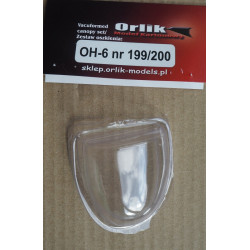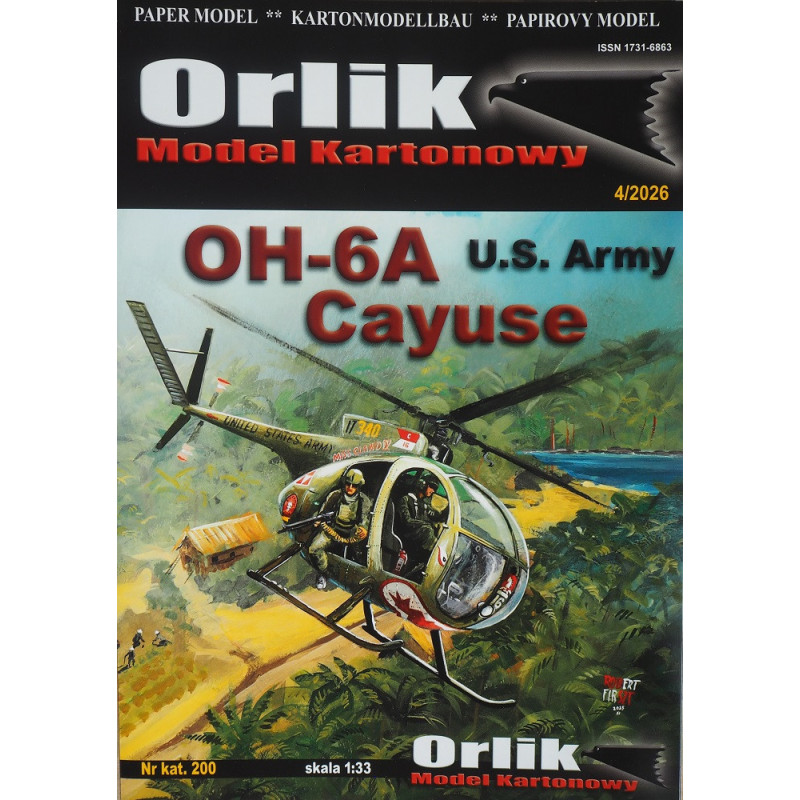


Publisher / Manufacturer: "Orlik". Poland
Scale: 1 : 33
Number of sheets: 8 x A4
Number of sheets with details: 3
Number of assembly drawings: 31
Difficulty: For modelers of any experience.
Model dimensions: 280 mm x 243.5 mm x 75 mm
 Security policy
(edit with the Customer Reassurance module)
 Delivery policy
(edit with the Customer Reassurance module)
 Return policy
(edit with the Customer Reassurance module)
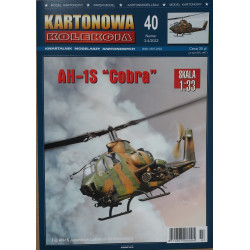
Hughes OH-6 "Cayuse" - a single-engine light helicopter, designed and manufactured by the US aerospace company "Hughes Helicopters". Its official name comes from the Cayuse Indian tribe, and the nickname "Loach" - from the Light Observation Helicopter (LOH) program, under which it was designed and purchased by the US Army. The OH-6 was designed in accordance with United States Army Technical Specification 153, issued in 1960, to replace the Bell H-13 “Sioux”. Hughes's Model 369 competed with two other finalists, Fairchild-Hiller and Bell, for the production contract. The first prototype made its test flight on February 27, 1963. The Model 369 had a distinctive teardrop-shaped fuselage, that was impact-resistant and provided excellent external visibility. Its four-blade main rotor made it highly maneuverable and suitable for personnel transport, escort and attack missions, and surveillance. In May 1965 the U.S. Army awarded Hughes a production contract. The OH-6 entered service in the U.S. Army in 1966 and immediately began active combat operations in the Vietnam War. There, it was often used in formations with other helicopters, such as the Bell AH-1 “Cobra” attack helicopter, using what is known as a "hunter-killer" tactic to identify and destroy enemy ground targets. The OH-6 served as a decoy to attract enemy fire and mark targets for other aircraft, such as the AH-1, to attack. In one covert incident in 1972, known as the "Vinh Eavesdropping," the Central Intelligence Agency (CIA) used a pair of OH-6As, via Air America, to infiltrate high-level Vietnamese communications systems and provide valuable intelligence. It is reported, that 964 of the 1,422 OH-6As built for the US Army, were destroyed in Vietnam alone. In 1967, as the cost of the OH-6 increased, the U.S. Army reopened the program, allowing bids for up to 2,700 additional helicopters, in addition to the 1,300 OH-6s already under the previous contract. After comparative flights and a closed tender, Hughes lost the contract to Bell, and the competing Bell OH-58 “Kiowa” was put into production. The OH-6/Model 369 was manufactured overseas under license by the Japanese aerospace company “Kawasaki Heavy Industries” for both military and civilian users. It was also converted into the Model 500 civil helicopter, which was manufactured by MD Helicopters into the 21st century as the MD 500.
A small and well-designed and highly detailed model of a small helicopter, it is quite complex due to its cockpit glazing. But, using a set of plastic parts, we can recommend it even to beginners and modelers with little experience, but they should work under the supervision of a more experienced colleague and simplify or even omit something. Of course, the model will not forgive haste and carelessness. The model perfectly recreates the fuselage, all visible exterior detailing, cabin interior, rotors and undercarriage. The color reserve is quite large - and not only the stripes in the middle of the sheets. The textual instruction in Polish is small and only covers the gluing of some nodes in general terms, the graphical instruction is quite extensive, consistent, informative and easy to read. From the publication You can make a model of a helicopter, used by the U. S. Army in Operation “Hunter-Killer” during the Vietnam War.

You might also like
Publisher / Manufacturer: "Orlik". Poland
Scale: 1 : 33
Number of sheets: 8 x A4
Number of sheets with details: 3
Number of assembly drawings: 31
Difficulty: For modelers of any experience.
Model dimensions: 280 mm x 243.5 mm x 75 mm