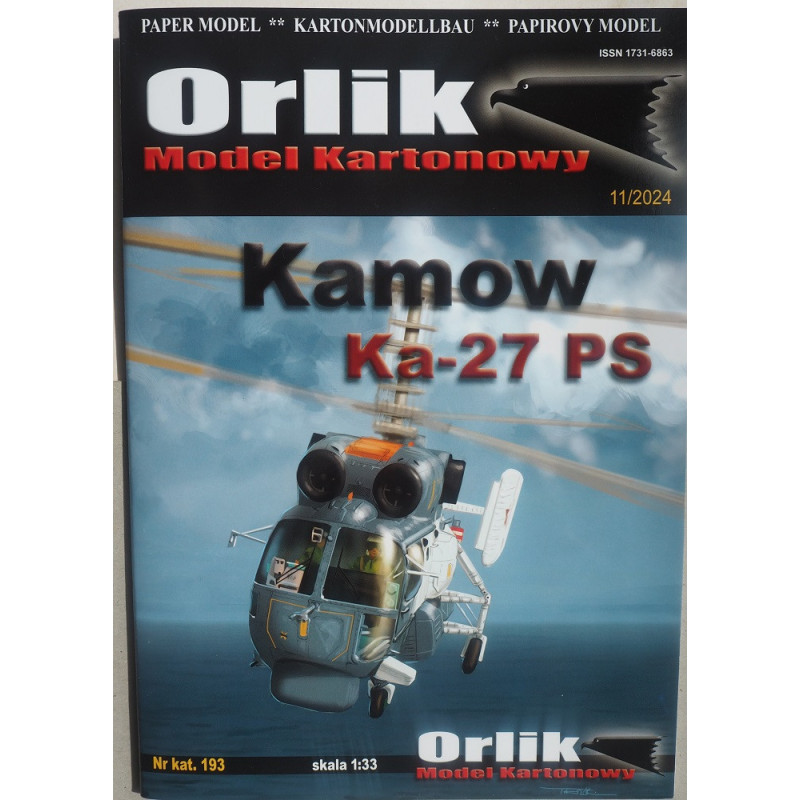


Publisher/ manufacturer: "Orlik". Polland
Scale: 1 : 33
Number of sheets: 20 x A4
Number of pages with details: 13 1/2
Number of assembly drawings: 73
Difficulty: For medium-experienced and experienced modelers
Model dimensions: 394 mm x 482 mm x 165 mm
 Security policy
(edit with the Customer Reassurance module)
 Delivery policy
(edit with the Customer Reassurance module)
 Return policy
(edit with the Customer Reassurance module)
The Ka-27 was designed as a transport and anti-submarine helicopter. Design work began in 1969, and the first prototype took to the air in 1975. It was intended to replace the Kamov Ka-25 and, like most Kamov KB machines, has two counter-rotating propellers on a common axis, which eliminates the need for a tail rotor. A total of five prototypes and pre-production helicopters were built. Serial production began in July 1979 at the Kumertau plant, and the new helicopter was officially accepted into service in the USSR Navy in April 1981. The Ka-27 has a crew of 3 people, with the pilot and navigator, sitting in the cockpit, and the sonar operator in the compartment behind them. Two high-pressure inflatable pontoons are installed on the sides of the helicopter, which are inflated in the event of a forced landing on water. They create the necessary buoyancy for the machine in such a case. The search and rescue version of the Ka-27PS helicopter can transport 12 passengers on folding benches or 4 wounded on stretchers, the helicopter is equipped with a lifting winch with a lifting capacity of 300 kg. Machines of this modification have an increased radius of action due to the increased amount of fuel up to 3450 liters (compared to the anti-submarine version Ka-27PL takes only 2940 liters of fuel). On the basis of the basic version of the Ka-27, a number of different modifications of the helicopter for different purposes have been created. It is worth noting the attack version Ka-29 and the long-range patrol Ka-31. The version, intended for civilian users, is designated Ka-32.
A well-designed and very richly detailed helicopter model, intended only for medium-experienced and experienced modelers. But even for them this model will be a "hard nut to crack". The model has a perfectly detailed crew and transport space, the external detailing is also impeccable, the chassis and propeller construction are perfectly recreated, there is an opportunity to make opening engine compartment covers with engine models. In a word - high modeling pilotage. The textual instruction is large and detailed in Polish and Russian, the graphic instruction is excellent, understandable and easy to read, there are color reserves, some of the details are printed on thin paper (not just the frame).

You might also like
Publisher/ manufacturer: "Orlik". Polland
Scale: 1 : 33
Number of sheets: 20 x A4
Number of pages with details: 13 1/2
Number of assembly drawings: 73
Difficulty: For medium-experienced and experienced modelers
Model dimensions: 394 mm x 482 mm x 165 mm