
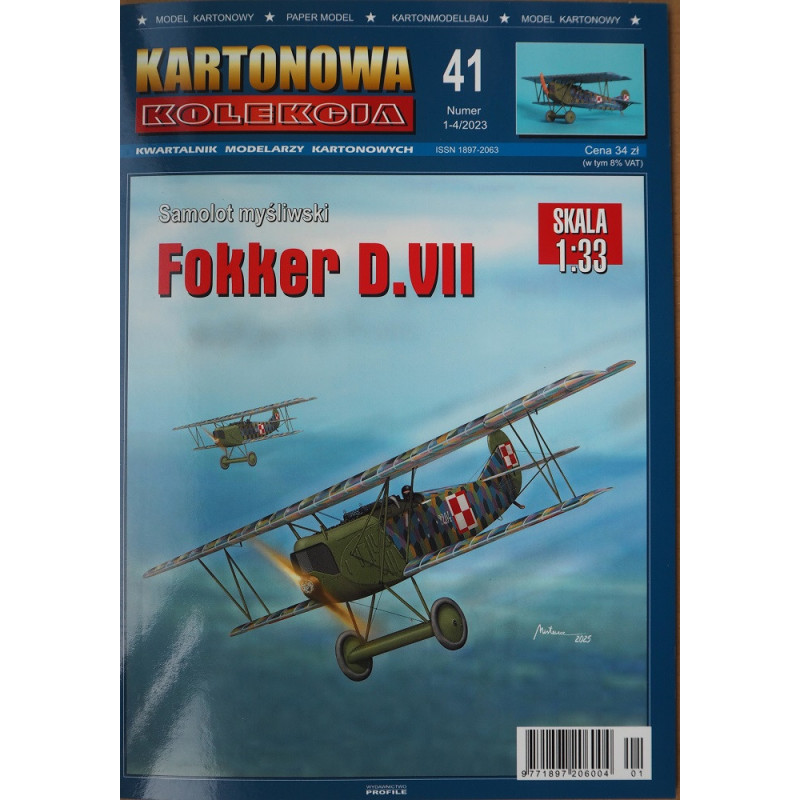


Publisher/ Manufacturer: "Kartonowa Kolekcja". Poland
Scale: 1 : 33
Number of sheets: 10 x A4
Number of pages with details: 4 1/3
Number of assembly drawings: 24
Difficulty: For modelers of any experience
Model dimensions: 210.5 mm x 269.5 mm x 86.5 mm
 Security policy
(edit with the Customer Reassurance module)
 Delivery policy
(edit with the Customer Reassurance module)
 Return policy
(edit with the Customer Reassurance module)
The Fokker D.VII was a single-seater mixed biplane fighter with free-carrying wings developed by the German Empire at the end of World War I. Produced by Fokker-Flugzeugwerke in Schwerin, Germany. The first flight took place in 1918. in January, 1918 was accepted into the armed forces. in April This plane is called the best German fighter of that time. Used in front units since 1918. in April Under the terms of the Armistice of Compiegne, Germany had to hand over all Fokker D.VIIs to the Entente. Most of them were taken by the French. Over 140 ended up in the USA, Belgium – 75, England – 44, Canada – 20. Before the Entente began to control the implementation of the terms of the Treaty of Versailles (April 1920), a number of Fokker D.VIIs were sold by the German army. At the end of the war, licensed production of the Fokker D.VII with 208 hp Austro-Daimler engines was started in Budapest, and managed to produce a dozen examples. Sensing that there were no prospects for a victorious Germany, and taking advantage of the chaos after Germany's capitulation, Fokker managed to transport 6 trains with production etc. across the border to his native Holland. equipment, in addition 98 completed D VII and 118 units. Fokker C.I (slightly larger two-seater variant), several hundred engines, etc. Fokker established a new factory in Amsterdam and continued moderate production: 100 Fokker D VIIs were built between 1920 and 1922, of which 22 were purchased by the Dutch Army and 20 by the Navy. 50 Fokker D VIIs were purchased by Soviet Russia (along with approximately 500 other Fokker aircraft). The last order to make Fokker D.VII was in 1928. by the Swiss Army. Switzerland acquired the Fokker D.VII production license in 1929. A total of 27 Fokker D.VIIs flew there and only in 1931. they began to be replaced by the Dewoitine D-27. The Poles purchased 20 Fokker D VIIs in 1919. from the Germans and about 20 more from the French in 1921. The air forces of Czechoslovakia, Latvia, Denmark, Finland, and Italy had one Fokker D VII one after the other. Both "Albatross" companies produced about 2600, Schwerin - 700 copies of the Fokker D.VII, so a total of 3500 units were produced. Fokker D VII. The first "fokers" were purchased by the then Aviation part of the Lituanian army in 1919. in autumn The exact date has not been found in the military archives, because these purchases from the Germans were both unofficial and illegal (the Germans had no right to sell any warplanes). From the later documents of the Military Aviation Warehouse, it was possible to determine that two airplanes manufactured by the "Albatross" branch (Schneidemunde) with Mercedes D.III 160 HP engines - Fokker D.VII (OAW) 8397/18 and Fokker D VII (OAW ) 8497/18. Of the others, one is described as unnumbered, with the more powerful BMW IIIa 185 HP high-altitude engine, Fokker D.VII 6508/18 also with BMW IIIa, Fokker D.VII 9397/18 with Mercedes IIIa, also Fokker D.VII no. 508/18 torso. Also in stock were various quality Fokker D VII wings, tail-plates, radiators, etc. parts. These planes could fly only after extensive repairs and the completion of missing parts. in 1919 in the photo taken in October, one Fokker D.VII (still with German military aviation markings) can already be seen at the Kaunas airfield. The first of several dismantled Fokker D VIIs was assembled by V. Rauba, head of the Aviation School. The first serious flight was made by the Lituanian "Foker" in 1920. October 2 That day pilot J. Dobkevičius with Fokker D.VII no. 2 flew to Vilnius, and on October 3 - flew to Kaunas. At that time, the Poles started an attack on the Vilnius region. Fokker D.VII No. 2 made its first combat flight in 1920. on November 6, when two Polish bombers attacked the Kaunas airfield. To defend against them with the fighter Fokker D.VII rose Itn. Jurgis Dobkevičius. The Polish pilots did not dare to fight in the air and, without waiting for the fighter to rise to them, withdrew. One of them even threw the bombs without removing the fuses. In the following years, several more airplanes (Fokker D.VII No. 27, 37, 38) were produced in the Lituanian Military Aviation Workshop based on the available copies. The Lituanian-built Foker used an English Siddeley Puma 240 HP engine. As a result, it was significantly different from conventional ones: the fuselage at the front was significantly raised, occupying almost the entire space to the upper wing, the propeller sleeve was covered by a large sleek coke, and the water radiator was placed outside the front of the engine (the Fokker D.VII radiator was too small for the Pumas) , and at the bottom of the torso. These planes reached a speed of 200 km/h. The Fokker D.VII was a fighter with excellent piloting and performance data. Due to its technological and strong construction (the fuselage is welded from steel tubes and covered with canvas), it was easy to repair even after accidents, and due to its good piloting characteristics, it was popular and one copy served in the Lituanian military aviation until its liquidation in 1940. Since 1928 Fokker D.VII was used in Lituania only for pilot training. In administrative documents, the name of this aircraft was shortened to "Fok D.VII".
An uncomplicated, well-designed and well-detailed model that, under the supervision of a more experienced colleague, would be great for a novice modeler to stick together, but not as one of the more complex first models. The interior of the cabin is well detailed, there is a model of the engine, the control planes are separated. The model recreates the appearance of aircraft No. 22.04, which was flown by the pilots of the Polish AF 14 Fighter Escadre in 1920. And after a little work with computer rendering programs, it is not difficult to "turn" this plane into any "Lituanian Fokker".

You might also like
Publisher/ Manufacturer: "Kartonowa Kolekcja". Poland
Scale: 1 : 33
Number of sheets: 10 x A4
Number of pages with details: 4 1/3
Number of assembly drawings: 24
Difficulty: For modelers of any experience
Model dimensions: 210.5 mm x 269.5 mm x 86.5 mm


