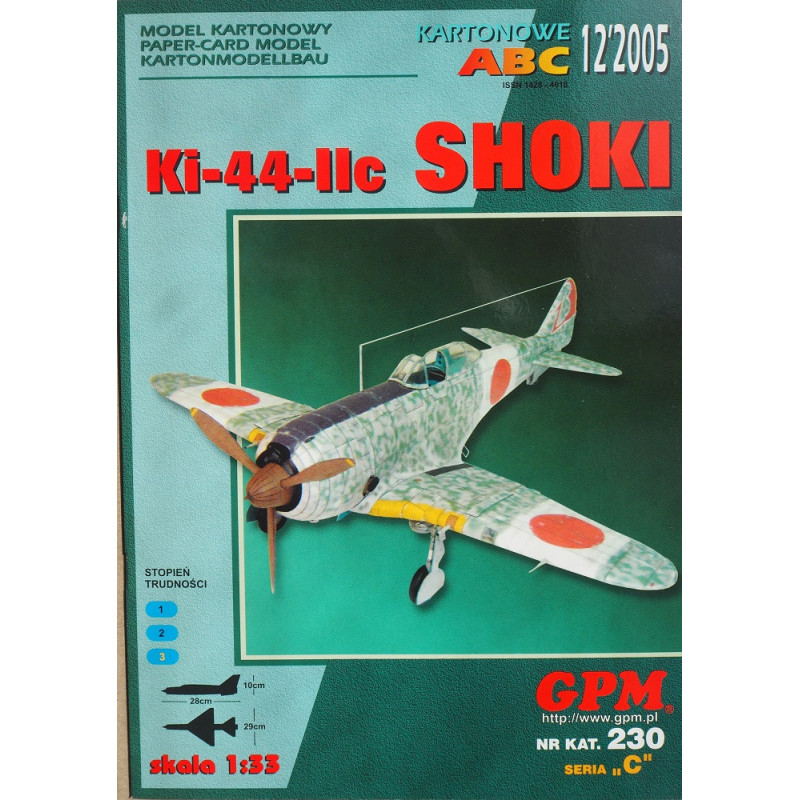


Publisher/ Manufacturer: "GPM". Poland
Scale: 1 : 33
Number of sheets: 8 x A4
Number of sheets with details: 4 1/4
Number of assembly drawings: 40
Difficulty: For modelers of any experience.
Model dimensions: 266 mm x 286.5 mm x 98.5 mm
 Security policy
(edit with the Customer Reassurance module)
 Delivery policy
(edit with the Customer Reassurance module)
 Return policy
(edit with the Customer Reassurance module)
Nakajima Ki-44 "Shoki" - Japanese, single-engine, metal, semi-shell construction, low-wing fighter - interceptor of the Second World War. The first flight of the prototype took place in August 1940, and the supply to the formation units began in 1942. In the Allied code it was called "Tojo". During the war, three versions of the Ki-44 were created. The first, designated Ki-44-I, was powered by a Nakajima Ha-41 engine with a power of 1200 h. p. Only 40 of this version were built. Another modification, called the Ki-44-II, had a new, more powerful engine and reinforced armament. Initially, it was used in the battles for Burma, Malaysia and Sumatra, but soon found itself in the defense units of the main Japanese islands. The last, produced in small quantities, was the Ki-44-III version with the new Nakajima Ha-145 engine. All versions of the Ki-44, despite their considerable maximum speed, were not liked by pilots, especially due to their low maneuverability and difficult piloting. They were effective against bombers, but had significant problems with escort fighters.
A small, well-detailed and well-designed model of a small aircraft for modelers of any experience. Only beginners and modelers with little experience are recommended to work under the supervision of a more experienced colleague, to work without rush, carefully and attentively, and to do the cabin equipment, transparent windows and the extended chassis as an experiment: if it works - great!!! - we make a full-fledged model, if it doesn't work - we make opaque windows, the chassis retracted... The model has a perfectly designed cabin interior, engine, chassis and its niches, exterior detailing, and what is more, the camouflage is truly impressive. The color reserves would really not help with such camouflage, there is none. The textual instruction in Polish and English is large, detailed and will really help in the process of assembling the model. The graphical instruction may be a bit too small, but it is certainly sufficient, informative and easy to read.

Publisher/ Manufacturer: "GPM". Poland
Scale: 1 : 33
Number of sheets: 8 x A4
Number of sheets with details: 4 1/4
Number of assembly drawings: 40
Difficulty: For modelers of any experience.
Model dimensions: 266 mm x 286.5 mm x 98.5 mm