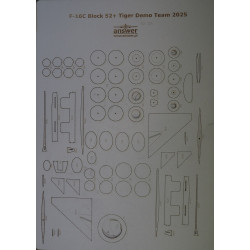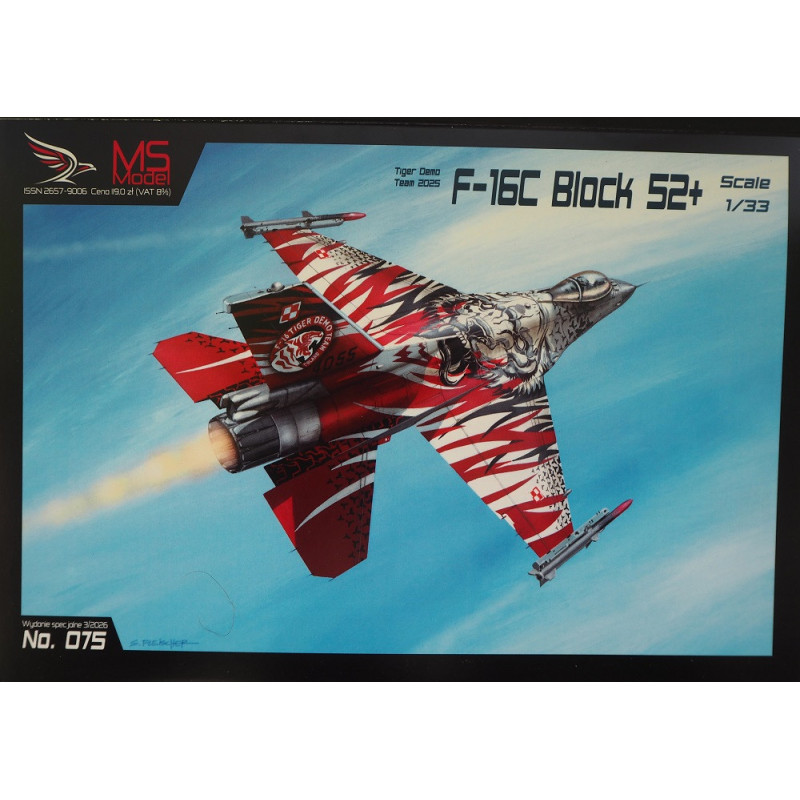


Publisher/ Manufacturer: "Answer. MS Model". Poland
Scale: 1 : 33
Number of sheets: 22 x A4
Number of sheets with details: 14
Number of assembly drawings: 57
Difficulty: For medium and experienced modelers.
Model dimensions: 448,5 mm x 297 mm x 145,5 mm
 Security policy
(edit with the Customer Reassurance module)
 Delivery policy
(edit with the Customer Reassurance module)
 Return policy
(edit with the Customer Reassurance module)
General-Dynamics F-16 "Fighting Falcon" is an American single-seat multi-role fighter and attack aircraft. Design work on the F-16 began in 1971 at “General Dynamics” (which merged with aerospace giant “Lockheed Martin” in 1993) to compete for a light multi-role fighter for the US Air Force. The prototype YF-16 first flew on February 2, 1974. It used a computerized electronic control system "Fly-by-wire", which allowed to reduce the area of the wing and tail plates, while reducing the weight of the fighter, which became a turning point in this competition. The F-16 became the first fighter to use this control system. The first versions were mainly made of aluminum (about 83% of the total structure), but later this metal increasingly gave way to composite materials. Different versions of the plane are equipped with 3 different engines: “Pratt-Whitney” F-100-PW-200, “General Electric” F110-GE100 or “Pratt-Whitney” F-100-PW-2020. The "brain" of the targeting system was the APG-66 radar, changed to APG-68(V) in later versions. It should be noted, that the design of the YF-16 was so perfect, that it won not only the US Air Force competition against the “Northrop” YF-17, but also the NATO European competition. In this competition, the “Falcon” competed against the Dassault “Mirage” F.1 and the SAAB J-37 “Viggen”. Serial production of the F-16 began in 1975. NATO European countries also participated in it, for which it was an "injection" of the latest aviation technologies. The final assembly of the planes took place in the USA, Belgium, Holland. The first production F-16A "Fighting Falcon" took to the air on August 7, 1978. It was a strike version of the F-16, designed primarily to destroy ground targets. The F-16 was also combat-tested, achieving a number of aerial victories in the Lebanon War (1982) and Operation “Desert Storm” (1991). By the end of the 20th century, more than 4,000 units of these great airplanes were produced. Six main versions of the F-16 were built, designated A, C, E (single) and B, D, F (twin). On the basis of these six models, a number of modifications, differing in avionics, which are marked with the "Block" designation, have been constructed. Since 2006 the F-16 has been in service in the Polish Air Force. The Polish Ministry of Defense decided, that the F-16 would form the basis of the modernized Air Force and rejected the proposed “Mirrage” F2000 and JAS-39 “Grippen”.
A medium-sized, beautiful, well-designed and richly detailed, quite complex model of a US-made Polish AF-operated aircraft, painted in special "Tiger Demo Team 2025" camouflage for medium-experienced and experienced modelers. The model perfectly reproduces all visible exterior details, cockpit interior, landing gear, its niches, visible engine details, a wide selection of hanging weapons, control surfaces - only separated from the main surfaces. There is a fairly large reserve of colors, the text instruction in Polish is small, but perfectly complements the exemplary graphic rather large instruction.

You might also like
Publisher/ Manufacturer: "Answer. MS Model". Poland
Scale: 1 : 33
Number of sheets: 22 x A4
Number of sheets with details: 14
Number of assembly drawings: 57
Difficulty: For medium and experienced modelers.
Model dimensions: 448,5 mm x 297 mm x 145,5 mm