Publisher/ Manufacturer: "Answer" – "MP Model". Poland
Scale: 1 : 33
Number of sheets: 8 x B4
Number of sheets with details: 4 2/3
Number of assembly drawings: 13
Difficulty: For modelers of any experience.
Model dimensions: 276 mm x 318.5 mm x 119.5 mm
 Security policy
(edit with the Customer Reassurance module)
 Delivery policy
(edit with the Customer Reassurance module)
 Return policy
(edit with the Customer Reassurance module)
The "Focke-Wulf Fw-190" was a German, single-engine, all-metal construction low-wing fighter of World War II. Pilots considered the "Fw-190" to be a better aircraft, than the "Messerschmitt Bf-109". The "Fw-190" was ordered by the Luftfahrtministerium in the fall of 1937. Kurt Tank submitted two design proposals with two different engines – the liquid-cooled Daimler-Benz DB 601 and the new BMW 139 radial engine. The latter was chosen, and work began in the spring of 1938 under the direction of Obering R. Blaser. The first prototype of the Fw-190V1 was completed in May 1939 and Captain Hans Sander took off for first flight in Bremen on 1 June 1939. The second prototype, the FW-190V2, armed with two MG131 and two MG17 machine guns – all 7.92 mm caliber – was tested in October 1939. In order to reduce aerodynamic drag, both were equipped with a tunnel air intake in the upper front part of the aircraft, but due to engine overheating problems, it was necessary to return to the proven NACA organoid design. Even, before the final tests of these prototypes began, it had already been decided to replace the BMW 139 engine with the more powerful, but longer and heavier BMW 801. This required many changes, strengthening the construction and moving the cockpit back, which later led to problems with the aircraft's center. But the good thing was that, there were no more problems with exhaust gas penetration into the cockpit and overheating of the cabin interior due to the direct proximity to the engine. The third and fourth prototypes were abandoned, and the Fw-190V5 with the new engine was ready in early 1940. Later it was equipped with a wing with a larger span (one meter from the original 9.5 m), which reduced the speed by 10 km/h, but increased the climb rate and improved maneuverability. It was designated Fw-190V5g, the variant with a shorter wing was the Fw-190V5k. The first 7 Fw-190A-0 aircraft of the information series were equipped with a short wing, the others - with a longer one. The first combat unit, armed with the Fw-190 - 6./JG 26, stationed at Le Bourget, declared combat readiness in August 1941, and from the first meeting of the new fighter with the British Supermarine “Spitfire”, the advantage of the "German" became clear. During the war, several dozen versions of the fighter were created. The "A" version, several dozen modifications of the aircraft, were "pure" fighters. The "B" and "C" versions were only high-altitude fighter prototypes, designed to combat strategic bombers, but they were not mass-produced. The "D" version, the only one of the Fw-190s, was powered by a new 1750 hp Jumo 213A engine and was the German response to the P-51 “Mustang”. The new engine lengthened the fuselage by several tens of centimeters. This variant also served mainly as an interceptor and high-altitude fighter. Many variants of the "F" version were used as fighter-bombers, directly supporting forces on the battlefield. The "G" version performed the same role, as the "F" version, but had a longer range. Over 20,000 examples of this, one of the best fighters of World War II, were produced throughout the war.
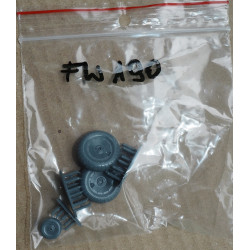
A small and well-designed and richly detailed model of a small fighter, of medium complexity, painted in the late summer 1944 in Italy camouflage of the German 1./SG4 group. The model is suitable for modelers of any experience. Only beginners and modelers with little experience should work under the supervision of a more experienced colleague, don’t rush, and do the detailing of the cockpit equipment, transparent cockpit hood glasses and deployed landing gear and suspended bombs as a test: if it works - GREAT!!! - we make a complete model, if it doesn't work - we don't make the cockpit equipment, we make the windows opaque, the landing gear retracted, we have already dropped the bombs.... The model perfectly recreates all visible external details, the landing gear, its niches, cockpit equipment, control plates only separated from the main plates, the engine is perfectly recreated, suspended armament (one bomb). There are no color reserves, the textual instruction in Polish is small and only describes the assembling process of the model in general terms, but it perfectly complements the not very large, but quite informative and easy-to-read graphical instruction.

You might also like
Publisher/ Manufacturer: "Answer" – "MP Model". Poland
Scale: 1 : 33
Number of sheets: 8 x B4
Number of sheets with details: 4 2/3
Number of assembly drawings: 13
Difficulty: For modelers of any experience.
Model dimensions: 276 mm x 318.5 mm x 119.5 mm