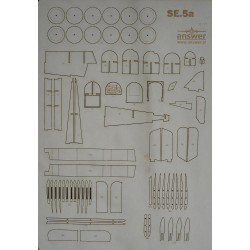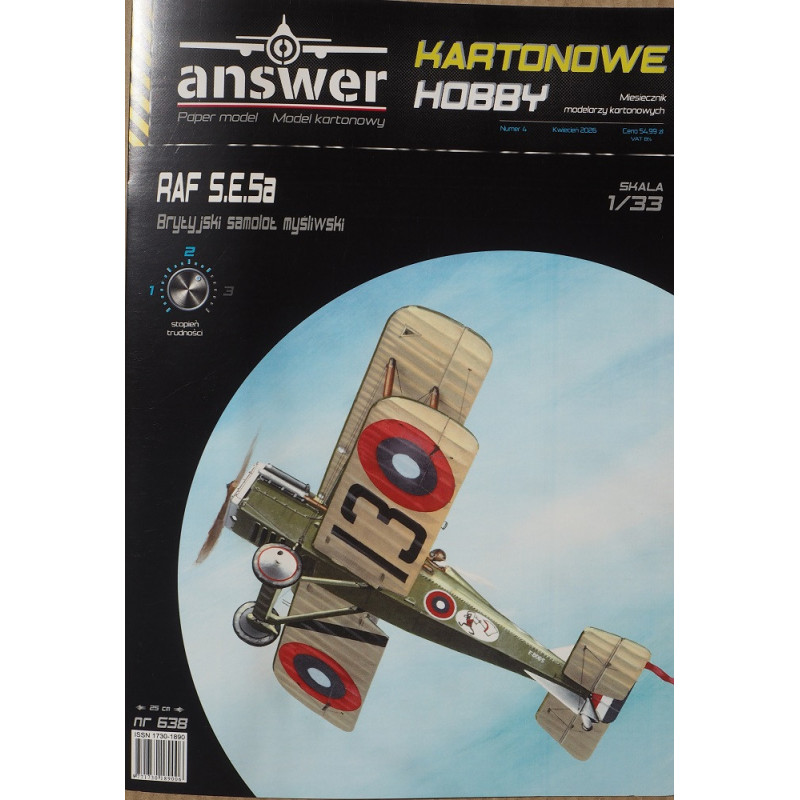


Publisher/ Manufacturer: "Answer" – "Kartonowe Hobby". Poland
Scale: 1 : 33
Number of sheets: 6 x B4
Number of sheets with details: 3 1/10
Number of assembly drawings: 11
Difficulty: For modelers of any experience.
Model dimensions: 193.5 mm x 246 mm x 72.5 mm
 Security policy
(edit with the Customer Reassurance module)
 Delivery policy
(edit with the Customer Reassurance module)
 Return policy
(edit with the Customer Reassurance module)
During World War I in 1916, in connection with the appearance of new German fighters “Fokker” and “Albatros”, which had better flight characteristics, than the British aircraft, used at the front, the aviation leadership turned to the Royal Aircraft Factory in Farnborough for the construction and production of a fighter with a more powerful engine and armament, than the British fighters, produced so far. The aircraft was to have better flight and fighting characteristics, than the already used Sopwith “Camel”. In the summer of 1916 a team of constructors, led by engineers H. P. Folland and J. Kenworth, designed a new fighter according to these requirements - a biplane, the construction of which was very simple, but strong and resistant to damage. The frame fuselage had a rectangular cross-section, only its top was rounded. An 8-cylinder V-shaped engine was installed in the front. Behind the engine, the lower wing parts were attached to the fuselage with the help of fasteners, to which the upper wing was attached through two pairs of parallel struts. Both wings were rectangular in shape and had ailerons. The wing box was reinforced with paired steel wires, 4 struts and additional wires. The central part of the wing was covered with aviation plywood, the wing spars - with canvas. The central part of the fuselage was equipped with a cockpit with the necessary piloting instruments and control equipment, at the rear were classic tailplanes, covered with canvas, the stabilizer could be adjusted during flight. The fuselage in the engine area was covered with aluminum sheet, in the middle - with plywood, and in the rear part - with canvas. This fighter was equipped with the following innovations: a windscreen adjustable in flight, a steerable rear strut and aluminum covers of landing gear rubber shock absorbers, protecting the rubber from the effects of dust and precipitation. The aircraft was equipped with a 150 h. p. French V-shaped engine "Hispano - Suiza". The prototype was designated S.E.5 (abbreviation from the English Scout Experimental) and took off for its first flight in November 1916. Tests lasted until December, when Major Pilot F. V. Goden flew it to France. In January 1917 the S.E. 5 prototype crashed due to the poor quality of the wing mounting hardware and the still insufficient strength of the wing box structure. After quickly correcting the construction errors and installing the 200 h. p. “Hispano-Suiza” engine, serial production of the new RAF S.E. 5 began at the end of January 1917. After 60 units were produced, a number of minor changes were made to the aircraft - the windshield area was reduced, the shape of the wingtips was changed, a gargoyle was added behind the pilot's head, long exhaust pipes were installed and the engine was replaced with the Wolesley “Viper”, produced in Britain under license. The thus modernized fighter began to be designated S. E. 5a and was produced until the end of World War I. A total of about 5,200 fighters of both versions were produced.
A simple, well-designed and excellently detailed model, that will suit modelers of any experience. However, advanced beginners and modelers with little experience should work under the supervision of a more experienced colleague, don’t rush, work patiently and carefully. The fuselage, cockpit equipment, wings, chassis, armament and all other external detailing are perfectly detailed. There is a considerable reserve of colors. The textual instruction in Polish is not very extensive and provides only general notes and a description of the assembly of the most complex nodes. But it perfectly complements the small, but sufficient for good model assembly, informative and easy-to-read graphical instruction.

You might also like
Publisher/ Manufacturer: "Answer" – "Kartonowe Hobby". Poland
Scale: 1 : 33
Number of sheets: 6 x B4
Number of sheets with details: 3 1/10
Number of assembly drawings: 11
Difficulty: For modelers of any experience.
Model dimensions: 193.5 mm x 246 mm x 72.5 mm